

China Pauses Rescue Operation in Tibet over Risk of Another Flood
China has temporarily paused rescue operations in Tibet after authorities warned that a newly formed barrier lake near the Nepal border could trigger another major flood. The decision comes as emergency teams continue dealing with the aftermath of devastating flash floods and landslides that struck the Himalayan region earlier this week. Barrier Lake Creates New […]
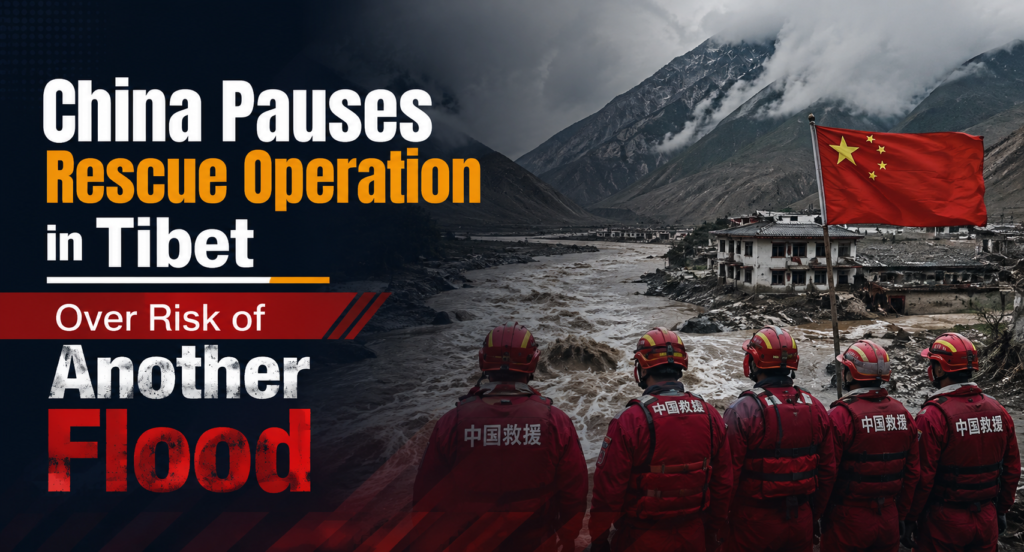
China has temporarily paused rescue operations in Tibet after authorities warned that a newly formed barrier lake near the Nepal border could trigger another major flood. The decision comes as emergency teams continue dealing with the aftermath of devastating flash floods and landslides that struck the Himalayan region earlier this week.
Barrier Lake Creates New Flood Threat
The latest danger has emerged from a lake created by debris following a glacier collapse and landslide near the China-Nepal border. Chinese authorities have warned that the lake is already overflowing and could receive several million cubic metres of additional water in the coming days. The risk of a breach has forced rescue teams to move away from the most dangerous areas and remain on standby.
China’s Ministry of Water Resources has issued an emergency alert over the situation. Officials are closely monitoring the lake because a sudden release of the accumulated water could produce another destructive flood downstream, potentially worsening conditions in communities already affected by the initial disaster.
Rescue Efforts Suspended as Conditions Deteriorate
The decision to pause the rescue operation reflects the difficult conditions facing emergency workers. Steep Himalayan terrain, unstable slopes, landslides, avalanches and the possibility of a barrier-lake breach have made access to the disaster zone extremely dangerous.
Chinese authorities have deployed an engineering team to conduct aerial surveys and develop three-dimensional models of the affected area. Officials are also working to create a drainage channel designed to reduce pressure from the rising lake. Water levels are expected to remain a major concern over the next several days, with forecasts indicating that flows could peak around September 1.
Nepal Faces Continuing Humanitarian Crisis
The new flood threat comes as Nepal continues a massive search-and-rescue operation. The initial disaster killed at least 469 people in Nepal, while more than 1,300 people remained missing according to reports on Friday. Foreign tourists, pilgrims and workers are among those still unaccounted for.
The flooding destroyed roads, bridges, homes and critical infrastructure across parts of Nepal and Tibet. Hydropower facilities were also affected, while rescue teams have struggled to reach some isolated areas because major transport links have been damaged.
Thousands of people have already been evacuated from vulnerable locations. The possibility of another flood means authorities must now balance the urgent need to locate survivors with the safety of rescue personnel and communities downstream.
Geopolitical and Economic Implications
Beyond the humanitarian impact, the disaster highlights the vulnerability of the strategically important Himalayan border between China and Nepal. Damage to border infrastructure and transport routes could disrupt cross-border trade, tourism and regional connectivity.
For financial markets, developments such as this can become relevant to Forex News and FX news because severe natural disasters can affect economic activity, infrastructure spending, tourism revenues and regional trade flows. The broader situation is also significant Geopolitics News, particularly because China and Nepal share important economic and strategic links in the Himalayan region.
For now, authorities are prioritising flood-risk management before fully resuming rescue operations. The coming days will be critical as officials monitor the barrier lake and assess whether additional flooding can be prevented.
