

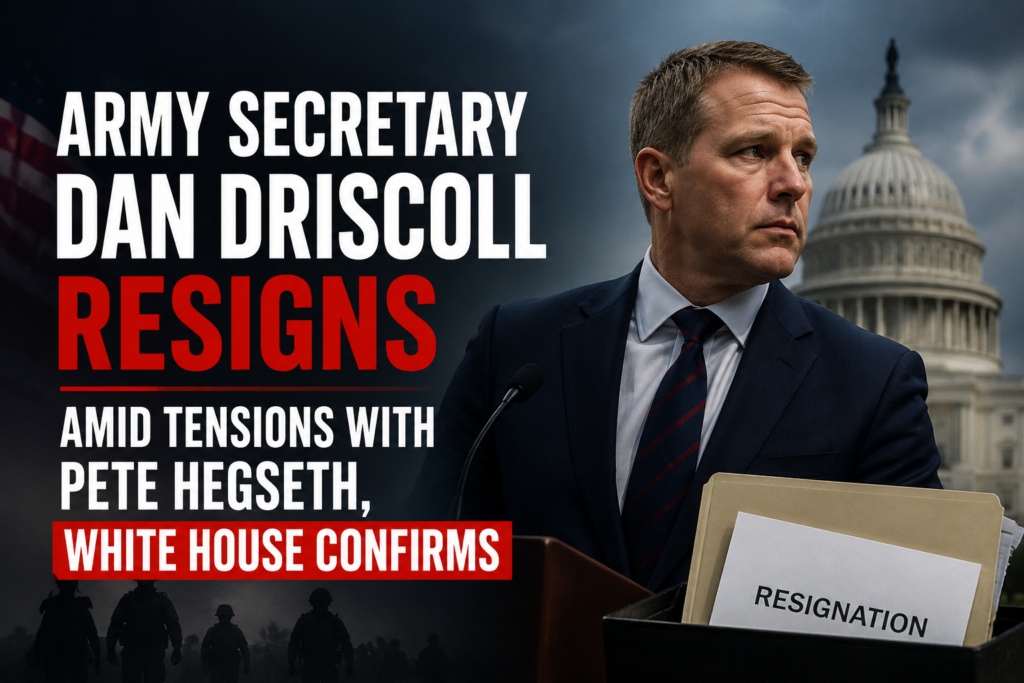
Army Secretary Dan Driscoll Resigns Amid Tensions With Pete Hegseth, White House Confirms
WASHINGTON: U.S. Army Secretary Dan Driscoll has resigned from his position after about 18 months in office, marking another significant leadership change at the Pentagon as the Trump administration faces ongoing military and geopolitical challenges. The White House confirmed Driscoll’s departure on August 31, while reports linked the resignation to months of friction between Driscoll […]
WASHINGTON:
U.S. Army Secretary Dan Driscoll has resigned from his position after about 18 months in office, marking another significant leadership change at the Pentagon as the Trump administration faces ongoing military and geopolitical challenges. The White House confirmed Driscoll’s departure on August 31, while reports linked the resignation to months of friction between Driscoll and Defense Secretary Pete Hegseth.
The resignation comes at a particularly sensitive time for the U.S. military, with American forces involved in ongoing operations in the Middle East and the Iran conflict continuing to place pressure on the Pentagon. Driscoll had been closely involved in efforts to strengthen Army readiness and modernize the service during his tenure.
Dan Driscoll Resigns as Army Secretary
Driscoll submitted his resignation to President Donald Trump after months of reported disagreements with Hegseth. Earlier reports had suggested that Driscoll could leave his position before the end of the year, following a period of growing tensions inside the Pentagon.
The White House praised Driscoll’s performance, describing him as effective in advancing President Trump’s defense agenda. Officials highlighted his work on military readiness, modernization and his involvement in diplomatic efforts related to the Russia-Ukraine conflict.
Driscoll, an Iraq War veteran and former venture-capital and private-equity professional, became Army secretary in February 2025 after being nominated by Trump. He was known for pushing the Army toward greater technological innovation, including efforts involving drones, counter-drone capabilities and faster acquisition of new military technologies.
Tensions With Pete Hegseth
The resignation follows months of reported friction between Driscoll and Hegseth. One major point of tension involved Hegseth’s decision to remove Army Chief of Staff Gen. Randy George earlier this year. Reports said the decision intensified disagreements between the two civilian leaders.
The departure also comes amid wider changes in senior U.S. military leadership. Several senior officials have recently left their positions, increasing scrutiny over stability and decision-making within the Pentagon. The latest developments have raised questions about how the administration will manage military leadership while the United States remains engaged in major international security challenges.
What Happens to the U.S. Army Next?
Driscoll’s resignation could create another leadership transition at the Army during an especially demanding period. Reports indicate that Undersecretary of the Army Michael Obadal could potentially serve as acting secretary if required.
The timing is particularly significant because the Army has been heavily involved in U.S. military operations related to the Iran conflict. Any prolonged leadership transition could therefore attract attention from lawmakers, defense officials and financial markets assessing the broader geopolitical risks facing the United States.
Market and Geopolitical Impact
For financial markets, Driscoll’s resignation is unlikely to be a direct market-moving event by itself. However, investors may view another senior Pentagon leadership change as part of the broader geopolitical picture surrounding the Trump administration.
Continued uncertainty around U.S. military policy could contribute to volatility in oil, gold, the U.S. dollar and other safe-haven assets, particularly if developments involving Iran or the wider Middle East escalate. Oil markets remain especially sensitive to developments affecting regional security and supply routes, including the Strait of Hormuz.
Forex traders will therefore be watching whether the leadership change produces any meaningful shift in U.S. military policy. The U.S. dollar, gold and crude oil could remain particularly sensitive to new developments.
What Traders Should Watch
The key issues for markets now include the next Army secretary appointment, developments involving Pete Hegseth, the direction of U.S. military policy and the continuing Iran conflict. Any major change in Washington’s approach could influence geopolitical risk sentiment and create fresh volatility across global markets.
For The Finance Chronicles, this story is best positioned not simply as a U.S. political story, but as a developing geopolitical and financial-markets story connecting Pentagon leadership changes with Iran, oil, gold, the U.S. dollar and broader global risk sentiment.
