

Pezeshkian Vows Continued Resistance as Iran-US Tensions Raise Fresh Oil and Hormuz Risks
Iranian President Masoud Pezeshkian has vowed that Tehran will continue its resistance with full strength until what he described as the “aggressors” become regretful, signalling that Iran is not yet ready to adopt a more conciliatory position as tensions with the United States continue to escalate. Pezeshkian made the remarks on Tuesday in a post […]
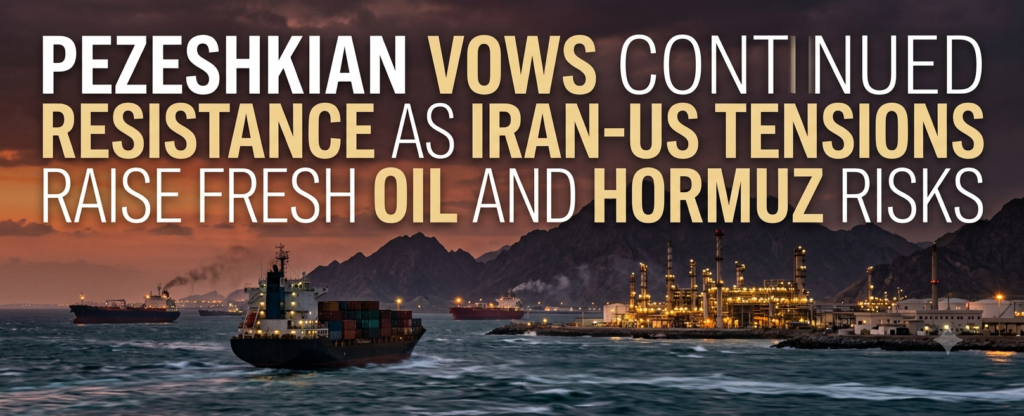
Iranian President Masoud Pezeshkian has vowed that Tehran will continue its resistance with full strength until what he described as the “aggressors” become regretful, signalling that Iran is not yet ready to adopt a more conciliatory position as tensions with the United States continue to escalate.
Pezeshkian made the remarks on Tuesday in a post on X, saying Iran would continue defending its rights and resisting aggression. He also said Iran had historically opposed war and considered regional security and the interests of its people best served by avoiding conflict.
The statement comes at a particularly sensitive time for global financial markets. Tensions between Washington and Tehran have already disrupted energy flows through the Middle East, while shipping traffic through the strategically important Strait of Hormuz has fallen sharply.
Iran Signals No Immediate De-escalation
Pezeshkian’s comments suggest that Tehran intends to maintain its current position despite growing economic and military pressure.
The Iranian president’s message follows a series of increasingly serious developments involving US and Iranian forces. Tehran has threatened further retaliation and warned that Gulf energy infrastructure could become vulnerable if attacks against Iran continue.
Iran has also tightened restrictions affecting shipping through the Strait of Hormuz, with officials warning of further measures and a potential new restricted zone in the Gulf.
For investors, this raises concerns that the current conflict could continue for longer than previously expected.
A prolonged confrontation would increase uncertainty around energy supplies, shipping costs and inflation, while also making it more difficult for central banks to assess the path of interest rates.
Hormuz Risk Keeps Oil Markets on Edge
The Strait of Hormuz remains at the centre of the financial-market impact.
The waterway is a critical route for global energy shipments, and Reuters reported that only seven commodity vessels passed through the Strait on Monday, compared with eight the previous day. Shipping activity has fallen sharply as Iran threatens retaliation against further US attacks.
The reduction in traffic has already contributed to a rise in the geopolitical risk premium in crude markets.
Brent crude recently climbed towards $100 a barrel, reaching around $99.46, while West Texas Intermediate rose to approximately $94.73. Both benchmarks reached their highest levels in several weeks as concerns about prolonged supply disruptions increased.
The latest oil-market reaction demonstrates why statements from Iranian leaders are closely watched by traders. Any indication that Tehran intends to restrict shipping further could put additional upward pressure on crude prices.
Oil Prices Could Feed Inflation
Higher oil prices create risks well beyond the energy sector.
If crude remains elevated for an extended period, higher fuel and transportation costs could feed into consumer prices. Businesses may also face higher production and logistics expenses, potentially passing some of those costs on to customers.
That could complicate monetary-policy decisions around the world.
Central banks that were considering lower interest rates could become more cautious if energy-driven inflation begins to rise. For the Federal Reserve and other major central banks, the combination of geopolitical uncertainty and persistent inflation could therefore create a more difficult policy environment.
Markets are already closely monitoring inflation data and interest-rate expectations, meaning another sustained oil-price surge could quickly affect bonds, currencies and equities.
Implications for Gold and the US Dollar
The escalation could also influence traditional safe-haven assets.
Gold may benefit from increased geopolitical uncertainty as investors seek protection from conflict and market volatility. At the same time, the US dollar could attract safe-haven demand, although higher US inflation expectations and changing Federal Reserve rate expectations could create competing forces for the currency.
The direction of these markets will depend heavily on whether the conflict produces further disruption to global energy supplies.
If tensions ease and shipping through Hormuz begins to normalise, some of the geopolitical premium in oil could disappear. However, if Iran follows through on further restrictions or attacks, energy prices could remain elevated.
Global Markets Watch Tehran’s Next Move
The latest statement from Pezeshkian therefore carries significance beyond Iran’s domestic or political messaging.
For financial markets, the key question is whether Tehran’s commitment to continued resistance translates into further military action or additional restrictions on energy and maritime activity.
Reuters has reported that Iran’s ability to disrupt Hormuz has become a major focus of the current confrontation, although alternative export routes and supplies from other producers have helped prevent crude prices from moving decisively above $100.
Nevertheless, the risk of a prolonged disruption remains significant.
For traders, attention will remain on developments around the Strait of Hormuz, Gulf energy infrastructure, US-Iran military activity and any signs of renewed diplomatic engagement.
For now, Pezeshkian’s latest message reinforces the view that tensions remain elevated and that a rapid resolution may be difficult. As long as uncertainty persists, oil, gold, the US dollar and broader global markets are likely to remain highly sensitive to developments in Tehran and the Gulf.

Alexander
Alexander is a veteran of the currency markets with over 15 years of experience in institutional trading and risk management. He specializes in the intersection of macroeconomics and regulatory frameworks.
