

Viral Rubio–Araghchi Exchange Over Hormuz Tolls Remains Unverified as Oil Risks Persist
A viral social-media exchange allegedly involving US Secretary of State Marco Rubio and Iranian Foreign Minister Abbas Araghchi is circulating online, but there is no credible evidence that the reported conversation actually took place. The posts appear to combine a genuine statement by Rubio about the Strait of Hormuz with an unverified response allegedly attributed […]
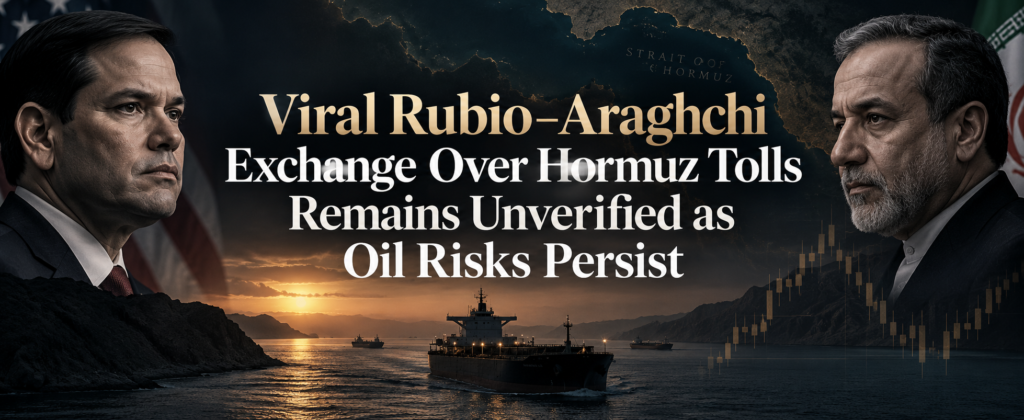
A viral social-media exchange allegedly involving US Secretary of State Marco Rubio and Iranian Foreign Minister Abbas Araghchi is circulating online, but there is no credible evidence that the reported conversation actually took place.
The posts appear to combine a genuine statement by Rubio about the Strait of Hormuz with an unverified response allegedly attributed to Araghchi. The distinction is important as tensions around the strategically critical waterway continue to influence oil markets, shipping activity and broader geopolitical risk.
Rubio did publicly oppose the idea of Iran imposing tolls or fees on ships using the Strait of Hormuz. However, the widely shared “Venezuela” response attributed to Araghchi has not been independently verified by credible news organisations or official Iranian sources.
What Rubio Actually Said
The verified part of the viral claim relates to comments made by Rubio in June. During his Gulf visit, the US secretary of state said Washington would not accept Iranian tolls or fees on vessels transiting the Strait of Hormuz.
Rubio argued that the waterway is an international route and warned that allowing one country to charge fees could create wider problems for international shipping. He later warned that such charges could spread to other waterways, describing the potential consequences as similar to a contagion.
The comments came amid negotiations between Washington and Tehran over the future of the Strait and the broader US-Iran conflict. At the time, Iran had discussed temporary arrangements concerning transit fees while diplomatic talks continued.
These verified remarks are likely part of the material being reused in the viral social-media posts.
The Alleged Araghchi Response Remains Unverified
The second part of the viral exchange claims that Iranian Foreign Minister Abbas Araghchi responded with a reference to Venezuela and its oil resources.
However, there is currently no reliable evidence confirming that Araghchi made the alleged statement in the manner presented in the viral graphic.
This means the statistic or geopolitical comparison used in the post could potentially be based on real information, while the accompanying quotation is still fabricated or misleading.
For financial-news publishers, this distinction is particularly important. A genuine statistic does not automatically validate a quotation or conversation presented alongside it.
The claim should therefore be treated as an unverified social-media narrative, rather than a confirmed diplomatic exchange.
Why the Hormuz Issue Matters for Oil Markets
Although the viral exchange itself remains questionable, the underlying subject is highly relevant to global financial markets.
The Strait of Hormuz is one of the world’s most important energy corridors, and disruption to shipping through the waterway can quickly affect crude oil prices, freight costs and inflation expectations.
Current developments show that the risk is not merely theoretical. Reuters reported on September 8 that traffic through the Strait had fallen sharply after Iran threatened retaliation against potential new US attacks. Only seven commodity vessels passed through the waterway on Monday, according to Kpler data.
Reuters has also reported that average daily commodity-ship traffic through the Strait had fallen to its lowest level since May following recent attacks involving US and Iranian forces.
This makes the Hormuz issue particularly important for oil traders. Any further reduction in shipping activity could increase concerns about supply disruptions and push crude prices higher.
Venezuela Adds Another Energy-Market Dimension
The reference to Venezuela in the viral post may also be intended to connect two major oil-producing regions and the changing structure of global energy markets.
Venezuela has significant crude reserves and remains an important geopolitical factor in US energy policy. Recent developments involving US-Venezuela oil agreements have also attracted international attention as Washington seeks to influence global energy flows.
However, linking those developments to a supposed direct exchange between Rubio and Araghchi requires evidence that is currently missing.
For investors, separating verified developments from viral claims is essential because inaccurate geopolitical information can quickly influence sentiment around oil, currencies and risk assets.
Market Impact Could Still Be Significant
Even without the alleged exchange, the underlying Hormuz dispute remains a major market risk.
Lower shipping traffic through the Strait can increase the risk premium in crude prices. Higher oil prices could subsequently raise transportation and production costs, potentially adding to inflationary pressure and complicating decisions by central banks.
The effects could extend beyond energy markets. Gold could benefit from renewed geopolitical uncertainty, while currencies such as the US dollar may attract safe-haven demand. Oil-sensitive economies and companies could also experience increased volatility.
For traders, the key issue is therefore not whether the viral Rubio–Araghchi exchange is authentic, but whether tensions around the Strait continue to disrupt global energy flows.
What Investors Should Watch
Markets will be watching further developments involving US-Iran relations, commercial shipping through the Strait of Hormuz and any threats to Gulf energy infrastructure.
If shipping disruptions become more severe, crude oil could face additional upward pressure. Conversely, a diplomatic breakthrough that improves navigation and reduces geopolitical risk could ease the oil risk premium.
For now, the viral Rubio–Araghchi exchange should be treated cautiously. Rubio’s opposition to Iranian tolls on Hormuz is documented, but the alleged “Venezuela” comeback has not been independently confirmed.

Alexander
Alexander is a veteran of the currency markets with over 15 years of experience in institutional trading and risk management. He specializes in the intersection of macroeconomics and regulatory frameworks.
