

PM Modi at SCO Summit Warns Against Terrorism ‘Double Standards’ as West Asia Crisis Threatens Energy Security
BISHKEK: Prime Minister Narendra Modi delivered a strong message on terrorism at the 26th Shanghai Cooperation Organisation (SCO) Summit in Bishkek, calling on member states to take a unified approach against terrorism and dismantle the wider ecosystem that supports militant activity. Modi said there should be “no room for double standards” on terrorism and warned […]
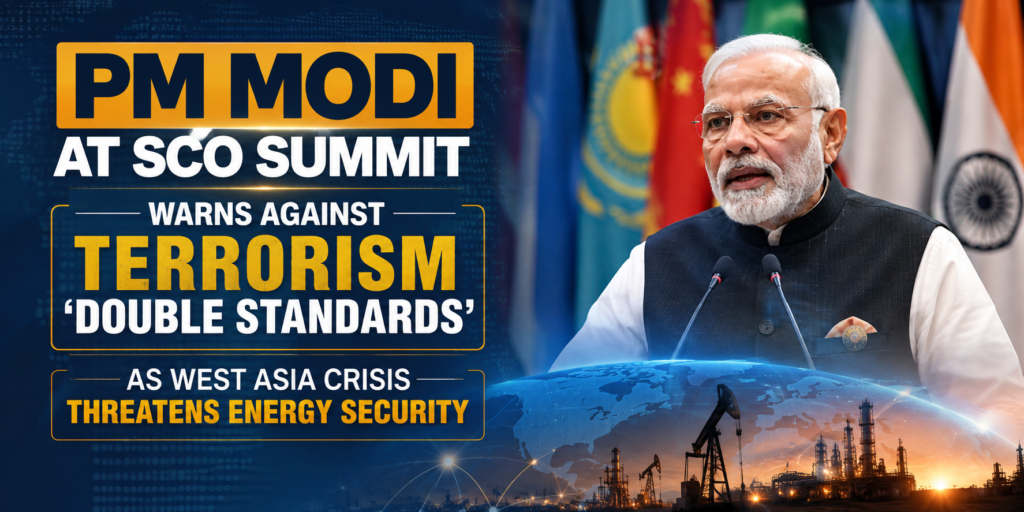
BISHKEK: Prime Minister Narendra Modi delivered a strong message on terrorism at the 26th Shanghai Cooperation Organisation (SCO) Summit in Bishkek, calling on member states to take a unified approach against terrorism and dismantle the wider ecosystem that supports militant activity. Modi said there should be “no room for double standards” on terrorism and warned that countries using terrorism as an instrument of policy or providing shelter and support to terrorists must face a firm response.
The remarks came as leaders from across the SCO gathered in Kyrgyzstan against a backdrop of heightened geopolitical tensions, including the continuing conflict in West Asia. For India, the summit has become an important platform to highlight regional security concerns while also discussing the economic consequences of conflicts, particularly for energy, shipping and global supply chains.
Modi Calls for Dismantling the Entire Terror Ecosystem
Addressing SCO leaders, Modi said the fight against terrorism must go beyond targeting individual militant groups. He called for action against the complete ecosystem that enables terrorism, including its financing, recruitment, radicalisation and safe havens.
The Prime Minister argued that countries cannot selectively condemn terrorism depending on political circumstances. According to Modi, the SCO needs to speak with one voice and reject the idea that terrorism can be used as a strategic instrument.
His remarks were delivered in the presence of Pakistan Prime Minister Shehbaz Sharif, adding further geopolitical significance to India’s message. Modi’s position reflects India’s long-standing call for stronger international action against cross-border terrorism and greater accountability for countries accused of supporting militant networks.
West Asia Crisis Raises Energy Security Concerns
Beyond terrorism, Modi highlighted the broader economic consequences of conflicts. He said the West Asia crisis is affecting global energy security, maritime trade and supply chains, areas that extend far beyond the immediate conflict zone.
This is particularly important for India because the country depends heavily on international energy and shipping routes. Any prolonged disruption in the Middle East can increase transportation costs, raise energy prices and create additional pressure on import-dependent economies.
The security of commercial shipping has become especially important as tensions around the Strait of Hormuz continue to influence global markets. Modi has also stressed the importance of protecting civilians, commercial shipping and freedom of navigation during discussions with Iranian President Masoud Pezeshkian in Bishkek.
Impact on Oil, Gold and Global Markets
For financial markets, the West Asia crisis represents a significant source of geopolitical risk. Any disruption to energy supplies or major maritime routes could push crude oil prices higher and increase uncertainty around inflation.
Higher oil prices can affect economies through increased fuel, transportation and production costs. For central banks, persistent energy-price increases can make inflation management more difficult and potentially influence expectations for interest-rate policy.
Gold could also benefit from renewed safe-haven demand if geopolitical tensions intensify. At the same time, the U.S. dollar may attract investors seeking liquidity and safety during periods of heightened global uncertainty.
Forex traders will therefore be watching developments involving oil, the U.S. dollar, gold and major currency pairs as the situation develops.
India Pushes Dialogue, Security and Economic Cooperation
Modi’s message at the SCO Summit also reflects India’s broader effort to balance security concerns with economic cooperation. The SCO provides India with a platform to engage with major regional powers including Russia, China and Iran while advancing its interests in trade, connectivity, energy and regional stability.
The Prime Minister has repeatedly argued that conflicts should be resolved through dialogue and diplomacy. His meetings in Bishkek, including discussions with Iranian and Russian leaders, underline India’s attempt to maintain diplomatic engagement while protecting its economic and security interests.
What Traders Should Watch Next
Markets will closely monitor developments in West Asia, particularly any escalation that could threaten oil production, exports or shipping through strategic waterways. A sustained increase in geopolitical risk could support crude oil and gold while increasing volatility across currencies and equities.
For investors and forex traders, the key indicators to watch include Brent crude, WTI oil, gold, the U.S. dollar and major global currency pairs.
Modi’s SCO address therefore goes beyond a security statement. His warning highlights how terrorism and geopolitical conflicts can increasingly affect energy security, maritime trade, supply chains and global financial markets. As tensions in West Asia remain elevated, developments in the region could continue to influence investor sentiment well beyond the Middle East.
