

Russia Orders Germany to Close St. Petersburg Consulate as Diplomatic Tensions Escalate
Russia has ordered the closure of Germany’s Consulate-General in St. Petersburg, marking another sharp deterioration in relations between Moscow and Berlin as accusations over alleged Russian sabotage and hybrid attacks continue to intensify across Europe. The Russian Foreign Ministry said on September 7 that Germany’s consulate in St. Petersburg must cease operations no later than […]
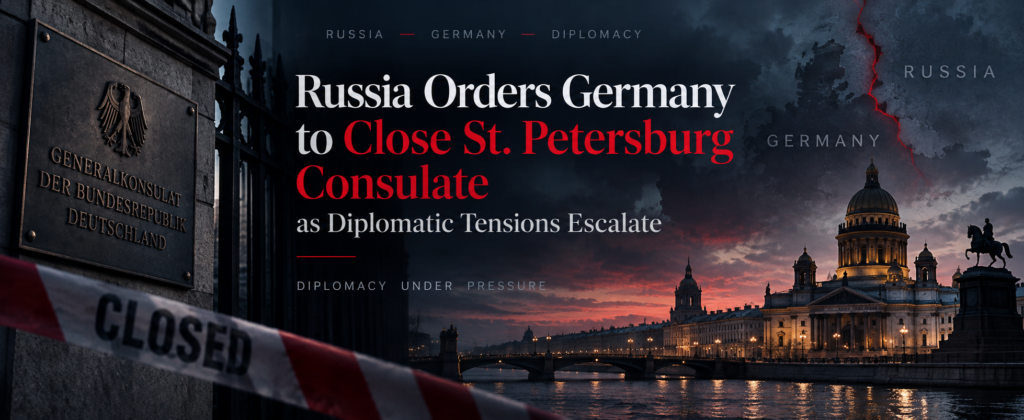
Russia has ordered the closure of Germany’s Consulate-General in St. Petersburg, marking another sharp deterioration in relations between Moscow and Berlin as accusations over alleged Russian sabotage and hybrid attacks continue to intensify across Europe.
The Russian Foreign Ministry said on September 7 that Germany’s consulate in St. Petersburg must cease operations no later than September 18. Moscow also ordered German staff working at Goethe-Institut cultural centres in Russia to leave the country by September 13.
The move came in retaliation for Germany’s decision to close Russia’s Consulate-General in Bonn and the Russian House cultural centre in Berlin. Berlin had taken those measures after German authorities accused Russia of responsibility for an attempted drone attack at Leipzig/Halle Airport.
Germany Accuses Russia Over Leipzig Airport Drone Incident
The latest diplomatic escalation is linked to an August 4 incident near Leipzig/Halle Airport, an important logistics hub in Germany.
German authorities said an explosives-laden drone had been involved in an attempted attack near a Ukrainian cargo aircraft. On September 1, the German government formally said it had concluded that Russia was responsible for the attempted attack. Moscow rejected the accusation and described the claims as fabricated.
The incident has added to wider European concerns about what governments increasingly describe as Russian “hybrid” activity, including suspected sabotage, cyber operations, espionage and attacks against critical infrastructure.
For Germany, the issue is particularly sensitive because Berlin remains one of Ukraine’s major European supporters. Any further deterioration in relations with Moscow could therefore have implications beyond bilateral diplomacy.
Diplomatic Retaliation Deepens the Divide
Russia’s latest measures represent a tit-for-tat response rather than an isolated diplomatic decision.
Moscow has blamed Berlin for provoking the latest escalation, while Germany has argued that its actions are necessary because of growing security threats linked to Russia.
The closure of diplomatic and cultural institutions reduces channels for communication between the two countries at a time when political relations are already severely strained. The Goethe-Institut closures are also significant because they extend the confrontation beyond government-to-government relations into cultural and educational ties.
The developments come after years of deteriorating Germany-Russia relations following Russia’s invasion of Ukraine and the resulting European sanctions, military support for Kyiv and reduction in economic cooperation.
Why Markets May Be Watching
Although the immediate impact of the consulate closures on financial markets is likely to be limited, investors may pay closer attention if diplomatic tensions develop into broader European security or economic measures.
Germany is Europe’s largest economy, while Russia remains an important factor in European energy and commodity markets despite years of efforts to reduce dependence on Russian supplies. A significant escalation could increase concerns over energy security, trade restrictions and defence spending.
That could become particularly relevant for European equities, the euro and government bond markets if geopolitical risks begin affecting business confidence or inflation expectations.
Energy markets are especially sensitive to geopolitical developments involving Russia and Europe. Any renewed disruption concerns could add to volatility in oil and gas prices, potentially complicating the outlook for inflation and interest-rate policy.
European governments are already discussing stronger measures to protect critical infrastructure and counter suspected Russian hybrid operations.
A Wider European Security Concern
The Germany-Russia dispute is unfolding alongside broader European concerns about Russian activity targeting infrastructure and security interests.
Recent reports of suspected sabotage operations and threats to critical infrastructure have increased pressure on European governments to strengthen security measures. At the same time, NATO countries are increasing surveillance of strategically important infrastructure, including undersea communications networks.
For financial markets, the key question is whether the current diplomatic confrontation remains contained or becomes part of a wider cycle involving additional sanctions, trade restrictions and energy-market disruptions.
For now, Russia’s order to close Germany’s St. Petersburg consulate represents another visible sign that diplomatic ties between Moscow and Berlin continue to deteriorate. If tensions continue rising, investors may increasingly price geopolitical risk into European assets, energy markets and the euro.

Alexander
Alexander is a veteran of the currency markets with over 15 years of experience in institutional trading and risk management. He specializes in the intersection of macroeconomics and regulatory frameworks.
