

Why the SCO Summit in Kyrgyzstan Matters to India More Than Ever
The SCO Summit in Bishkek, Kyrgyzstan, has gained renewed importance for India as global geopolitical tensions reshape trade, energy markets and international alliances. Prime Minister Narendra Modi is attending the 26th Shanghai Cooperation Organisation summit on August 31 and September 1, with regional security, connectivity and economic cooperation among the key issues on the agenda. […]
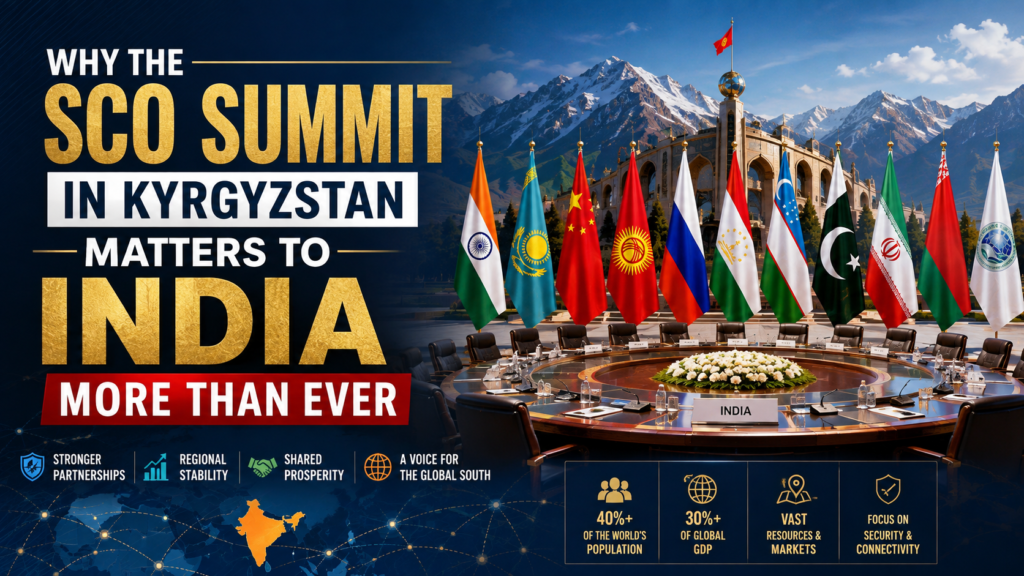
The SCO Summit in Bishkek, Kyrgyzstan, has gained renewed importance for India as global geopolitical tensions reshape trade, energy markets and international alliances. Prime Minister Narendra Modi is attending the 26th Shanghai Cooperation Organisation summit on August 31 and September 1, with regional security, connectivity and economic cooperation among the key issues on the agenda. India has been a full SCO member since 2017.
The summit comes at a time when relations between major powers are undergoing significant changes. The presence of Indian Prime Minister Narendra Modi alongside Chinese President Xi Jinping, Russian President Vladimir Putin and other leaders makes the meeting particularly important for geopolitical news and global markets.
Why the SCO Summit Is Strategically Important for India
For India, the SCO is more than a regional diplomatic forum. It provides New Delhi with an opportunity to engage simultaneously with China, Russia, Iran and Central Asian countries while advancing its own strategic interests.
India’s priorities at the summit are centred on security, connectivity and opportunity. New Delhi is expected to push cooperation against terrorism, separatism and extremism while seeking stronger economic and transport links with Central Asia.
The summit also gives India an important diplomatic platform at a time when global power relationships are becoming increasingly fragmented. Rather than aligning exclusively with one geopolitical bloc, India continues to pursue a multi-alignment strategy that allows it to maintain relationships with both Western and Eurasian powers.
India, Central Asia and Connectivity
Improving connectivity with Central Asia remains one of India’s biggest strategic challenges. India has geographical barriers separating it from several Central Asian markets, making alternative transport corridors particularly important.
The International North-South Transport Corridor (INSTC) and Iran’s Chabahar Port can help India develop alternative trade routes into Central Asia and beyond. The INSTC, linking India with Russia through Iran and other regional routes, could reduce dependence on traditional maritime corridors and potentially improve the movement of goods.
For businesses and investors following financial news today, developments around trade corridors, energy supplies and regional infrastructure can have wider implications for currencies, commodities and emerging-market investment.
SCO, Iran and the Changing Geopolitical Landscape
Iran’s participation adds another important dimension to this year’s summit. The country has been a full SCO member since 2023, meaning developments involving Iran can have direct relevance to discussions within the organisation.
Against the backdrop of continuing tensions involving Iran and the United States, the SCO provides India with another channel for diplomatic engagement. Investors monitoring US Iran war news, oil prices and broader geopolitical risk will therefore be watching the summit closely.
Any disruption involving the Middle East can influence energy prices, inflation expectations and major currencies. For this reason, Forex News increasingly overlaps with geopolitical developments, particularly when energy-producing countries and major trading powers are involved.
Economic and Financial Implications for India
The SCO’s discussions on trade, energy, digital cooperation and cross-border payments could have long-term implications for regional commerce. Greater use of local currencies and alternative payment mechanisms could gradually reduce dependence on traditional international financial channels.
For India, stronger economic relationships with Central Asia, Russia and other SCO members could diversify trade and energy partnerships. However, significant challenges remain, including political differences between member states, India-China tensions and the geographical difficulties surrounding regional connectivity.
What the SCO Summit Means for India’s Global Position
The biggest significance of the SCO Summit for India is strategic flexibility. New Delhi can use the forum to strengthen ties with Central Asia, maintain dialogue with China and Russia, engage Iran and promote its interests in a changing international order.
As global markets respond rapidly to wars, sanctions, energy shocks and diplomatic developments, the SCO’s growing importance extends beyond traditional foreign policy. It is increasingly relevant to world news real time, geopolitical news, Forex News and financial news today.
For India, the Bishkek summit therefore represents an opportunity to convert diplomatic engagement into practical gains in connectivity, security, energy and trade—while reinforcing its role in an increasingly multipolar world.
