

Trump $1 Coin Goes on Sale as Legal Tender: What It Means for the US Currency
The United States Mint has begun selling a new $1 coin featuring President Donald Trump, marking an unusual development in US currency and attracting attention from collectors, lawmakers and financial observers. The coin was released on September 2, 2026, as part of the United States’ 250th anniversary celebrations and is being offered in rolls and […]
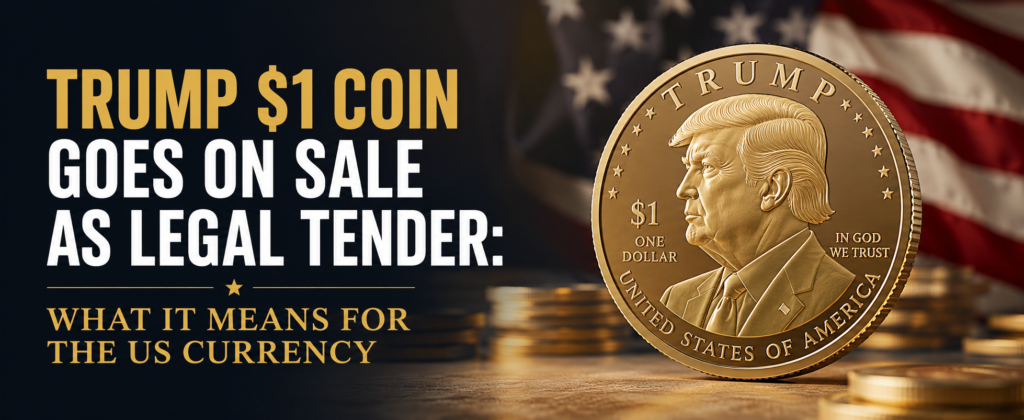
The United States Mint has begun selling a new $1 coin featuring President Donald Trump, marking an unusual development in US currency and attracting attention from collectors, lawmakers and financial observers. The coin was released on September 2, 2026, as part of the United States’ 250th anniversary celebrations and is being offered in rolls and bags through the US Mint.
The release is particularly notable because Trump is a sitting president, while US federal law has traditionally restricted the appearance of living individuals on American currency. The new coin has therefore generated considerable discussion over how it was authorised and whether its design complies with existing legal restrictions.
Trump $1 Coin Is Legal Tender
Despite the controversy surrounding its design, the Trump $1 coin is legal tender and has a face value of one dollar. The US Mint describes it as a circulating-quality coin commemorating the nation’s semiquincentennial.
The obverse features Trump’s portrait along with the inscriptions “LIBERTY,” “IN GOD WE TRUST” and “1776~2026.” The reverse carries the Presidential Seal, with the number 250 incorporated into the design to mark America’s 250th anniversary.
The coin has a gold-coloured appearance, but it is not a gold coin in the investment sense. It is made using the standard metal composition specified for the issue rather than precious-metal content.
Why Does the Coin Cost More Than $1?
One of the most interesting aspects of the release is the difference between the coin’s face value and its purchase price from the Mint.
The US Mint is selling a roll containing 25 coins for $61, while a bag containing 100 coins is priced at $154.50. That means buyers are paying a premium over the combined $25 or $100 face value.
The premium reflects the fact that these are being sold as numismatic products rather than simply being distributed at face value through banks. The Mint has also included a limited number of coins struck on July 4 with a special “July 4th” privy mark, adding a collector element to the release.
Why Is Trump’s Image Allowed?
The legal question surrounding the coin is more complicated than simply asking whether federal law permits a living president to appear on US currency.
Federal law has historically restricted the depiction of living individuals on US currency. However, the Trump coin was authorised under legislation relating to the United States’ 250th anniversary and the Mint’s authority to issue special circulating coins.
According to reporting on the release, the relevant legislation prohibits portraits of individuals on the reverse side of these special coins, while Trump’s portrait appears on the obverse. This distinction forms part of the legal reasoning behind the coin’s issuance.
The issue has nevertheless attracted criticism from lawmakers who argue that putting a sitting president’s image on US currency breaks with longstanding American traditions.
What Does It Mean for the US Dollar?
From a Forex perspective, the Trump $1 coin does not change the value of the US dollar or alter the Federal Reserve’s monetary policy. Its face value remains exactly $1, meaning the release itself does not create a new dollar-denomination system or change the dollar’s role in global markets.
However, the story is relevant as a broader US financial and currency news development. The dollar is not only a medium of exchange but also a major symbol of US economic and political power. A new coin featuring a sitting president therefore attracts attention beyond the collector market.
For Forex traders, the more important factors influencing the US dollar remain interest rates, inflation, Treasury yields, economic growth, Federal Reserve policy and geopolitical developments.
A Symbolic Currency Story With Financial Interest
The Trump $1 coin is unlikely to have a direct impact on major currency pairs such as EUR/USD or USD/JPY. However, it provides an interesting look at the intersection of US politics, currency design and financial policy.
The US Mint says the coin is intended to commemorate 250 years of American heritage, while critics have questioned the decision to feature a sitting president.
For financial markets, the key takeaway is that the coin is legal tender with a $1 face value, even though collectors must pay more than face value to purchase it directly from the Mint.
As the United States approaches its 250th anniversary, the unusual coin is likely to remain a subject of political and financial discussion, particularly because it represents a rare intersection between presidential politics, American currency and the country’s monetary heritage.
