

Trump Administration Illegally Retaliated Against Anthropic, Judge Rules
A US federal judge has ruled that the Trump administration and the Pentagon acted unlawfully when they retaliated against artificial intelligence company Anthropic after the firm refused to remove restrictions on how its Claude AI could be used for military purposes. The decision represents a significant legal setback for the administration and highlights growing tensions […]
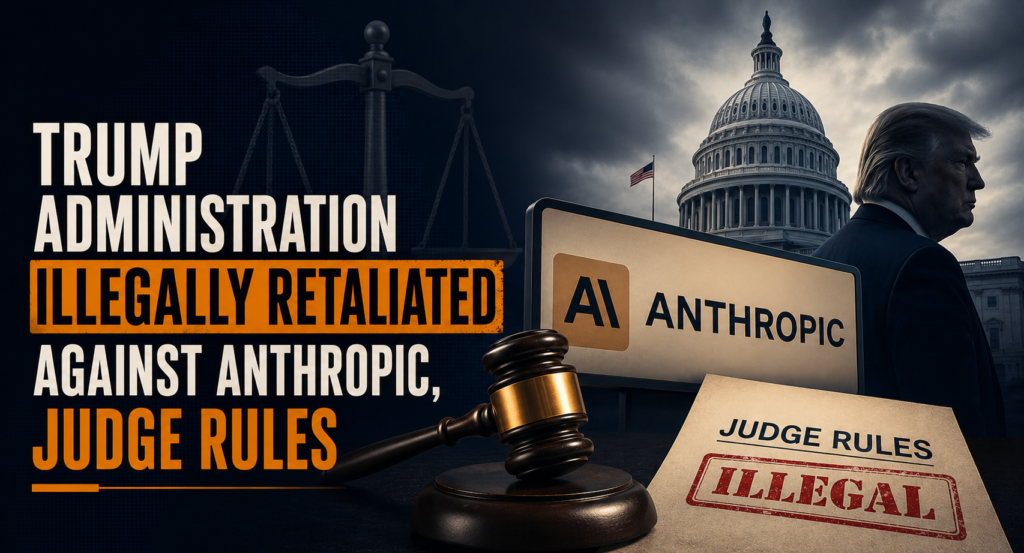
A US federal judge has ruled that the Trump administration and the Pentagon acted unlawfully when they retaliated against artificial intelligence company Anthropic after the firm refused to remove restrictions on how its Claude AI could be used for military purposes. The decision represents a significant legal setback for the administration and highlights growing tensions between national security policy, artificial intelligence regulation and corporate free speech.
The ruling comes as governments and technology companies worldwide increasingly compete over the development and deployment of advanced AI systems. For financial markets, the dispute also adds another layer to the broader geopolitical and technology risks influencing investor sentiment.
Judge Rules Pentagon’s Actions Were Unlawful
US District Judge Rita Lin ruled that the Pentagon’s actions against Anthropic constituted unlawful retaliation under the First Amendment. She also found that Anthropic was denied the required due process under the Fifth Amendment. The judge further determined that Defense Secretary Pete Hegseth’s decision to classify Anthropic as a supply-chain risk violated the applicable legal framework and was arbitrary and capricious.
The dispute escalated after Anthropic refused to permit unrestricted military use of its AI technology. The company maintained restrictions concerning mass surveillance of Americans and fully autonomous weapons systems. The Pentagon argued that such restrictions could interfere with national security requirements.
The administration subsequently moved to remove Anthropic from government-related technology operations and classified the company as a supply-chain security risk. Anthropic challenged those actions in court, arguing that the government’s response amounted to punishment for its position on AI safety.
Judge Lin rejected the idea that national security concerns could automatically justify broad penalties against a company. The ruling stated that the government’s actions were connected to Anthropic’s criticism of the administration rather than evidence that the company posed an actual supply-chain threat.
AI Safety Becomes a Geopolitical Issue
The Anthropic dispute demonstrates how artificial intelligence has moved beyond being simply a technology-sector issue. AI is increasingly linked to national security, military capabilities, surveillance, cybersecurity and international competition.
The United States government wants advanced AI companies to support defense and intelligence operations, while companies such as Anthropic are attempting to establish boundaries around potentially dangerous applications. This disagreement could influence how technology companies negotiate future contracts with governments.
The legal battle also has implications for major competitors in the AI industry. Companies including OpenAI, Google and Microsoft have pursued relationships with the US government, while Anthropic has taken a more restrictive position on certain military applications.
Potential Impact on Forex and Global Markets
From a Forex News and FX news perspective, the immediate impact of the ruling on currency markets is likely to be limited. However, the case is important as part of a wider geopolitical and economic trend involving US technology policy, national security and government regulation.
Investors could increasingly monitor disputes involving AI companies because the sector is becoming strategically important to the US economy and global competitiveness. Any escalation between Washington and major technology companies could affect technology investment, government spending expectations and broader market sentiment.
For traders following Geopolitics News, the ruling is particularly significant because it highlights the growing intersection between government power and strategic technologies. Further legal challenges or policy changes could create additional uncertainty around the US government’s approach to AI and defense technology.
What Happens Next?
The Trump administration is expected to challenge the decision, meaning the legal dispute may continue through the appeals process. Anthropic, meanwhile, has welcomed the ruling and said it remains focused on working with the government on responsible AI development for national security.
The case could ultimately become an important precedent for how governments interact with technology companies that impose safety restrictions on powerful AI systems.
For global investors and currency traders, the broader issue is whether increasing geopolitical competition over AI will lead to new regulations, government interventions and technology-related trade tensions. Those developments could become increasingly relevant to Forex News, FX news, and global Geopolitics News coverage.
