

Trump’s Greenland Fixation Puts Security at the Heart of Iceland’s Knife-Edge EU Vote
Iceland is heading into a closely watched referendum on whether to resume negotiations for European Union membership, with security concerns increasingly competing with traditional debates over sovereignty, fisheries and economic independence. The August 29 vote comes as President Donald Trump’s repeated focus on Greenland has pushed Arctic security higher up Iceland’s political agenda. The referendum […]
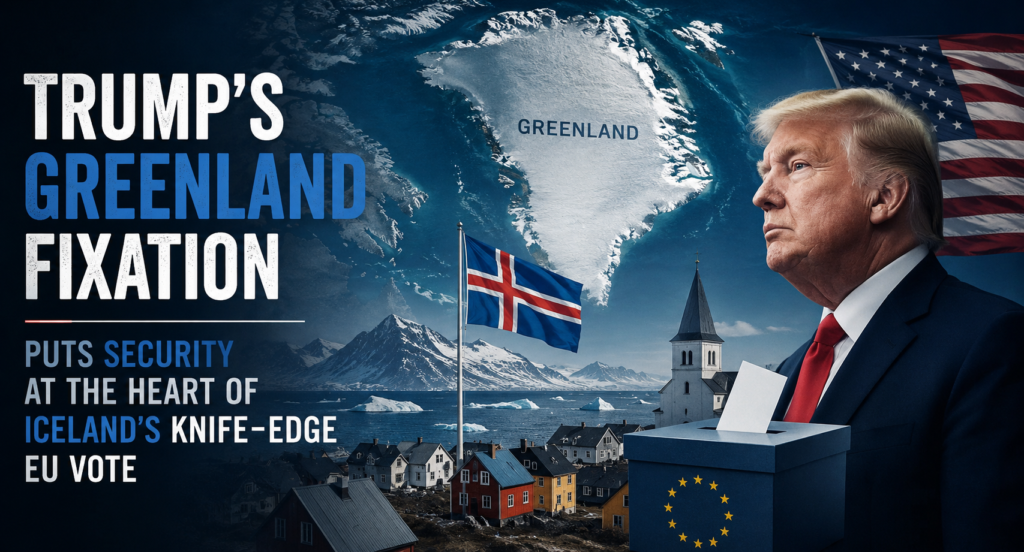
Iceland is heading into a closely watched referendum on whether to resume negotiations for European Union membership, with security concerns increasingly competing with traditional debates over sovereignty, fisheries and economic independence. The August 29 vote comes as President Donald Trump’s repeated focus on Greenland has pushed Arctic security higher up Iceland’s political agenda.
The referendum is not a final vote on EU membership. Instead, Icelanders will decide whether the country should reopen accession negotiations with Brussels. If talks eventually produce an agreement, Iceland would need to hold another referendum on the final membership terms.
Greenland and Arctic Security Reshape Iceland’s EU Debate
Iceland has traditionally maintained a careful balance between European economic integration and political independence. The country is already part of the European Economic Area, Schengen and the European Free Trade Association, giving it extensive access to European markets without being an EU member.
However, the strategic environment surrounding Iceland has changed. Trump’s statements about Greenland have generated concerns across the Nordic and Arctic regions, prompting Icelandic voters to reconsider how the country should protect its long-term security interests.
Iceland is a NATO member but does not maintain a conventional standing army. Its strategic position in the North Atlantic makes it important to regional defence and transatlantic security. As geopolitical competition intensifies in the Arctic, the question of whether closer European integration could strengthen Iceland’s strategic position has become more prominent.
The European Policy Centre has described the changing geopolitical environment in the North Atlantic as increasingly uncertain, particularly as competition among major powers grows.
Iceland’s EU Referendum Comes Down to Sovereignty and Economics
Despite the growing security dimension, fisheries remain one of the most sensitive issues in Iceland’s EU debate. Fishing is deeply connected to the country’s economy and national identity, and opponents of EU membership fear that closer integration could reduce Iceland’s control over its fishing resources.
Economic conditions are also influencing voters. Icelanders face concerns over living costs, mortgage rates and currency volatility. Supporters of reopening negotiations argue that eventual EU membership could provide greater economic stability, potentially including access to the euro and stronger influence over decisions that already affect Iceland through its relationship with the European single market.
Recent polling highlights how finely balanced the decision is. A Reuters-reported poll showed 51.3% supporting the resumption of EU negotiations and 48.7% opposing it, leaving the outcome highly uncertain.
What an Iceland EU Vote Could Mean for Global Markets
For Global Markets, the immediate financial impact of the referendum is likely to be limited because the vote concerns restarting negotiations rather than immediate EU accession. Nevertheless, the political signal could be significant.
A stronger push toward Europe could influence expectations around Iceland’s currency, investment environment and longer-term economic integration. More broadly, the vote could demonstrate how geopolitical uncertainty is changing economic alliances in smaller European states.
For Forex News and FX news traders, Iceland’s króna may attract greater attention if the referendum produces a surprise result or significantly changes expectations about future EU membership. Currency markets could also interpret the outcome through the broader lens of European economic and security integration.
Why the Vote Matters Beyond Iceland
Iceland’s referendum illustrates how geopolitics is increasingly influencing economic decisions. What was once primarily a debate about fisheries, sovereignty and EU trade arrangements is now also a discussion about security in an increasingly contested Arctic.
A “yes” vote would only reopen negotiations, but it could mark a major strategic shift for Iceland and potentially strengthen the European Union’s position in the North Atlantic. A “no” vote, meanwhile, would reinforce Iceland’s preference for maintaining its existing relationship with Europe while preserving greater national autonomy.
For investors following Geopolitics News, financial news and financial news today, Iceland’s decision is therefore worth watching—not because it will immediately transform markets, but because it reflects a wider restructuring of European security, alliances and economic strategy.
