

Turkey Becomes 71st Artemis Accords Signatory, Deepening Space Cooperation With the US
WASHINGTON: Turkey has formally joined the US-led Artemis Accords, becoming the 71st country to sign the international framework for peaceful and responsible space exploration. The agreement was signed on Monday, August 31, 2026, during a ceremony at NASA headquarters in Washington, marking another step in the expansion of Turkey’s space programme and its cooperation with […]
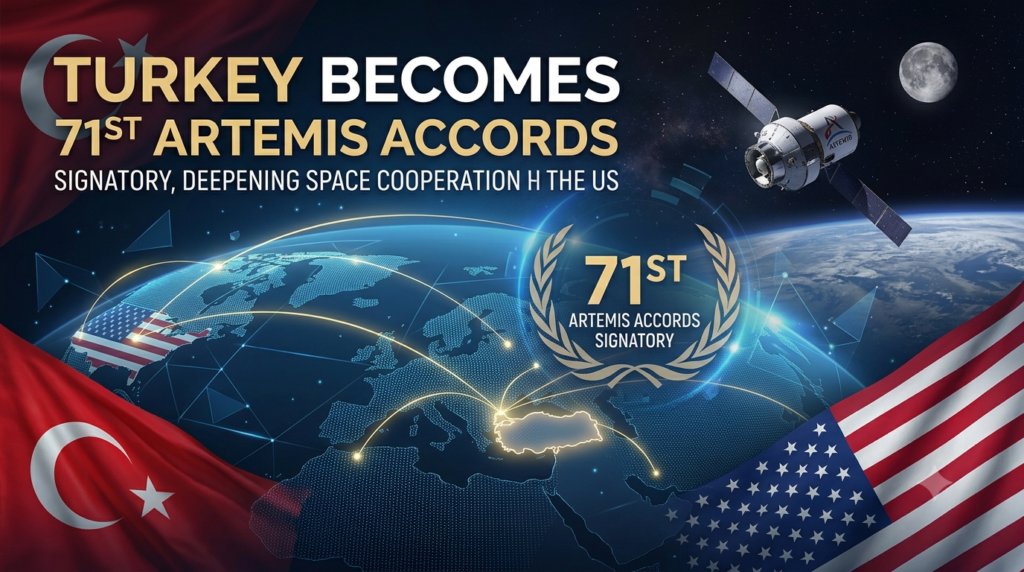
WASHINGTON: Turkey has formally joined the US-led Artemis Accords, becoming the 71st country to sign the international framework for peaceful and responsible space exploration. The agreement was signed on Monday, August 31, 2026, during a ceremony at NASA headquarters in Washington, marking another step in the expansion of Turkey’s space programme and its cooperation with the United States.
Turkey’s Minister of Industry and Technology Mehmet Fatih Kacır signed the agreement on behalf of Ankara, while NASA Administrator Jared Isaacman hosted the ceremony. The development comes as Turkey seeks to expand its capabilities in space technology and prepare for future lunar exploration.
Must Read This Blog : Why the SCO Summit in Kyrgyzstan Matters to India More Than Ever
Turkey Joins Growing Artemis Coalition
The Artemis Accords were established in 2020 by NASA, the US Department of State and seven founding nations. The framework sets out principles for safe, peaceful, transparent and sustainable civil exploration of the Moon, Mars and beyond.
With Turkey joining the programme, the number of signatories has reached 71. Mauritius became the 70th country to join in July 2026, highlighting the continued expansion of the US-led space cooperation framework.
The accords are not a traditional military or defence treaty. Instead, participating nations agree to cooperate around responsible civil space exploration, transparency, scientific data sharing, emergency assistance for astronauts and the registration of space objects.
Turkey’s Space Ambitions Gain Momentum
Turkey has been investing heavily in developing its domestic space capabilities. The country sent its first astronaut, Alper Gezeravcı, to the International Space Station in 2024, an important milestone for Ankara’s emerging space programme.
Turkey has also announced ambitions to conduct lunar missions and develop greater domestic capabilities in satellites, launch systems and space technologies. Joining the Artemis Accords gives Ankara a framework for closer cooperation with NASA and other participating countries as its space programme develops.
Turkish officials have described the agreement as an important step toward establishing a sustainable presence in space and expanding the country’s capabilities in science and technology.
Why the Artemis Agreement Matters for US-Turkey Relations
The agreement also carries wider geopolitical significance.
Turkey is a NATO member and an important regional power connecting Europe, the Middle East and Asia. Closer cooperation with Washington in space technology could strengthen an already strategically important relationship while creating opportunities for scientific, technological and commercial partnerships.
The development comes after US President Donald Trump’s visit to Turkey during the NATO summit in July, which Turkish officials said helped strengthen plans for bilateral cooperation in space.
For Washington, bringing more countries into the Artemis framework also expands the international coalition supporting US-led principles for lunar exploration.
Must Read This Blog : China Pauses Rescue Operation in Tibet over Risk of Another Flood
Artemis Accords and the Global Space Economy
Turkey’s entry is also significant from an economic perspective. The global space sector is increasingly moving beyond government-funded missions toward commercial satellites, communications, launch services, data infrastructure and private-sector lunar exploration.
Greater international cooperation could create opportunities for Turkish companies and research institutions to participate in future space projects, technology development and supply chains.
For investors, the expansion of the Artemis coalition highlights the growing economic importance of the global space industry. Demand for satellite communications, advanced electronics, aerospace manufacturing, navigation systems and other space-related technologies is expected to remain an important area of technological investment.
US-China and Russia Competition Adds Geopolitical Importance
The Artemis Accords are also developing against the backdrop of increasing competition among major space powers.
The United States and its partners are pursuing the Artemis programme, while China is developing its own lunar exploration plans and international partnerships. Russia has also maintained its own space ambitions and has previously criticised the Artemis framework as being too US-centric.
Turkey’s decision to join therefore gives Ankara a stronger position within the US-led international space architecture while allowing it to maintain its broader diplomatic and strategic relationships.
What Turkey’s Artemis Membership Means Next
The immediate impact of Turkey joining the Artemis Accords is unlikely to be significant for traditional financial markets such as forex, oil or gold. However, the agreement is important for geopolitics, aerospace technology and the growing global space economy.
For The Finance Chronicles, the story is best viewed through the wider lens of US-Turkey relations, strategic technology cooperation and the international competition for future space infrastructure.
As Turkey develops its lunar ambitions and expands cooperation with NASA and other Artemis members, its participation could create new opportunities for aerospace companies, technology suppliers and research institutions.
The signing ultimately represents more than another addition to the Artemis Accords. It signals Turkey’s intention to play a larger role in the emerging global space economy while deepening technological and strategic cooperation with the United States.
