

Dollar Languishes at 3-Month Lows as Sovereign Debt Doubts Overshadow Buybacks
The US dollar remained under pressure near three-month lows as investors continued to question the outlook for US government debt, even after the Treasury announced measures designed to support liquidity in the Treasury market. Instead of producing a lasting boost for the greenback, the latest policy developments have highlighted a broader concern confronting global financial […]
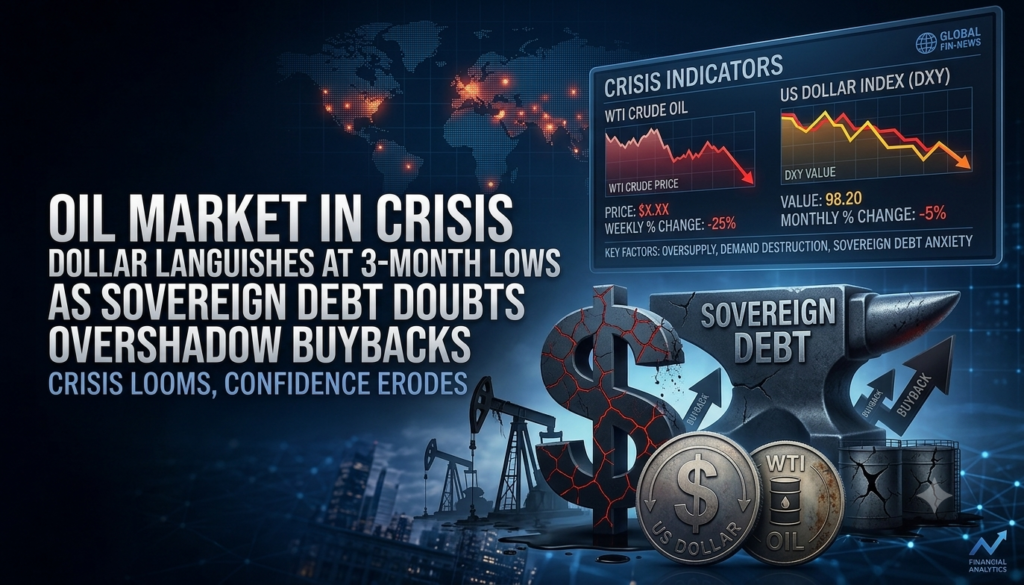
The US dollar remained under pressure near three-month lows as investors continued to question the outlook for US government debt, even after the Treasury announced measures designed to support liquidity in the Treasury market. Instead of producing a lasting boost for the greenback, the latest policy developments have highlighted a broader concern confronting global financial markets: whether rising government debt and borrowing costs will eventually become a more important driver of currency markets.
The dollar’s weakness comes at a particularly complicated time for the global economy. Investors are simultaneously dealing with elevated oil prices, geopolitical tensions surrounding Iran, disruptions around the Strait of Hormuz, inflation risks and uncertainty over the future path of monetary policy. Recent market developments have therefore created a difficult environment for traditional safe-haven assets.
According to current market reporting, the dollar has remained close to its lowest level in roughly three months despite the US Treasury’s move to conduct debt buybacks.
For forex traders, the development is important because the dollar’s performance is increasingly being influenced by factors beyond the Federal Reserve’s interest-rate outlook.
Why Is the US Dollar Under Pressure?
The US dollar traditionally benefits when investors seek safety during periods of market stress. However, the current environment is different. Concerns about the scale of US government borrowing and the sustainability of sovereign debt are increasingly competing with the dollar’s traditional safe-haven status.
The US government’s debt burden has reached historically high levels, while investors are paying closer attention to Treasury yields and the cost of servicing government debt. Recent market developments have shown that even measures intended to improve Treasury-market liquidity may not automatically translate into stronger demand for the dollar.
Instead, investors are assessing the longer-term implications of fiscal policy.
This distinction matters for the Forex market. A currency can benefit from high interest rates in the short term, but persistent concerns about fiscal sustainability can create longer-term pressure.
As a result, traders are watching the relationship between:
- US Treasury yields
- Federal Reserve policy
- Government borrowing
- Inflation expectations
- Foreign demand for US assets
- Global economic growth
- Oil prices
- Geopolitical risk
Together, these factors are shaping the latest FX news.
Treasury Buybacks Fail to Deliver a Major Dollar Boost
The US Treasury’s buyback programme was intended to improve liquidity and market functioning. Treasury buybacks can help manage the government’s outstanding debt and support more efficient trading conditions.
However, investors appear to be looking beyond the immediate technical benefits.
The central issue is whether buybacks can meaningfully address broader concerns about the US fiscal position. If government borrowing remains elevated, investors may continue demanding higher compensation for holding long-term Treasury securities.
That can create a complicated relationship between bond yields and the dollar.
Normally, higher Treasury yields can attract international capital because investors seek higher returns on US assets. This can support the dollar. But if yields rise because markets are demanding a larger risk premium for holding government debt, the currency response can be much less straightforward.
That is why current Forex News is increasingly focused not simply on the level of Treasury yields, but on why those yields are moving.
Sovereign Debt Concerns Become a Currency-Market Issue
Sovereign debt has traditionally been viewed primarily as a bond-market issue. Today, however, fiscal sustainability has become an important currency-market consideration.
When investors become concerned about government debt, several market reactions can occur simultaneously.
First, bond yields can rise as investors demand greater compensation for risk. Second, governments can face higher borrowing costs. Third, expectations surrounding monetary policy can change. Finally, international investors can reconsider the allocation of their portfolios.
For the United States, these developments have global implications because the dollar remains the dominant reserve currency and US Treasuries remain central to the international financial system.
This means a change in investor sentiment toward US government debt can affect currencies, commodities, equities and emerging markets at the same time.
Oil Prices Add Another Layer of Pressure
The dollar’s weakness is occurring alongside renewed volatility in global energy markets.
The Strait of Hormuz remains one of the world’s most important energy chokepoints. Around a quarter of global seaborne oil trade normally passes through the waterway, making disruptions there highly significant for energy prices and global inflation.
Recent shipping data shows that traffic through the Strait of Hormuz has remained dramatically below normal levels. Reuters reported that only seven commodity ships passed through the strait on Thursday, compared with much higher historical traffic levels, and no very large crude carriers or LNG tankers were recorded among those vessels.
This matters for the global economy because higher oil prices can feed directly into inflation.
When energy becomes more expensive, transportation, manufacturing, aviation, logistics and consumer prices can all come under pressure.
Recent oil-market developments demonstrate the risk. Brent crude was trading around $93 per barrel on August 21, while WTI was around $86, with both benchmarks heading toward a second consecutive weekly gain.
For forex traders, this creates a complicated environment.
How the Hormuz Crisis Could Affect Forex Markets
Oil-importing economies are particularly vulnerable to a sustained energy shock.
Countries that rely heavily on imported crude may experience:
- Higher inflation
- Wider trade deficits
- Greater pressure on foreign-exchange reserves
- Weaker economic growth
- Reduced consumer spending
- Higher interest-rate expectations
These developments can have significant implications for currencies.
If an oil-importing country experiences a sharp increase in its energy bill, more foreign currency may be required to purchase energy imports. This can place downward pressure on the domestic currency.
Oil exporters, meanwhile, can experience an improvement in trade revenues when crude prices rise, although the current geopolitical environment makes the economic impact more complicated.
The Strait of Hormuz crisis has already demonstrated how an energy disruption can spread across financial markets. The IMF has described the de facto closure of the strait and damage to regional infrastructure as producing the largest disruption to the global oil market in its history.
The Dollar’s Safe-Haven Status Is Being Tested
One of the most important questions for the FX market is whether investors will continue treating the US dollar as the ultimate safe-haven currency.
Historically, geopolitical crises have often generated strong demand for dollars because investors move capital into highly liquid US assets.
However, the current situation is more complicated because the geopolitical shock is occurring alongside concerns about US fiscal sustainability.
That creates two opposing forces.
Force one: geopolitical risk.
Investors may seek the liquidity and safety of the US dollar.
Force two: sovereign debt concerns.
Investors may become increasingly cautious about US government debt and the long-term fiscal outlook.
The balance between these two forces could determine the dollar’s next major move.
Treasury Yields Remain a Key Indicator for FX Traders
Forex traders should closely monitor US Treasury yields because they remain one of the most important drivers of the dollar.
When Treasury yields rise because investors expect stronger economic growth or tighter Federal Reserve policy, the dollar can benefit.
But when yields rise because of concerns about government borrowing or fiscal risk, the currency reaction can be less supportive.
This distinction is particularly important in the current environment.
Markets are assessing whether higher yields represent attractive returns or a growing risk premium.
If investors increasingly interpret higher yields as compensation for fiscal risk, the traditional positive relationship between yields and the dollar could weaken.
That would represent an important structural development for the currency market.
Federal Reserve Policy Remains Critical
The Federal Reserve remains another major factor for the dollar outlook.
The central bank must balance inflation risks against economic growth. Higher oil prices make this task more difficult because energy shocks can push inflation higher while simultaneously reducing consumer purchasing power.
This is a classic policy challenge.
If inflation remains elevated, the Federal Reserve may have less room to ease monetary policy. But if higher energy costs weaken economic activity, policymakers may face pressure to support growth.
For forex traders, the question is therefore not simply whether the Fed will cut or raise interest rates.
The bigger question is how markets interpret the Fed’s reaction function.
A more restrictive Federal Reserve could support the dollar through higher relative interest rates. Conversely, expectations of monetary easing could put additional pressure on the currency.
Global Growth Risks Could Become More Important
The oil shock is also raising concerns about global economic growth.
The IMF has warned that the energy disruption can act like a sudden tax on income for fuel-importing economies.
Higher energy prices reduce the amount of money households and businesses can spend elsewhere.
For consumers, higher petrol, heating and transportation costs can reduce discretionary spending.
For companies, higher energy and logistics costs can reduce profit margins.
For governments, higher energy costs can increase pressure for subsidies and fiscal support.
The result can be slower economic growth combined with higher inflation — a combination commonly described as stagflationary pressure.
This scenario is particularly challenging for central banks because fighting inflation with higher interest rates can further weaken economic activity.
What Does This Mean for Major Currency Pairs?
The dollar’s weakness has implications across the major FX pairs.
EUR/USD
A weaker US dollar can provide support to EUR/USD, particularly if European economic data remains resilient.
However, higher energy prices can also hurt Europe because the region is highly exposed to imported energy costs.
Therefore, EUR/USD traders need to monitor both dollar weakness and the impact of the energy crisis on European growth.
GBP/USD
Sterling can benefit when broad dollar weakness dominates the market.
However, the UK is also exposed to inflation and energy-price pressures. If higher energy costs increase expectations for tighter monetary policy, sterling could receive support, but worsening growth expectations could offset that benefit.
USD/JPY
USD/JPY is particularly sensitive to changes in US Treasury yields and global risk sentiment.
A decline in US yields can put downward pressure on USD/JPY. At the same time, geopolitical uncertainty can increase demand for traditional safe-haven assets such as the Japanese yen.
USD/CHF
The Swiss franc can also attract safe-haven flows when investors become concerned about geopolitical and financial risks.
If concerns about US debt increase while global risk aversion rises, USD/CHF could face additional downside pressure.
AUD/USD and NZD/USD
Commodity-linked currencies can behave differently because their economies are sensitive to global commodity demand.
Higher commodity prices can provide support, but a major global slowdown could eventually become negative for commodity currencies.
Emerging-Market Currencies Face a More Difficult Environment
Emerging-market currencies could face increased volatility if the oil crisis persists.
Higher energy prices can widen current-account deficits for oil-importing economies while increasing inflationary pressure.
At the same time, global investors may reduce exposure to emerging-market assets if geopolitical uncertainty increases.
This can create capital outflows and currency depreciation.
For countries that rely heavily on energy imports, the combination of higher oil prices and a weaker currency can become particularly challenging because imported energy becomes even more expensive in domestic-currency terms.
Gold Could Remain an Important Market Indicator
Although the primary focus of this story is the dollar, gold is another asset traders should monitor.
Gold often attracts demand during periods of geopolitical uncertainty, inflation concerns and questions about traditional financial assets.
The relationship between gold and the dollar is not always fixed, but a weaker dollar can make gold cheaper for holders of other currencies, potentially supporting demand.
At the same time, elevated Treasury yields can create competition for non-yielding assets such as gold.
Therefore, the gold market could provide another indication of how investors are positioning for inflation, geopolitical uncertainty and fiscal risk.
What Forex Traders Should Watch Next
The next phase of the dollar story will depend on several major indicators.
1. US Treasury Yields
Traders should watch whether Treasury yields continue rising and, more importantly, whether the increase reflects stronger growth expectations or fiscal-risk concerns.
2. Federal Reserve Expectations
Changes in interest-rate expectations can quickly influence the dollar.
3. US Inflation Data
Higher energy prices could feed into inflation expectations, making upcoming inflation releases particularly important.
4. Oil Prices
Brent crude and WTI remain critical indicators for assessing the economic consequences of the Hormuz disruption.
5. Strait of Hormuz Shipping Activity
A meaningful recovery in shipping traffic could reduce the geopolitical risk premium in oil markets. Continued disruption could have the opposite effect.
6. US Treasury Demand
Foreign demand for US government debt will remain an important indicator of international confidence in US fiscal assets.
7. Global Economic Growth
Investors will need to determine whether the energy shock produces only temporary volatility or develops into a broader global slowdown.
Why This Matters for the Global Economy
The dollar’s current weakness should not be viewed in isolation.
The currency market is effectively reflecting several major global themes simultaneously: fiscal sustainability, interest-rate expectations, energy security, geopolitical risk and economic growth.
The Strait of Hormuz crisis has amplified these concerns because the waterway is critical to global energy trade. UN Trade and Development has highlighted the importance of the strait for global trade, while the IMF has warned about the broader economic effects of the energy disruption.
Meanwhile, oil markets remain sensitive to developments in the Middle East. Reuters reported that reduced Iranian crude availability and continued restrictions on shipping are contributing to tighter supply conditions for Asian buyers.
This combination means that currency traders cannot rely solely on traditional indicators such as interest-rate differentials.
Dollar Outlook: What Happens Next?
The dollar’s next major direction will likely depend on whether fiscal concerns, geopolitical risk or monetary-policy expectations dominate market sentiment.
A continuation of concerns over US government debt could keep the dollar under pressure, particularly if investors begin demanding higher risk premiums for long-term US assets.
On the other hand, a sharp deterioration in global risk sentiment could restore demand for the dollar because of its deep liquidity and central role in global finance.
The oil market represents another major swing factor.
If the Strait of Hormuz gradually returns to normal shipping conditions, oil prices could ease and some inflation concerns could fade. This could reduce pressure on global central banks and potentially improve risk sentiment.
If disruptions continue, however, higher oil prices could reinforce inflation concerns, complicate central-bank decisions and increase the risk of slower global growth.
Final Takeaway
The US dollar’s slide toward three-month lows is more than a simple reaction to daily currency-market movements. It reflects a changing balance between traditional dollar-supportive factors and growing concerns about US sovereign debt, Treasury-market conditions and the wider global economic outlook.
The Treasury’s buyback programme may improve market liquidity, but investors remain focused on the bigger fiscal picture. At the same time, the ongoing disruption around the Strait of Hormuz is keeping oil prices elevated and increasing risks for inflation and global growth.
For Forex News and FX News traders, the key takeaway is that the dollar’s outlook will increasingly depend on the interaction between US fiscal policy, Treasury yields, Federal Reserve expectations, oil prices and geopolitical developments.
The market is entering a period where currency movements may be driven less by one individual economic indicator and more by the interaction of several global risks.
Traders should therefore monitor the dollar alongside Treasury yields, Brent crude, gold, central-bank expectations and developments around the Strait of Hormuz.
Until investors gain greater clarity on US debt sustainability and the future of global energy supplies, volatility is likely to remain a defining feature of the Forex market.
