

Trump and Xi Set for Washington Summit as China Trade Tensions Keep Markets on Edge
US President Donald Trump and Chinese President Xi Jinping are preparing to meet in Washington later this month, putting the future of US-China trade relations back in focus for investors and financial markets. While the upcoming summit could provide an opportunity to reduce tensions, some China watchers have kept expectations low because major disagreements over […]
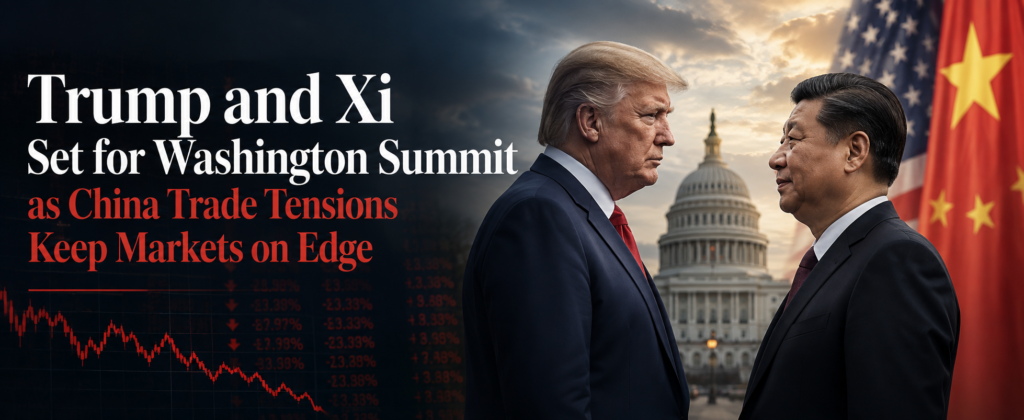
US President Donald Trump and Chinese President Xi Jinping are preparing to meet in Washington later this month, putting the future of US-China trade relations back in focus for investors and financial markets. While the upcoming summit could provide an opportunity to reduce tensions, some China watchers have kept expectations low because major disagreements over tariffs, trade imbalances and economic policy remain unresolved.
The planned meeting comes at a particularly sensitive time for the world’s two largest economies. Washington has been increasing pressure on Beijing over China’s large trade surplus and export-driven economic model, while Chinese officials have resisted calls for policies that could restrict its international trade.
US Treasury Secretary Scott Bessent recently urged G20 countries to reconsider their trade relationships with China, arguing that China’s roughly $1.2 trillion trade surplus is unsustainable. He also warned that Chinese exports could increasingly be redirected toward Europe and Latin America as US trade barriers change the flow of global goods.
G20 Dispute Highlights Challenges Ahead
The tensions were also visible during the recent G20 finance ministers’ meeting. All G20 members except China supported language addressing non-market policies and trade distortions contributing to global imbalances. China opposed the approach, highlighting the difficulty of building a coordinated international position on Beijing’s economic policies.
The G20 disagreement provides an important backdrop to the Trump-Xi meeting. Rather than entering negotiations with a clean slate, both leaders will face unresolved disputes involving tariffs, Chinese exports, market access and strategic industries.
For Washington, reducing the US trade deficit and encouraging China to increase domestic consumption remain important objectives. Beijing, meanwhile, has its own priorities, including protecting access to international markets and seeking greater stability in its economic relationship with the United States.
Why Expectations for a Major Breakthrough Are Low
Although a presidential summit can create space for diplomatic progress, analysts are cautious about expecting a comprehensive trade agreement from a single meeting.
The two governments have previously managed to reach temporary arrangements while leaving deeper structural disagreements unresolved. Issues involving industrial capacity, technology restrictions, critical minerals and market access are difficult to settle because they involve long-term economic and national-security interests.
The upcoming meeting could therefore focus more on preventing further escalation than delivering a major trade breakthrough.
Even a limited agreement could be important for markets if it reduces the risk of additional tariffs. On the other hand, a failure to make progress could revive concerns about another round of trade restrictions.
USD/CNY and Global Markets in Focus
The Trump-Xi meeting is particularly important for the foreign exchange market because developments in US-China relations can directly influence the Chinese yuan and USD/CNY.
A positive signal from the summit could improve investor risk appetite and reduce expectations of additional tariffs, potentially supporting the yuan. Conversely, renewed tariff threats or a breakdown in negotiations could increase demand for the US dollar as investors seek a safer asset.
The impact would not necessarily be limited to USD/CNY. Asian currencies, the euro, commodities and global equities could also react to changes in expectations for international trade.
China’s manufacturing and export sector is closely connected to global supply chains, meaning significant changes in US-China trade policy could affect companies and economies well beyond the two countries.
Trade War Risks Remain a Market Concern
The latest G20 developments suggest that concerns over China’s export model are becoming broader. Washington is encouraging other economies to address trade imbalances, while European policymakers are also increasingly focused on China’s growing presence in international markets.
This raises the possibility that the next phase of US-China trade tensions could involve more than bilateral tariffs. If other major economies introduce additional restrictions on Chinese imports, global trade flows could change further.
For financial markets, that could influence inflation expectations, corporate earnings and central-bank policy. Higher tariffs can increase import costs, while weaker international trade can weigh on economic growth.
What Traders Will Watch
As Trump and Xi prepare for their Washington meeting, traders will focus on any announcements involving tariffs, Chinese purchases of US goods, technology restrictions, critical minerals and broader trade commitments.
The most immediate market reaction could come through USD/CNY, but the consequences could extend to the US dollar, Asian currencies, equities and commodities.
The summit therefore represents an important test for the current US-China economic relationship. A limited agreement could calm markets and reduce trade-war fears, while a failure to make progress could reinforce expectations of prolonged economic confrontation.
For Forex traders, the key question is not simply whether Trump and Xi meet, but whether the meeting produces enough progress to change expectations for future tariffs and trade policy. With global markets already sensitive to geopolitical and economic uncertainty, even small changes in the tone between Washington and Beijing could trigger significant market moves.
