

EUR/USD Forex Surges on ECB Rate Hike Expectations
EUR/USD Forex Upswing: Divergent Central Bank Policies Will Strengthen EUR in August 2026 The euro has emerged as the clear winner in currency markets during August 2026, with EUR/USD surging to 1.1684—its highest level in two months—as the European Central Bank signals increasingly aggressive rate hiking intent while the Federal Reserve remains cautious about tightening. […]
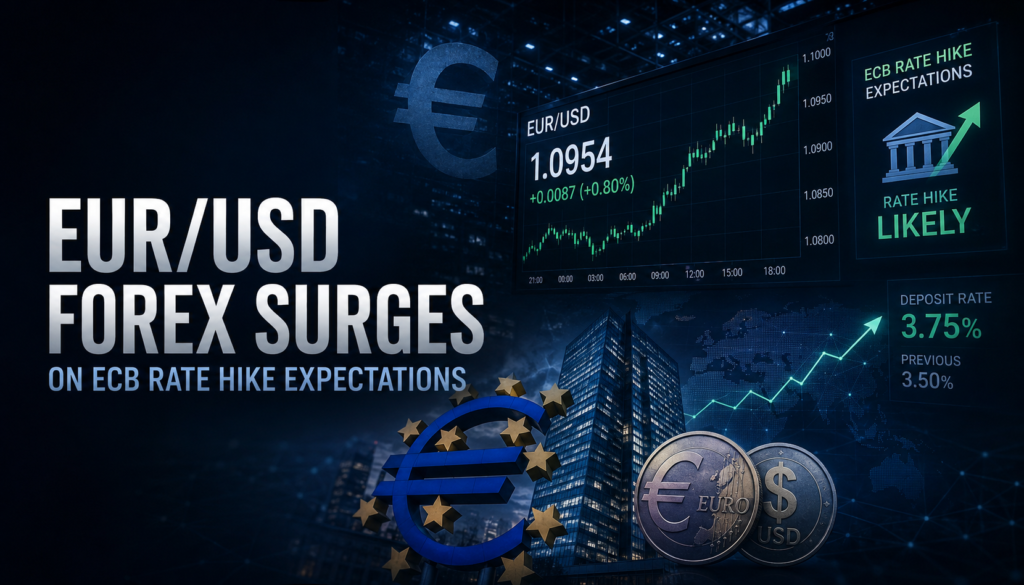
EUR/USD Forex Upswing: Divergent Central Bank Policies Will Strengthen EUR in August 2026
The euro has emerged as the clear winner in currency markets during August 2026, with EUR/USD surging to 1.1684—its highest level in two months—as the European Central Bank signals increasingly aggressive rate hiking intent while the Federal Reserve remains cautious about tightening. This divergence in monetary policy between the two largest central banks is reshaping currency flows, creating one of the most significant forex trends in 2026.
THE EUR/USD BREAKOUT: TECHNICAL AND FUNDAMENTAL DRIVERS
The EUR/USD pair, which represents trade between the world’s two largest economic blocs, has staged a remarkable recovery from its June lows:
EUR/USD Price Action (July-August 2026):
| Date | EUR/USD Level | Significance |
|---|---|---|
| June Low | 1.1324 | Correction low |
| Mid-July High | 1.1530 | Resistance test |
| August 2 Level | 1.1500 | Consolidation |
| August 20 Level | 1.1684 | New 2-month high |
| Q3 2026 Forecast | 1.1600-1.1700 | Range expectation |
The pair’s move from 1.1324 to 1.1684 represents a gain of 360 basis points—a significant move in major currency pairs where typical daily moves are 50-100 basis points. This strong uptrend signals a fundamental shift in currency market sentiment.
EUROZONE ECONOMIC MOMENTUM: THE SURPRISE STRENGTH
The primary driver of EUR strength is unexpected economic resilience in the eurozone:
Second Quarter 2026 GDP Surprise: The eurozone economy expanded 0.4% quarter-over-quarter in Q2 2026—beating the 0.2% consensus estimate by 100%. This represents stronger growth than expected and contrasts sharply with many forecasts predicting eurozone stagnation.
Growth Composition:
- Consumer spending: More resilient than anticipated
- Business investment: Moderate strength despite uncertainty
- Exports: Supported by global AI infrastructure spending
- Government spending: Stable despite fiscal pressures
This better-than-expected growth surprised markets and forced traders to reconsider eurozone growth prospects. Rather than a weak recovery, the eurozone appears to be achieving solid if unspectacular growth.
Inflation Persistence: The ECB’s Rationale
Accompanying this growth surprise is inflation that remains elevated:
- July 2026 Eurozone Inflation: 2.9%
- Target: ECB’s 2% price stability goal
- Persistence: Inflation stubbornly above target despite 2025-2026 disinflationary expectations
- Core Inflation: Excludes energy/food, remains near 3.0%
This combination—stronger growth with persistent inflation—is the ECB’s rationale for continued rate hikes. Growth that’s not so weak as to require rate cuts, but with inflation that’s not falling adequately.
ECB MONETARY POLICY: THE HIKING CYCLE CONTINUES
The ECB’s policy stance has shifted markedly in 2026:
2025 Stance: ECB cut rates in June 2025 as inflation fell and growth disappointed
2026 Trajectory: ECB paused cuts and is now signaling new rate hikes
September 2026 Rate Hike Probability: Market-derived probabilities show an 84% probability of a 25 basis point rate hike in September 2026. This near-certainty reflects:
- ECB guidance strongly implying continued tightening
- Inflation data stubbornly above target
- Growth resilience removing case for cuts
- Wage growth pressures in labor market
Forward Rate Expectations: Markets are pricing in multiple additional rate hikes through 2026, potentially pushing the ECB’s deposit rate (currently 3.75%) to 4.25%-4.50% by year-end. This represents a significant tightening from recent levels.
THE FEDERAL RESERVE: HOLD AND WATCH STANCE
In stark contrast to the ECB’s hiking trajectory, the Federal Reserve has shifted toward a holding pattern:
Fed Monetary Policy (July-August 2026):
The Federal Open Market Committee (FOMC) held rates steady at 3.50%-3.75% at its July 29, 2026 meeting. More importantly, the voting pattern reveals shifting sentiment:
- Vote to Hold Rates: 9 members
- Vote to Hike Rates: 3 members (dissenters advocating tightening)
- Vote to Cut Rates: 0 members
This represents a significant shift from earlier in 2026 when there was more discussion of potential rate cuts. However, the 3 dissenting votes for hiking (vs. typical 0-1 dissents) shows continued hawkishness among minority Fed officials.
Fed Guidance on Future Policy:
- Next FOMC meeting: September 2026
- Current forward guidance: Rates to remain elevated as long as inflation persists
- Market expectations: Fed holding through year-end 2026, potential cuts in 2027
The key divergence with the ECB: While ECB will likely hike in September, the Fed is expected to hold.
THE USD WEAKNESS CATALYST: EMPLOYMENT DATA DISAPPOINTMENT
A critical catalyst for USD weakness in August 2026 was disappointing U.S. employment data:
July 2026 Nonfarm Payroll Report:
| Metric | Actual | Expected | Surprise |
|---|---|---|---|
| Nonfarm Payrolls | -23,000 | +83,000 | -106,000 (massive miss) |
| Unemployment Rate | 4.1% | 4.2% | Beat |
| Labor Force Participation | 61.4% | 61.5% | Decline |
The -23,000 payroll decline was unexpected and raised concerns about U.S. economic momentum. With employment actually contracting rather than expanding, the rationale for Fed rate hikes diminished considerably.
Market Interpretation:
- Lower labor demand = reduced inflation pressure from wage growth
- Economic softness = lower growth outlook
- Rate cut probabilities increased as market repriced Fed path
- USD weakened as markets priced lower rates ahead
This employment miss was perfectly timed (from EUR perspective) to coincide with ECB signals of continued hiking, creating the ideal setup for EUR strength.
TECHNICAL ANALYSIS: KEY LEVELS FOR EUR/USD
The EUR/USD pair has established critical technical levels:
Resistance Levels (Where EUR Strength May Face Opposition):
- 1.1730: Early resistance level (being tested August 20)
- 1.1800: Significant resistance from July highs
- 1.2000: Psychological round level (longstanding resistance)
Support Levels (Downside Protection if Trend Reverses):
- 1.1400: Intermediate support
- 1.1324: June low (strong support)
- 1.1200: Extended support (pre-crisis levels)
Current Technical Position (August 20, 2026): The daily chart shows EUR/USD in an uptrend, trading near 1.1700. Bollinger Bands indicate moderate volatility, with the pair positioned near the upper band. RSI (Relative Strength Index) near 65-70 suggests strength but potential for consolidation/pullback.
RELATIVE INTEREST RATE DIFFERENTIAL: THE CORE DRIVER
At the heart of the EUR/USD move is the interest rate differential between the ECB and Fed:
Current Rate Differential:
- ECB Deposit Rate: 3.75%
- Fed Funds Rate: 3.50%-3.75%
- Differential: Near parity (essentially equal)
Expected Differential (October 2026):
- ECB Deposit Rate (after September hike): 4.00%
- Fed Funds Rate: 3.50%-3.75% (expected to hold)
- Differential: 25-50 basis points favoring EUR
As interest rate differentials widen in EUR’s favor, currency carry trades become more attractive, driving capital flows into EUR-denominated assets.
THE CARRY TRADE DYNAMICS
For currency traders, interest rate differentials matter enormously. The EUR/USD pair exhibits classic carry trade characteristics:
Carry Trade Mechanics:
- Borrow USD at 3.62% (mid-point of Fed target)
- Convert to EUR
- Invest in EUR-denominated assets at 3.75-4.00%
- Earn net interest spread
- Profit from potential EUR appreciation (double bonus)
As the ECB/Fed differential widens with September hikes, carry trade attractiveness increases. Large hedge funds and currency traders increase EUR longs, driving prices higher and creating self-reinforcing uptrend.
RISK SCENARIOS: WHAT COULD REVERSE THE EUR STRENGTH
While EUR strength appears well-supported, several scenarios could reverse the trend:
Scenario 1: Geopolitical Escalation If Middle East tensions escalate or new geopolitical crises emerge, safe-haven demand could support USD despite rate disadvantages. The USD’s status as the global reserve currency supports it during risk-off environments.
Scenario 2: Eurozone Growth Disappointment Economic data has surprised to the upside recently, but eurozone recessions can emerge quickly. A recession would force ECB rate cuts, weakening EUR.
Scenario 3: ECB Easing Surprise If inflation suddenly drops, the ECB could halt the hiking cycle or even cut rates, reversing the EUR advantage.
Scenario 4: US Growth Acceleration If U.S. data surprises positively and the Fed begins planning rate hikes, this could reverse USD weakness.
IMPLICATIONS FOR TRADERS AND INVESTORS
For Forex Traders:
- EUR/USD bullish trend likely to persist through September
- Technical support at 1.1400 and 1.1324 provides downside protection
- Resistance at 1.1730-1.1800 should be approached cautiously
- September ECB decision (September 12, 2026) is critical event
For International Investors:
- U.S. assets (stocks, bonds) becoming cheaper for foreign investors (EUR-based investors need more EUR to buy same USD-denominated assets)
- European assets becoming expensive for USD-based investors
- Hedging currency exposure becomes more important
For Corporate Treasurers:
- EUR-based exporters enjoy competitiveness boost (EUR strong = products cheaper for foreign buyers)
- USD-based importers face margin pressure (EUR strong = imports expensive)
- Forward currency hedges should be locked in given elevated rates
CENTRAL BANK DYNAMICS: A DIVERGENCE STORY
The EUR/USD move in August 2026 is fundamentally a story of two central banks moving in opposite directions:
ECB: Normalizing policy from crisis-era accommodation, believing the economy is strong enough to withstand rate hikes
Fed: Maintaining elevated rates but signaling held policy, data-dependent and cautious about further hikes
This divergence—rare between two major central banks managing similarly large economies—creates powerful currency effects. Historically, such divergences have persisted for extended periods, suggesting EUR/USD could remain bid for quarters ahead.
LONG-TERM EUR/USD OUTLOOK
Next 3 Months (Sept-Oct 2026):
- Expected range: 1.1600-1.1800
- Bias: Slightly bullish above 1.1600
- Key event: September 12 ECB rate decision
Next 6 Months (Sept 2026-Feb 2027):
- Expected range: 1.1500-1.2000
- Bias: Bullish IF both growth remains solid and rates divergence persists
- Risk: Reversal IF geopolitical shock or EUR recession risk emerges
2027 Outlook:
- Base case: EUR/USD gravitates toward 1.1200-1.1400 range as differentials normalize
- Bull case: EUR/USD approaches 1.2000 IF ECB continues hiking while Fed cuts
- Bear case: EUR/USD breaks below 1.1200 IF EU recession emerges
CONCLUSION: EUR STRENGTH REFLECTS FUNDAMENTAL POLICY DIVERGENCE
The EUR/USD surge to 1.1684 in August 2026 isn’t a short-term technical bounce—it reflects a fundamental divergence in monetary policy between the ECB and Fed. As the ECB signals continued rate hikes while the Fed holds steady, capital flows favor EUR-denominated assets, driving EUR/USD higher.
For traders, investors, and policymakers, the EUR/USD pair encapsulates a crucial 2026 story: a strengthening eurozone economy that can withstand rate hikes, contrasted with a U.S. economy showing signs of softening. Whether this divergence persists or reverses will drive currency markets—and broader asset prices—through the remainder of 2026 and into 2027.
