

Iran Rial Hits Record Low as New US Sanctions Pressure Builds
Iran’s currency has fallen to another historic low against the US dollar as renewed US sanctions pressure, prolonged economic disruption and the continuing crisis around the Strait of Hormuz intensify financial stress in Tehran. On August 24, 2026, the Iranian rial fell to approximately 2.02 million rials per US dollar on informal currency markets, according […]
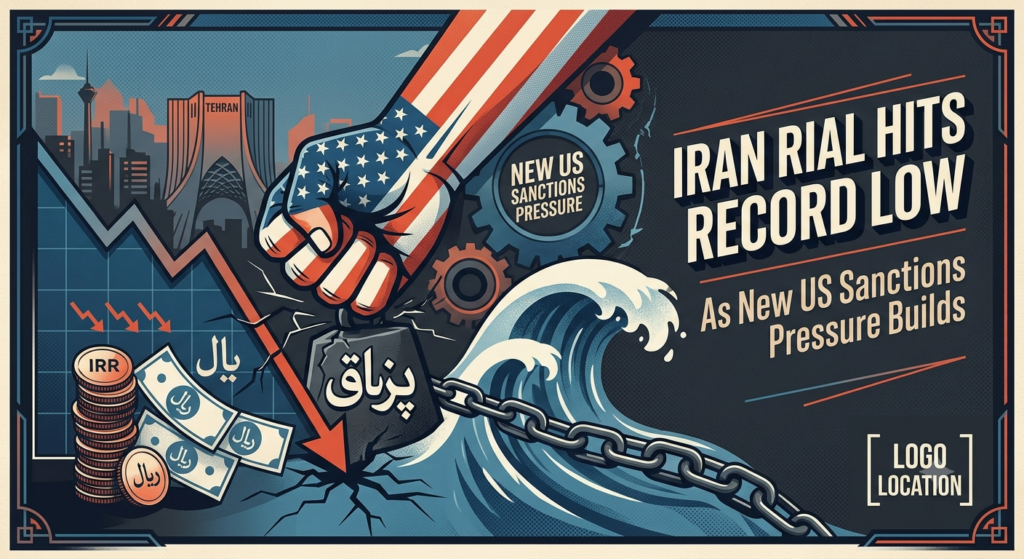
Iran’s currency has fallen to another historic low against the US dollar as renewed US sanctions pressure, prolonged economic disruption and the continuing crisis around the Strait of Hormuz intensify financial stress in Tehran.
On August 24, 2026, the Iranian rial fell to approximately 2.02 million rials per US dollar on informal currency markets, according to Associated Press reporting. Iran’s official Central Bank rate was around 1.5 million rials per dollar, highlighting the increasingly wide gap between official and market exchange rates.
The latest move marks another dramatic stage in the rial’s long-running decline. A report published by StoryChase on August 22 described the currency at around 194,000 tomans per US dollar, equivalent to roughly 1.94 million rials, in mid-July. It said the rial subsequently traded around the 190,000-toman area before approaching the 200,000-toman threshold.
The difference in terminology is important: one toman equals 10 rials. Therefore, the 194,000-toman level cited by Story Chase corresponds to approximately 1.94 million rials per dollar. The latest informal-market rate of 2.02 million rials therefore represents a further weakening.
The currency collapse comes as Washington prepares another round of sanctions against Iran, while the Strait of Hormuz remains heavily disrupted. Together, these developments are creating a difficult environment for Iran’s foreign-exchange market, oil revenues, imports and domestic purchasing power.
Iranian Rial Falls Through Another Major Psychological Level
The Iranian rial has been under pressure for years because of international sanctions, inflation, restricted access to foreign currency and structural weaknesses in the domestic economy. However, the latest decline has accelerated as geopolitical tensions have intensified.
JFeed reported on August 23 that the rial was trading at approximately 1.98 million rials per US dollar, after spending recent weeks around 1.8 million to 1.85 million.
Within a day, the informal market had moved beyond the psychologically important 2-million-rial level. AP reported that the currency opened at approximately 2.02 million rials per dollar on August 24.
For currency traders, psychological levels can become particularly important during periods of severe market stress. A move through 2 million rials per dollar does not automatically establish a new economic threshold, but it demonstrates the speed and scale of the currency’s depreciation.
The distinction between Iran’s official exchange rate and its informal market rate is also increasingly significant. While the official rate remains substantially stronger, most ordinary Iranians rely on market pricing for many transactions, meaning the informal rate can have a much greater effect on the real economy.
New US Sanctions Add to Pressure on Tehran
The latest rial decline comes ahead of a new US sanctions announcement.
US Treasury Secretary Scott Bessent has indicated that Washington is preparing a major new financial pressure campaign against Iran. Reuters reported on August 22 that Iran had condemned the planned measures, while Washington described the forthcoming sanctions as among the toughest it has imposed.
The potential impact goes beyond Iran’s government.
Sanctions can restrict the country’s ability to earn foreign currency, particularly dollars, through international trade. Restrictions on Iranian oil exports, financial transactions and companies dealing with Tehran can reduce the amount of hard currency entering the economy.
That creates a difficult cycle for the rial.
When fewer dollars are available, importers and businesses compete for limited foreign currency. Households may also seek dollars as a store of value when they expect further depreciation. Increased demand for foreign currency combined with limited supply can place additional pressure on the domestic currency.
StoryChase described a similar mechanism, arguing that sanctions affecting oil exports and access to foreign currency reserves can reduce the central bank’s ability to supply dollars to the market.
Strait of Hormuz Crisis Adds Another Layer of Risk
The currency crisis cannot be separated from the continuing disruption around the Strait of Hormuz.
The waterway is one of the world’s most important energy chokepoints. Before the current conflict, roughly one-fifth of the world’s traded oil passed through the Strait of Hormuz, according to AP reporting.
Iran continues to maintain significant control over shipping through the strategic waterway, while attacks, threats and restrictions have severely disrupted normal tanker traffic.
Reuters reported on August 18 that Iran had said the Strait would remain closed until the United States met conditions including the lifting of its blockade of Iranian ports, removal of oil sanctions and release of frozen Iranian assets.
For Iran, this creates a complicated economic trade-off.
Control over the Strait gives Tehran geopolitical leverage, particularly because of its importance to global energy markets. But prolonged disruption can also damage Iran’s own trade, imports and oil revenues.
The longer shipping remains restricted, the greater the potential pressure on businesses that depend on international trade and on the government that needs foreign currency to finance imports.
Why the Rial Is So Vulnerable
Currency depreciation is rarely caused by a single event. Iran’s latest exchange-rate crisis reflects several overlapping economic pressures.
1. Sanctions and Restricted Foreign Currency
International sanctions have limited Iran’s access to global financial markets and made international payments more difficult.
When access to foreign currency is restricted, the central bank has fewer tools available to stabilize the exchange rate.
2. Oil Revenue Pressure
Oil remains one of Iran’s most important sources of foreign currency.
Any reduction in exports, restrictions on buyers or difficulties transporting crude can reduce the inflow of dollars into the Iranian economy.
Reuters reported that the US is preparing further measures that could affect Iran and countries continuing to purchase Iranian oil.
3. Inflation
A weaker currency makes imported goods more expensive.
Iran already faces substantial inflationary pressure. Reuters reported in August that inflation had reached 66% in July, while food prices had increased sharply.
AP also reported that since the war began, rice prices had risen by roughly 60%, while beef prices had increased by more than 150%.
This illustrates the direct connection between the Forex market and household finances.
When the rial loses value against the dollar, importers generally need more rials to purchase the same amount of foreign goods. Those higher costs can eventually reach consumers.
4. Capital Flight and Dollar Demand
During periods of extreme uncertainty, businesses and households often seek assets they believe will preserve value.
In Iran’s case, demand for US dollars can increase when people expect the rial to lose further purchasing power.
That creates another feedback loop:
Rial weakness → higher dollar demand → limited dollar supply → further rial weakness.
Once expectations become deeply negative, stabilizing a currency becomes much more difficult.
Official Exchange Rate vs Informal Market
One of the most important features of Iran’s currency situation is the difference between official and informal exchange rates.
The Central Bank’s official rate was around 1.5 million rials per dollar, while the informal market reached approximately 2.02 million rials per dollar on August 24.
This gap indicates that the official rate does not fully reflect the price at which many people and businesses obtain foreign currency.
For Forex news readers, this distinction is important because the quoted exchange rate depends heavily on the market being measured.
The informal rate provides a better indication of immediate market sentiment and scarcity of foreign currency, while the official rate remains relevant for regulated transactions and government-linked pricing.
The widening gap can also create economic distortions, particularly for importers, exporters and businesses that operate across different exchange-rate systems.
What the Rial Collapse Means for Iran’s Economy
A rapidly weakening currency can affect virtually every part of an economy.
Higher Import Costs
Iranian companies that need machinery, technology, medicine, raw materials or other imported goods may have to pay significantly more in local currency.
Falling Household Purchasing Power
Workers receiving salaries in rials can see their purchasing power decline rapidly if wages fail to keep pace with inflation.
Pressure on Businesses
Companies may struggle to determine prices because replacement costs can change quickly as the currency depreciates.
Rising Demand for Hard Assets
When confidence in a domestic currency falls, households may seek alternatives such as foreign currency, gold or other stores of value.
Greater Government Pressure
A collapsing currency can make it more difficult for policymakers to maintain price stability while simultaneously funding government spending and supporting essential imports.
These factors can reinforce each other, increasing the risk of a prolonged economic downturn.
Impact on the Forex Market
Although the Iranian rial is not one of the world’s most actively traded major currencies, its collapse has broader significance for global Forex markets.
The immediate impact is through geopolitical risk, energy markets and inflation expectations.
The US dollar can benefit from increased demand for safe-haven liquidity during periods of geopolitical stress, although the broader dollar response depends on the source and scale of the risk.
Reuters reported on August 24 that the dollar index was around 98.983, while the euro was trading near $1.16655 and the dollar was around 159.2 yen.
Gold has also remained strong. Reuters reported that gold was up around 0.8% on the day at approximately $4,640 an ounce, having gained roughly 15% during August.
This combination illustrates an important relationship for Forex traders: geopolitical uncertainty can influence currencies, commodities, bonds and equities simultaneously.
Oil Markets Are Watching Iran Closely
The Strait of Hormuz crisis also makes the rial story important for oil traders.
Any prolonged disruption to shipping through the waterway can raise concerns about global energy supply.
However, oil prices were lower on August 24 as traders took profits after recent gains and waited for details of the new US sanctions. Reuters reported that oil prices fell by more than 1% ahead of Bessent’s scheduled announcement.
The market therefore faces two competing forces.
On one side, sanctions and shipping restrictions can reduce available oil supplies and increase geopolitical risk.
On the other, traders may already have priced in a substantial amount of the risk, creating opportunities for profit-taking when no additional escalation immediately occurs.
This explains why oil can sometimes fall even while geopolitical tensions remain extremely high.
Could the Rial Fall Further?
The latest move does not necessarily mean the rial has reached its final low.
The biggest question for financial markets is whether the currency can stabilize after crossing the 2-million-rial-per-dollar level or whether continued sanctions and economic disruption will push it even lower.
StoryChase highlighted 200,000 tomans per dollar, equivalent to 2 million rials, as a major threshold to monitor.
That threshold has now effectively been crossed in the latest informal-market reporting.
Further depreciation could occur if:
- US sanctions become significantly broader;
- Iran’s oil revenues decline further;
- access to foreign currency reserves becomes more restricted;
- the Strait of Hormuz remains disrupted;
- inflation continues accelerating;
- domestic confidence in the rial deteriorates;
- diplomatic negotiations fail to reduce geopolitical pressure.
On the other hand, a diplomatic breakthrough, improved access to foreign currency or an easing of sanctions could potentially reduce some of the pressure.
Global Economic Risks
The rial’s collapse is primarily an Iranian economic story, but the broader geopolitical situation has international consequences.
The Strait of Hormuz is particularly important because of its role in global oil and LNG transportation. Prolonged disruption can increase energy costs and potentially feed inflation in importing countries.
That creates a difficult situation for central banks.
If energy prices rise sharply, inflation could become more persistent even as economic growth slows. Policymakers could then face a choice between supporting growth and fighting inflation.
This is one reason Forex traders are watching developments in Iran alongside central-bank policy, bond yields and commodity markets.
Reuters reported on August 24 that global equities were under pressure while markets also monitored Iran sanctions, US monetary policy and the wider geopolitical environment.
What Forex Traders Should Watch Next
For traders following this story, several indicators will be particularly important.
US Sanctions Announcement
The details of Washington’s new measures will determine how severely Iran’s access to foreign currency and international trade could be affected.
USD/IRR Informal Rate
The informal rial market remains a critical gauge of real-time currency stress.
Oil Prices
Brent and WTI prices can provide clues about how markets are assessing the risk of prolonged disruption around Hormuz.
Gold
Gold remains a key safe-haven asset during geopolitical uncertainty and can help indicate investor demand for defensive positioning.
US Dollar Index
The broader dollar reaction will show whether the Iran crisis is generating meaningful safe-haven demand for the US currency.
Diplomatic Developments
Any progress between Washington and Tehran could quickly change expectations for sanctions, oil exports and the rial.
Iran Rial Record Low: What Comes Next?
Iran’s latest currency collapse highlights how geopolitical conflict can quickly become a currency and economic crisis.
The rial has moved beyond the 2-million-per-dollar level in informal trading, while the official exchange rate remains significantly stronger.
The currency’s weakness reflects years of sanctions and economic vulnerabilities, but the pressure has intensified amid the current conflict, restrictions on trade and the continuing disruption of the Strait of Hormuz.
New US sanctions represent the next major risk for the Iranian economy. If the measures significantly restrict oil revenues, foreign currency availability or international trade, the rial could face additional selling pressure.
For global financial markets, however, the story extends beyond Iran.
The developments around the rial are closely connected to oil prices, safe-haven demand, inflation expectations and geopolitical risk. Any major escalation around the Strait of Hormuz could quickly affect energy markets and, in turn, global currencies.
For Forex traders, the key lesson is that currency markets do not operate in isolation. Political decisions, sanctions, energy supply and investor sentiment can all combine to produce sharp moves in exchange rates.
As Washington prepares its next sanctions package and Tehran continues to resist pressure, the Iranian rial, oil prices, gold and the US dollar will remain important markets to watch.
