

Iran Suspends 10% Freight Fee as Oil Tops $100 and Hormuz Shipping Risks Persist
Iran has temporarily suspended a 10% freight charge imposed on foreign vessels carrying energy products to or from the country, according to Fars News, in a move that could reduce part of the additional cost facing international energy shippers as disruption around the Strait of Hormuz continues. The decision comes at a highly sensitive time […]
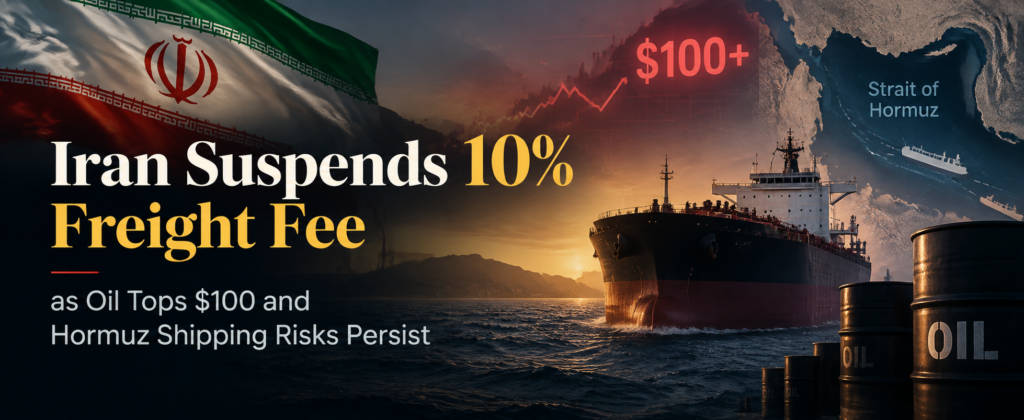
Iran has temporarily suspended a 10% freight charge imposed on foreign vessels carrying energy products to or from the country, according to Fars News, in a move that could reduce part of the additional cost facing international energy shippers as disruption around the Strait of Hormuz continues.
The decision comes at a highly sensitive time for global energy markets. Brent crude has remained above $100 a barrel, while shipping activity through the Strait of Hormuz has fallen sharply amid escalating military tensions between Iran and the United States. Reuters reported on Thursday that Brent was trading around $102 a barrel, with the benchmark having risen nearly 30% from its early-August lows.
The temporary suspension of the freight charge could therefore be viewed as an attempt to ease some of the financial pressure on foreign vessels involved in Iran-linked energy trade.
Shipping Costs Remain a Major Market Concern
The 10% charge is particularly important because freight and insurance costs have become a growing component of the cost of moving energy through the Gulf.
The Strait of Hormuz is one of the world’s most important energy shipping routes. Before the current disruption, roughly one-fifth of global oil and gas supplies moved through the waterway. With vessel movements now substantially lower, every additional fee or operational restriction can influence the economics of tanker operations.
Preliminary ship-tracking data cited by Reuters showed only seven vessel transits through Hormuz on Wednesday, down from 12 the previous day and below the 10-day average of 14. No liquefied natural gas tankers were recorded leaving the strait that day.
The reduced traffic highlights why shipping-related costs have become increasingly important for oil traders, tanker operators and energy companies.
Oil Remains Above $100
The Iranian announcement comes as the oil market is already dealing with significant supply uncertainty.
Brent crude rose to around $102.15 a barrel on Thursday, while U.S. West Texas Intermediate was near $97.50. Reuters reported that Brent has remained above $100 since September 3, reflecting concerns that prolonged disruptions could reduce the availability of crude in international markets.
The suspension of the freight charge does not remove the broader risks facing shipping companies. Security concerns, insurance costs, vessel availability and the possibility of further attacks remain important factors for companies deciding whether to transit the region.
For energy markets, the key issue is therefore not simply the 10% charge but whether shipping through Hormuz can return to more normal levels.
Energy Traders Watch Hormuz Closely
Any improvement in shipping conditions could help reduce some of the risk premium currently built into crude prices. However, continued attacks or restrictions could have the opposite effect.
Reuters reported that Iran claimed to have attacked 10 ships near the Strait of Hormuz after the United States sank five Iranian oil tankers. Iran’s Revolutionary Guard has also warned that it could escalate its response to further attacks.
This has created a difficult environment for global energy traders. Oil buyers are trying to assess whether the current disruption will be temporary or become a longer-lasting supply problem.
China is another important factor. Reuters reported that Chinese crude purchases have increased in recent weeks after a period of weaker demand. Continued buying from the world’s largest crude importer could provide additional support to prices if Gulf supply remains constrained.
Inflation and Global Markets in Focus
Higher oil and freight costs could also create broader consequences for financial markets.
Expensive crude raises transportation and production costs, potentially adding pressure to consumer inflation. That could complicate decisions for central banks that are trying to balance economic growth with price stability.
European and Asian economies could be particularly sensitive to sustained energy-price increases because higher fuel and energy costs can affect businesses, households and trade.
For investors, the Iranian decision is therefore a small but potentially relevant development within a much larger energy-market story. If the temporary freight-fee suspension encourages more foreign vessels to participate in Iran-linked energy trade, it could marginally improve shipping economics. But the bigger market question remains whether traffic through the Strait of Hormuz can recover.
For now, with Brent above $100 and vessel movements still well below normal levels, the global oil market remains highly exposed to further developments in the region.

Alexander
Alexander is a veteran of the currency markets with over 15 years of experience in institutional trading and risk management. He specializes in the intersection of macroeconomics and regulatory frameworks.
