
Iran Ready to Revive US Peace Deal if Trump Honours June Pact, Pezeshkian Says
Iranian President Masoud Pezeshkian has signalled that Tehran remains open to restoring a peace arrangement with the United States if President Donald Trump honours the commitments made under the June agreement. The statement comes as renewed military tensions between Washington and Tehran have increased geopolitical risks across the Middle East and raised concerns for global […]
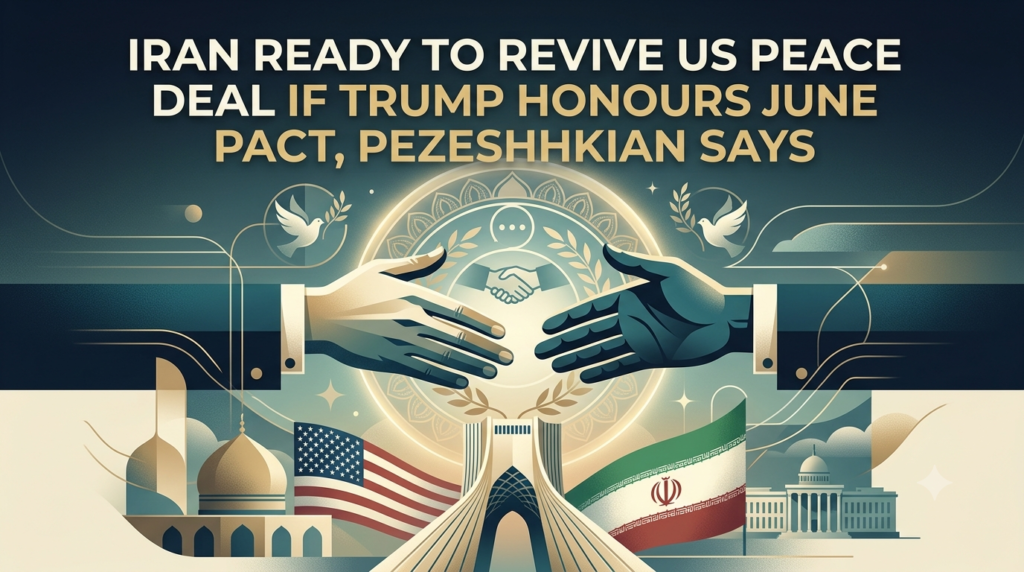
Iranian President Masoud Pezeshkian has signalled that Tehran remains open to restoring a peace arrangement with the United States if President Donald Trump honours the commitments made under the June agreement. The statement comes as renewed military tensions between Washington and Tehran have increased geopolitical risks across the Middle East and raised concerns for global financial markets.
Pezeshkian said Iran would immediately reciprocate if the United States returns to its commitments under the memorandum of understanding reached in June. The agreement was intended to reduce hostilities, support negotiations and address issues including navigation through the strategically important Strait of Hormuz. However, implementation has since deteriorated amid renewed military confrontations and disagreements over the terms of the pact.
Iran-US Tensions Raise Geopolitical Risks
The latest comments from Pezeshkian come after a fresh escalation between the United States and Iran. US forces recently struck Iranian targets on Larak Island, while Iran responded with attacks against US military bases in Jordan. The renewed confrontation has increased uncertainty over whether diplomatic efforts can prevent another prolonged escalation.
Despite the military tensions, Tehran’s latest position indicates that diplomacy remains possible. Pezeshkian has argued that continuing the conflict is not in Iran’s interests and has reiterated the country’s willingness to pursue a political solution if Washington respects the previous commitments.
The June memorandum had represented a significant diplomatic opening between the two countries. The agreement included provisions aimed at ending hostilities, reopening the Strait of Hormuz and easing restrictions that had affected Iran’s ability to export oil. The framework also provided for further negotiations over Iran’s nuclear programme.
Strait of Hormuz Remains Key for Oil Markets
For financial markets, the biggest concern is the potential impact on energy supplies. The Strait of Hormuz is one of the world’s most important oil transit routes, carrying roughly one-fifth of global oil consumption. Any prolonged disruption could put significant upward pressure on crude prices and increase inflationary risks for major economies.
Oil prices have already reacted to the latest escalation. Brent crude recently climbed above $91 per barrel, while West Texas Intermediate also moved higher as investors assessed the possibility of further supply disruptions.
Higher oil prices could also influence currencies, inflation expectations and central-bank policy. The US dollar may receive safe-haven demand during periods of heightened geopolitical uncertainty, while gold could attract additional buying from investors seeking protection against market volatility.
What It Means for Forex and Global Markets
The latest Iran-US development is therefore important beyond the Middle East. Forex traders will be watching movements in the US dollar, commodity-linked currencies and emerging-market currencies as geopolitical risks evolve.
A credible return to negotiations could reduce the geopolitical risk premium in oil and potentially support broader market sentiment. Conversely, another military escalation or prolonged restrictions around the Strait of Hormuz could push energy prices higher and increase demand for traditional safe-haven assets.
For traders and investors, Pezeshkian’s latest statement represents a potential diplomatic opening, but the situation remains highly uncertain. The key question is whether Washington and Tehran can rebuild enough trust to return to the framework agreed in June.
Until then, developments involving the US-Iran conflict, the Strait of Hormuz, oil supply and sanctions are likely to remain important drivers for Forex markets, commodities and global financial markets.
