

Oil Market in crisis: Strait of Hormuz blockage threatens global growth in 2026
The global energy market faces its most significant disruption since Russia’s 2022 invasion of Ukraine. The Strait of Hormuz—the chokepoint through which 20-21% of global crude oil flows—has been functionally disrupted since February 2026, creating unprecedented uncertainty in energy markets and threatening to derail global economic recovery. As oil prices hover near $93 per barrel […]
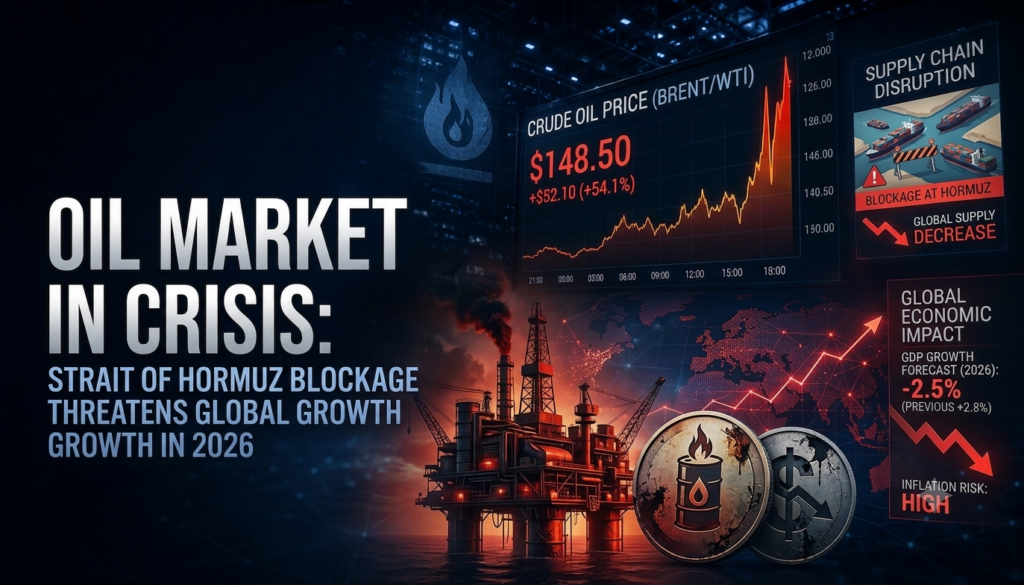
The global energy market faces its most significant disruption since Russia’s 2022 invasion of Ukraine. The Strait of Hormuz—the chokepoint through which 20-21% of global crude oil flows—has been functionally disrupted since February 2026, creating unprecedented uncertainty in energy markets and threatening to derail global economic recovery. As oil prices hover near $93 per barrel for Brent crude, traders and policymakers grapple with a crisis that could reshape geopolitics and energy markets for years to come.
THE STRAIT OF HORMUZ: WORLD’S MOST CRITICAL CHOKEPOINT
The Strait of Hormuz, a 21-mile-wide waterway between Iran and Oman, is arguably the world’s most strategically important passageway. Approximately 21 million barrels of crude oil flow through this narrow strait daily—roughly 20-21% of global petroleum supply. For comparison, the Panama Canal moves approximately 5% of global trade, yet receives far more international attention.
This concentration of global energy flows through a single, geographically limited chokepoint creates structural vulnerability. Any disruption—whether caused by military conflict, terrorism, or environmental catastrophe—can instantly reduce global oil supply by a fifth, triggering economic shocks across every nation dependent on oil imports.
In February 2026, this vulnerability became reality. Following escalating tensions between the United States and Iran, military activities in the region made transit through the Strait extremely hazardous. While official tanker shipping statistics showed some throughput continuing, shipping companies began routing oil around Africa (via the Cape of Good Hope), adding 4-6 weeks to transit times and dramatically increasing transportation costs.
CURRENT MARKET CONDITIONS: AUGUST 2026
As of mid-August 2026, the Strait of Hormuz remains functionally disrupted, though oil prices have not reached the catastrophic levels many feared. The reason lies in a complex interplay of factors:
Current Oil Pricing (August 19-20, 2026):
- Brent Crude: $91.19-$93.60 per barrel
- WTI Crude: $85.34-$86.16 per barrel
- 30-Day Change: +2.15% (modest rise)
- Year-over-Year Change: +35.64% (significant elevation)
Why Prices Haven’t Spiked Higher:
The puzzle of the 2026 oil crisis is why crude prices haven’t matched the supply shock’s severity. Several factors explain this apparent disconnect:
- Strategic Petroleum Reserves (SPR) Drawdowns: Major oil-importing nations, particularly the United States, have released oil from strategic reserves to supplement supply and moderate price increases. The U.S. SPR has declined significantly, but sustained releases have offset some supply loss.
- Alternative Shipping Routes: While routing around Africa adds cost and time, Saudi Arabia and UAE have developed sophisticated “discreet shipment” programs, moving crude through alternative channels including:
- Direct Middle East-to-US tanker shipments avoiding Hormuz
- Forward contracts pre-positioning oil in safer locations
- Smaller tanker convoys reducing detection/targeting risks
- Demand Destruction: Higher oil prices have reduced demand, particularly in price-sensitive emerging markets. High energy costs are dampening economic activity precisely where growth was most needed, creating an unfortunate trade-off.
- Inventory Normalization: Following global stockpiling during early COVID pandemic, oil inventories had been elevated.
The disruption has consumed excess inventory, but recent data shows inventory rebuilding as supply stabilizes.
GEOPOLITICAL ESCALATION AND CURRENT TENSIONS
The situation in August 2026 remains volatile and could escalate dramatically. Recent developments include:
U.S.-Iran Tensions:
- President Trump has stated he is “not interested” in extending interim peace deals with Iran, dramatically reducing negotiation possibilities
- Trump administration has threatened “economic isolation” of Iran and made threats toward Oman if it facilitates Iranian shipping
- Three U.S. Navy carrier strike groups maintain presence in the region, maintaining military pressure
Iran’s Response:
- Iranian officials have threatened to shift from “defensive” to “offensive” policy if U.S.-Iran diplomacy fails
- Iran has threatened escalated activities in the Strait and broader Middle East
- Reports of Iranian missile attacks on shipping and UAE targets add to tension
UAE Position:
- UAE announced suspension of all financial and economic transactions with Iran following Iranian ballistic missile strikes
- UAE diplomatic isolation of Iran removes a potential moderating influence
- Gulf Cooperation Council (GCC) states broadly aligning with U.S. positions
Houthi Attacks:
- Yemen’s Houthi militants (Iran-backed) claimed responsibility for striking Saudi Arabian tankers
- Red Sea shipping corridor faces elevated risk from Houthi drone and missile attacks
- Insurance costs for Red Sea transit have increased dramatically
ENERGY INFORMATION ADMINISTRATION FORECAST
The U.S. Energy Information Administration released updated forecasts on August 11, 2026, projecting a prolonged supply disruption:
EIA Supply Estimates:
- Middle East shut-in production: Increased estimates compared to July forecast
- Strait of Hormuz transit constraints: Expected to persist through August
- Production return timeline: Most crude production expected to return to near pre-conflict averages by early 2027
- Ongoing disruption: ~0.6 million barrels per day loss expected to continue through end of 2027
Global Oil Inventory Impact:
- Reduced shipments through Strait of Hormuz: Lower global inventories in coming months
- Crude oil prices: Expected to remain near August 2026 levels (around $85-95/barrel)
- Refinery activity: U.S. refineries operating at highest capacity levels since September 2019
ECONOMIC IMPACT: GROWTH THREATS AND INFLATION PRESSURES
The oil market disruption creates severe headwinds for global economic growth:
World Bank Assessment (August 2026): The World Bank has downgraded global growth forecasts, specifically citing the Middle East conflict and energy price pressures. Key impacts include:
- Global Growth Slowdown: Projected growth declining to 2.5% in 2026 (vs. 3.0-3.4% in base case forecasts)
- Emerging Market Impact: Emerging market and developing economies facing weakest per capita income growth since the pandemic
- Inflation Persistence: Central banks facing reduced flexibility to cut rates as energy inflation remains elevated
- Low-Income Country Risk: LIC growth expected at 5.4% (down 0.3 percentage points), with Ebola outbreak adding downside risks
Inflation and Monetary Policy Consequences:
Energy prices drive inflation throughout the economy. When crude oil prices rise:
- Gasoline and diesel prices increase at the pump
- Heating costs rise (particularly important as winter approaches)
- Transportation costs increase, raising prices for shipped goods
- Petrochemical and plastic prices rise, affecting manufacturing costs across industries
Central banks facing inflation pressures have limited policy tools. The Federal Reserve, facing elevated inflation from energy shocks, has maintained interest rates at 3.50%-3.75%, with three FOMC members voting for even higher rates at the July 2026 meeting. This restrictive policy stance dampens economic growth precisely when growth is needed most.
SECTORAL IMPACT: WINNERS AND LOSERS
The oil price elevation creates clear winners and losers:
Energy Sector Winners:
- Oil majors (ExxonMobil, Shell, Saudi Aramco) benefit from higher crude prices
- Smaller explorers suddenly become profitable at elevated price points
- U.S. shale producers (previously pressured by lower prices) return to profitability
- Energy infrastructure companies (pipelines, refineries) see increased throughput and profits
Energy Importer Losers:
- Airlines face elevated jet fuel costs, pressuring margins
- Shipping companies (other than oil tanker operators) face higher fuel surcharges
- Consumer goods companies see increased distribution costs
- Transportation-dependent businesses struggle with elevated costs
Emerging Market Vulnerability:
- Oil-importing emerging markets suffer most, as energy imports drain foreign reserves
- Countries like India, Indonesia, Philippines heavily dependent on imported oil
- Currency depreciation follows energy price spikes, importing inflation
- Government budgets strained by energy subsidies to protect low-income consumers
STRATEGIC PETROLEUM RESERVE DEPLETION RISKS
The U.S. and other nations have drawn strategic reserves to moderate prices and maintain supply. However, SPR drawdowns cannot continue indefinitely:
- U.S. SPR depleted from ~650 million barrels (historical average) to lower levels
- Refilling SPR would require purchasing oil at current high prices
- Political pressure to maintain SPR for true emergencies
- SPR serves as insurance policy for future crises (potential higher prices ahead)
GLOBAL ENERGY MARKET OUTLOOK: 2026-2027
World Bank Commodity Markets Outlook:
- Energy prices forecast to surge 24% in 2026 (highest since 2022)
- Natural gas prices particularly volatile (European natural gas +19.1% in July)
- Coal prices declining (-4.8%), partially offsetting crude gains
- Long-term outlook: Energy transition and renewables deployment accelerating
Oil Price Scenarios for Rest of 2026:
- Base Case ($85-95/barrel): Hormuz remains disrupted but alternative supply channels manage most demand
- Optimistic Case ($75-85/barrel): Diplomacy progress or U.S.-Iran agreement restores partial Hormuz throughput
- Pessimistic Case ($100-120/barrel): Escalation or major attack on Gulf production facilities
POLICY RESPONSES AND MITIGATION STRATEGIES
Governments and institutions are implementing several responses:
- SPR Releases: Strategic reserves release to moderate prices
- Diplomatic Engagement: Attempts to broker U.S.-Iran agreements to restore Hormuz transit
- Alternative Supply: Increased exploration and production in non-Middle East regions
- Energy Efficiency: Government programs promoting energy conservation
- Renewable Acceleration: Climate transition accelerated by supply security concerns
CONCLUSION: AN ENERGY CRISIS RESHAPING GLOBAL ECONOMICS
The Strait of Hormuz disruption in 2026 represents one of the most significant geopolitical risks to global economic stability. Unlike the COVID pandemic (a temporary shock) or the 2008 financial crisis (primarily financial), energy supply constraints directly affect every economy’s ability to function. As long as the Strait remains disrupted and tensions remain elevated, global growth will face persistent headwinds, inflation will remain elevated, and emerging markets will face particular stress.
The crisis underscore a critical vulnerability in global energy markets: excessive concentration of supply through a single chokepoint. The long-term solution lies in accelerating energy transition, developing alternative energy sources, and reducing dependency on Middle East oil. In 2026, however, these strategic shifts remain years away, leaving the global economy exposed to continued energy market volatility.
