

Trump’s Canada Tariff War: Why America Can’t Easily Untangle $880 Billion in Trade
The U.S.-Canada trade relationship has entered a dangerous new phase after negotiations collapsed and Washington imposed fresh tariffs on Canadian imports. The dispute is significant not simply because of the size of the new duties, but because the two economies are deeply integrated across manufacturing, energy, agriculture and supply chains. The United States and Canada […]
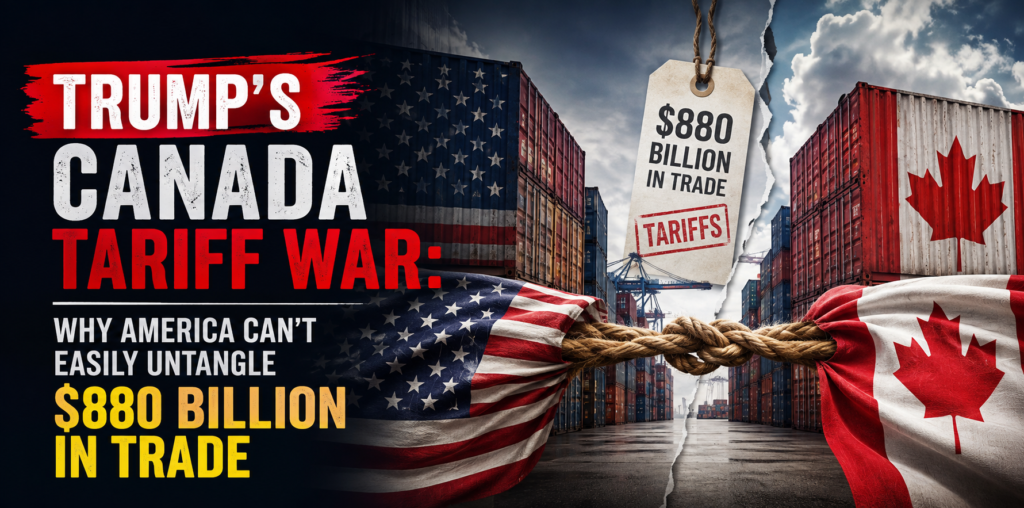
The U.S.-Canada trade relationship has entered a dangerous new phase after negotiations collapsed and Washington imposed fresh tariffs on Canadian imports. The dispute is significant not simply because of the size of the new duties, but because the two economies are deeply integrated across manufacturing, energy, agriculture and supply chains.
The United States and Canada exchanged approximately $880 billion in goods and services in 2025, making the relationship one of the most important bilateral economic partnerships in the world. Canada also sends roughly 72% of its goods exports to the United States.
U.S.-Canada Trade War Escalates After Talks Collapse
President Donald Trump’s administration has imposed 50% tariffs on around $20 billion of Canadian goods, covering products ranging from steel-related goods to consumer and industrial products. Canada has responded with plans for dollar-for-dollar retaliation, with its measures scheduled to begin on September 8.
The latest escalation followed the collapse of negotiations in Washington. Both sides blamed the other for the breakdown, while Canadian Prime Minister Mark Carney argued that some U.S. demands threatened Canadian industries and economic sovereignty.
The dispute has also complicated the future of the USMCA, the North American trade agreement that links the United States, Canada and Mexico. The agreement has helped create highly integrated supply chains, particularly in the automotive, manufacturing and agricultural sectors.
Why America Cannot Easily Replace Canadian Trade
The scale of bilateral commerce makes a rapid economic separation difficult. Canadian energy supplies are particularly important to parts of the United States, while American manufacturers rely on Canadian steel, aluminum, minerals and other industrial inputs.
U.S. farmers also depend on Canadian potash, a major fertilizer input, while refineries in the American Midwest rely heavily on Canadian crude oil. Border communities and businesses are similarly connected through daily cross-border commerce.
This means tariffs can create costs for American companies as well as Canadian exporters. Importers may face higher input costs, which can eventually be passed on to businesses and consumers through higher prices.
The automotive industry presents another major challenge. North American vehicle production depends on components crossing the U.S.-Canada border multiple times before a finished vehicle reaches consumers. Disrupting these supply chains could therefore increase production costs and reduce competitiveness.
Canada Retaliation Could Increase Economic Pressure
Canada’s planned retaliation adds another layer of uncertainty. Tariffs on U.S. steel, dairy products, appliances, agricultural equipment, pulp and paper, and electronics could affect American exporters while increasing costs for Canadian businesses and households.
The wider concern is that a prolonged dispute could damage business confidence and investment. Economists have warned that sustained tariffs could increase inflationary pressure in both economies, complicating monetary-policy decisions and potentially affecting interest-rate expectations.
Geopolitical Risks Extend Beyond Trade
The conflict is also becoming a broader geopolitical issue. For decades, Washington and Ottawa have maintained exceptionally close economic and security ties. The latest confrontation risks weakening that relationship and encouraging Canada to diversify its trading partners.
Bloomberg Law notes that the breakdown in negotiations has already pushed the two countries toward a more difficult and potentially prolonged trade confrontation.
For global markets, the dispute is therefore more than a bilateral tariff issue. It could influence the U.S. dollar, Canadian dollar, commodities, equities and inflation expectations if supply-chain disruptions intensify.
What Happens Next?
Despite the aggressive rhetoric, neither side has an easy path to complete economic separation. The enormous volume of trade, integrated production networks and dependence on critical resources create powerful incentives to return to negotiations.
For investors following Forex News, financial news today and geopolitical news, the key issue will be whether the dispute remains limited to selected products or develops into a broader tariff confrontation.
The $880 billion trade relationship means that prolonged escalation could eventually impose costs on American consumers and companies as well as Canada. That economic interdependence may ultimately become the strongest incentive for both governments to find a negotiated solution.
