

Trump Says Canada Wants ‘Benefits’ of Being a US State After Trade Talks Collapse
US-Canada trade relations have entered a new period of uncertainty after trade negotiations between Washington and Ottawa collapsed, prompting President Donald Trump to accuse Canada of seeking the economic benefits of being a US state without actually becoming one. Trump’s comments came after negotiations broke down on August 21, 2026, with both countries blaming the […]
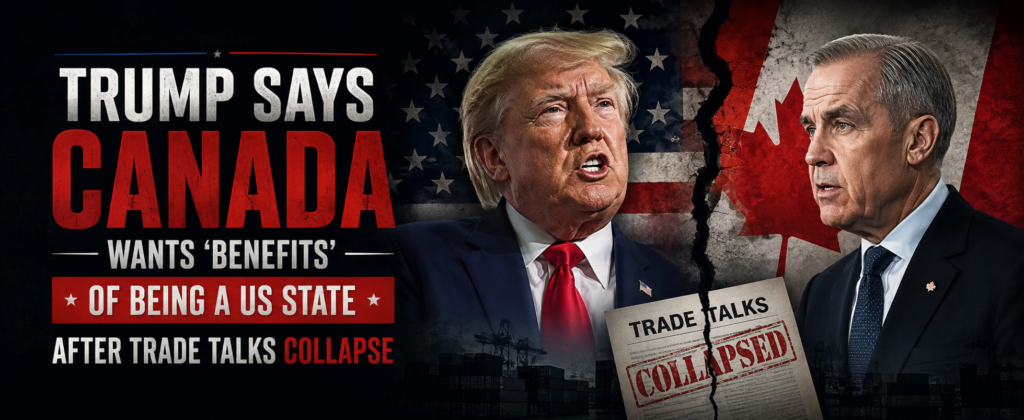
US-Canada trade relations have entered a new period of uncertainty after trade negotiations between Washington and Ottawa collapsed, prompting President Donald Trump to accuse Canada of seeking the economic benefits of being a US state without actually becoming one.
Trump’s comments came after negotiations broke down on August 21, 2026, with both countries blaming the other side for the failure to reach an agreement. The collapse has triggered a fresh escalation in tariffs and raised concerns about the outlook for North American trade, economic growth and currency markets.
For forex traders, the latest dispute is particularly important because Canada and the United States maintain one of the world’s most closely integrated trading relationships. Any significant deterioration in bilateral trade can affect expectations for Canadian economic growth, inflation, interest rates and the Canadian dollar. The USD/CAD currency pair is therefore likely to remain sensitive to developments surrounding tariffs, negotiations and economic policy.
The dispute also comes at a time when global markets are already dealing with elevated geopolitical and economic uncertainty. Investors are watching whether the latest tariff escalation remains limited or develops into a broader and longer-lasting trade conflict.
What Happened in the US-Canada Trade Talks?
The latest round of negotiations between the United States and Canada had initially generated hopes that the two countries could reach a compromise. Those expectations deteriorated as the deadline approached.
According to reports, negotiations collapsed late on August 21 after disagreements over the details of a potential agreement. Canadian officials argued that Washington introduced unacceptable last-minute demands, while US officials blamed Canada for changing its position during the negotiations.
The disagreement has now moved beyond negotiations and into a new tariff confrontation.
The United States has imposed 50% tariffs affecting approximately $20 billion worth of Canadian goods, while Canada has announced retaliatory measures that are scheduled to take effect on September 8. Canadian measures are expected to target a range of US products and industries.
The development has raised concerns about a broader trade war between the two North American economies.
Trump Revives the ‘51st State’ Argument
Following the collapse of negotiations, Trump accused Canada of wanting the advantages of closer economic integration with the United States while maintaining complete political independence.
His comments effectively revived his previous rhetoric describing Canada as a potential “51st state.”
Trump’s latest argument reflects a broader view within his administration that the United States has provided Canada with significant access to the American market while, in Washington’s view, receiving fewer corresponding benefits.
The rhetoric is politically sensitive because Canada’s sovereignty and independence have become central issues in the country’s response to Trump’s trade policies.
Canadian Prime Minister Mark Carney has rejected the idea that Canada should accept economic conditions that compromise its ability to make independent trade and economic decisions. The dispute therefore involves more than tariffs: it is increasingly becoming a debate over economic sovereignty and Canada’s long-term relationship with its largest trading partner.
Why the Trade Dispute Matters to Financial Markets
The United States and Canada have deeply interconnected economies. Canada sends a large share of its exports to the United States, meaning a prolonged deterioration in trade conditions could have a meaningful impact on Canadian companies, exporters, consumers and economic growth.
The currency market is particularly sensitive to these developments.
The Canadian dollar, commonly known as the loonie, can react to expectations surrounding Canada’s economic outlook. If investors believe that tariffs will significantly reduce Canadian exports and economic activity, expectations for Canadian interest rates may change.
That can influence the USD/CAD exchange rate.
A weaker Canadian economic outlook could increase demand for the US dollar against the Canadian dollar, potentially pushing USD/CAD higher. However, currency markets do not move in a straight line. Oil prices, US economic data, Federal Reserve policy, Bank of Canada policy and broader risk sentiment can all influence the pair.
This makes the latest dispute an important development for traders following Forex News and FX News.
Impact on USD/CAD
The USD/CAD pair is likely to remain one of the most closely watched currency crosses as the trade dispute develops.
A prolonged trade conflict could put pressure on the Canadian dollar through several channels.
1. Lower Canadian Export Demand
Canada relies heavily on access to the US market. Higher tariffs can make Canadian goods more expensive for American buyers and potentially reduce demand.
If Canadian exporters experience weaker sales, investors may lower their expectations for Canadian economic growth.
That could put downward pressure on the Canadian dollar.
2. Inflationary Pressure
Tariffs can increase the cost of imported goods. If businesses pass those higher costs on to consumers, inflationary pressure can increase.
This creates a complicated situation for the Bank of Canada.
If economic growth weakens while inflation rises, policymakers could face a difficult choice between supporting growth and controlling inflation.
3. Interest Rate Expectations
Currency markets are highly sensitive to interest-rate expectations.
If traders expect the Bank of Canada to respond to weaker growth by adopting a more accommodative monetary policy, the Canadian dollar could face additional pressure.
Conversely, persistent inflation could limit the central bank’s ability to ease policy aggressively.
4. Risk Sentiment
Trade disputes often increase market uncertainty.
When investors become more cautious, capital can move toward perceived safe-haven assets, including the US dollar and US government securities.
This can potentially provide additional support to USD/CAD.
Canada Announces Retaliatory Tariffs
Canada has responded to the latest US measures with plans for reciprocal tariffs.
Reports indicate that Ottawa intends to impose dollar-for-dollar tariffs beginning September 8, targeting products including steel, dairy and other US goods.
The Canadian government’s response is designed to demonstrate that Ottawa is unwilling to accept unilateral economic pressure.
However, retaliation also carries economic risks.
Higher tariffs can increase costs for businesses and consumers on both sides of the border. If companies are unable to absorb the additional costs, they may pass them on through higher prices.
That creates the possibility of a difficult combination of slower growth and higher inflation.
Why the Canadian Dollar Is Important for Forex Traders
The Canadian dollar is considered a commodity-linked currency because Canada’s economy is heavily connected to natural resources and energy exports.
Oil prices are especially important.
Canada is a major oil producer and exporter, while the United States remains an important destination for Canadian energy exports. Therefore, movements in crude oil prices can influence the Canadian dollar.
This creates an interesting dynamic during the current trade dispute.
If trade tensions weaken Canadian economic expectations but oil prices rise strongly, the Canadian dollar could receive some support from stronger energy revenues.
If both Canadian growth expectations and oil prices weaken, pressure on the Canadian dollar could become more pronounced.
Forex traders therefore need to monitor both the political developments surrounding tariffs and the broader commodity market.
US Dollar Could Benefit From Safe-Haven Demand
The US dollar may receive support if investors view the growing trade dispute as a threat to global economic stability.
The dollar remains the world’s dominant reserve currency and often benefits when investors become more risk-averse.
However, the effect is not guaranteed.
A prolonged trade war could also create economic costs for the United States. Higher import prices, weaker corporate investment and reduced international trade could eventually affect US growth expectations.
The impact on the dollar will therefore depend on how markets assess the relative economic damage to the US and Canada.
Trade War Could Increase Market Volatility
For forex traders, one of the most immediate consequences of the dispute could be increased volatility.
Currency markets react quickly to political headlines, particularly when those headlines involve tariffs or major trading relationships.
Statements from Trump, Carney, US trade officials and Canadian policymakers could generate sharp intraday movements in USD/CAD.
Traders should therefore be cautious about assuming that a single headline will establish a long-term trend.
The market may react differently depending on whether the news indicates:
- Higher tariffs
- Lower tariffs
- New negotiations
- Retaliatory measures
- Delays in implementation
- Exemptions for specific industries
- A broader US trade policy shift
- Signs of economic weakness
- Changes in Federal Reserve or Bank of Canada expectations
What Does the Dispute Mean for the North American Economy?
The US and Canadian economies are deeply connected through manufacturing, energy, agriculture, transportation and supply chains.
A prolonged tariff dispute could disrupt these relationships.
Canadian companies that depend on US customers may face higher costs and weaker demand. US companies that rely on Canadian inputs could also experience increased expenses.
Industries such as automotive manufacturing are particularly exposed because production chains frequently cross the US-Canada border.
Agriculture and energy are also important areas of concern.
The economic consequences may therefore extend well beyond the value of the goods directly affected by the latest tariffs.
USMCA and the Future of North American Trade
The dispute also raises broader questions about the future of the North American trading framework.
The United States-Mexico-Canada Agreement, or USMCA, provides the foundation for a large portion of regional trade.
If tensions continue to rise, companies may become less confident about the stability of North American supply chains.
Businesses could begin reviewing alternative suppliers, production locations and export markets.
That process could have long-term consequences even if the current dispute is eventually resolved.
For financial markets, the key question is therefore not simply whether tariffs remain in place for several weeks.
The bigger question is whether companies begin to view the US-Canada commercial relationship as structurally less predictable.
What Forex Traders Should Watch Next
The next stage of the dispute will be particularly important for currency traders.
Several developments could influence USD/CAD and the broader FX market.
US Tariff Policy
Traders should monitor whether Washington maintains the newly imposed 50% tariffs, increases them or offers exemptions.
Any indication of a softer US position could trigger a rapid repricing in the Canadian dollar.
Canadian Retaliation
Canada’s planned retaliatory measures will also be closely watched.
If Ottawa implements the announced tariffs without further negotiation, markets could interpret the move as evidence that the dispute will become more prolonged.
US-Canada Negotiations
A return to negotiations could reduce uncertainty.
However, after the latest collapse, traders may require evidence of concrete progress rather than relying on political statements.
Bank of Canada Policy
The Bank of Canada’s response will be critical.
Weak growth could increase expectations for monetary easing, while tariff-related inflation could complicate the policy outlook.
Federal Reserve Policy
The Federal Reserve remains another major driver of USD/CAD.
Even if Canada-specific risks increase, changes in US interest-rate expectations can have a significant influence on the currency pair.
Oil Prices
Because of Canada’s exposure to energy markets, crude oil prices remain an important variable.
A sharp rise or fall in oil prices could amplify or offset the impact of trade developments.
Potential Scenarios for USD/CAD
There are several possible outcomes for the Canadian dollar.
Scenario 1: Trade Tensions Escalate
If the United States increases tariffs and Canada responds with additional retaliatory measures, investors could become increasingly concerned about Canadian economic growth.
Under this scenario, USD/CAD could face upward pressure as the Canadian dollar weakens.
Scenario 2: Negotiations Resume
If Washington and Ottawa return to negotiations and signal a willingness to compromise, market uncertainty could decline.
That could support the Canadian dollar and potentially push USD/CAD lower.
Scenario 3: Economic Damage Becomes Clear
If tariffs begin to significantly affect Canadian businesses, employment or consumer activity, expectations for Bank of Canada policy could change.
The Canadian dollar could remain under pressure even if political rhetoric becomes less aggressive.
Scenario 4: Oil Prices Rise Sharply
A significant increase in crude oil prices could provide support for Canada’s external income and the Canadian dollar.
This could partially offset the negative impact of tariffs.
Broader FX Market Implications
The US-Canada dispute should not be viewed in isolation.
It is part of a broader environment in which investors are increasingly focused on tariffs, protectionism and changes to global trade relationships.
Trade policy can influence currencies because it affects economic growth, inflation, capital flows and central-bank decisions.
For traders following FX News, the current situation is therefore important beyond USD/CAD.
A deterioration in US-Canada relations could influence risk sentiment across global markets. If investors begin to expect wider trade restrictions, other commodity currencies and emerging-market currencies could also experience volatility.
The Australian dollar, New Zealand dollar and other trade-sensitive currencies may respond to changes in global growth expectations, although their reaction will depend on the broader economic environment.
Why This Is Important for Forex News
The latest Trump-Canada dispute demonstrates why political news has become increasingly important for forex traders.
A political statement can quickly alter expectations about:
- Trade flows
- Inflation
- Economic growth
- Interest rates
- Central-bank policy
- Commodity demand
- Investor risk appetite
- Currency valuations
This is why professional traders frequently monitor geopolitical developments alongside traditional economic indicators.
A trader focusing only on technical charts may miss the fundamental catalyst behind a sudden currency movement.
Conclusion
The collapse of US-Canada trade talks marks a significant escalation in relations between two of North America’s most economically connected countries.
President Donald Trump’s claim that Canada wants the benefits of being a US state without becoming one has added a political dimension to an already serious economic dispute. Meanwhile, the United States has imposed new 50% tariffs on approximately $20 billion worth of Canadian goods, and Canada has announced retaliatory tariffs beginning September 8.
For the forex market, the most important consequence may be increased uncertainty around the Canadian economic outlook.
USD/CAD traders should closely monitor tariff announcements, negotiations between Washington and Ottawa, Bank of Canada policy expectations, Federal Reserve decisions, oil prices and broader market risk sentiment.
The ultimate direction of the Canadian dollar will depend not only on the political rhetoric coming from Washington and Ottawa, but also on how businesses, consumers and central banks respond to the economic consequences of the dispute.
For now, the US-Canada trade conflict remains a major story for Forex News, FX News and currency-market traders, with the potential to create significant volatility in USD/CAD and broader financial markets.
