

Trump Vows to Hit Iran ‘Hard’ as Fighting Resumes, Oil Prices Rise on Hormuz Risk
WASHINGTON: U.S. President Donald Trump has vowed to hit Iran “hard” after American and Iranian forces exchanged fire for the first time in weeks, sharply raising concerns over a renewed escalation in the Middle East and its potential impact on global energy markets. The latest confrontation began after U.S. forces struck two Iranian rocket launchers […]
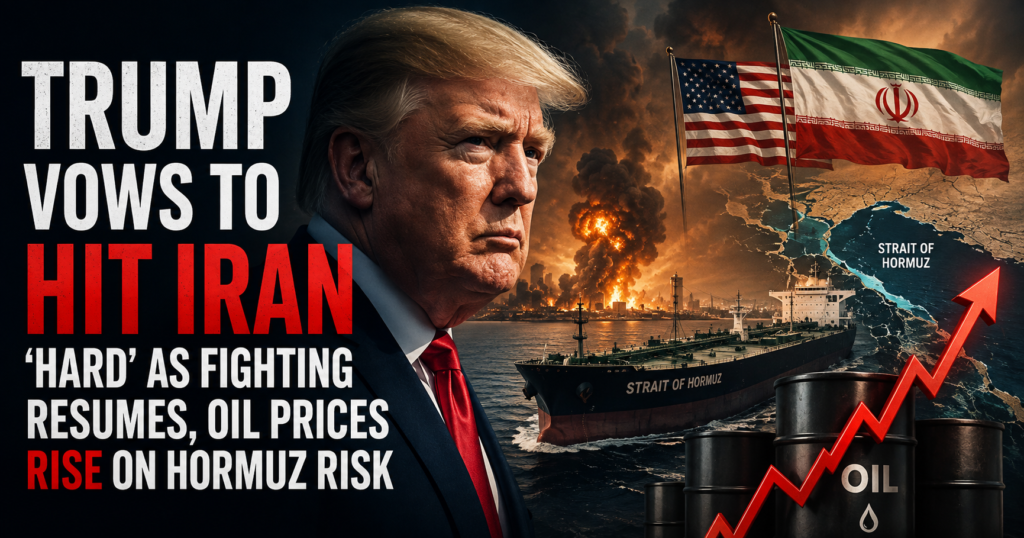
WASHINGTON: U.S. President Donald Trump has vowed to hit Iran “hard” after American and Iranian forces exchanged fire for the first time in weeks, sharply raising concerns over a renewed escalation in the Middle East and its potential impact on global energy markets.
The latest confrontation began after U.S. forces struck two Iranian rocket launchers on Larak Island in the Strait of Hormuz. Iran subsequently retaliated by targeting U.S. military positions in the region, according to reports. The exchange represents the first known direct U.S. strikes against Iran since late July and has renewed fears that the conflict could disrupt one of the world’s most important oil shipping routes.
Trump Warns Iran of Further Military Action
Trump said the United States would respond forcefully following the Iranian attacks. His warning came as Washington continued to increase economic pressure on Tehran through sanctions while military tensions also began to rise again.
The latest escalation follows weeks of relative calm between the two sides. U.S. officials said the strikes on Larak Island targeted Iranian launchers that were preparing to fire rockets toward the Strait of Hormuz. Iran, meanwhile, reported attacks against U.S. bases in Jordan, while the United Arab Emirates said it responded to a drone over its waters.
The renewed fighting creates another challenge for efforts to contain the conflict. Iranian President Masoud Pezeshkian has said Tehran wants the war to end and has expressed interest in negotiations, but the latest military exchange could make diplomacy more difficult.
Kharg Island Threat Adds to Oil Market Concerns
Markets were also unsettled after Trump posted an AI-generated video appearing to show Iran’s major oil hub at Kharg Island being destroyed. However, there was no evidence that Kharg Island had actually been attacked.
Vice President JD Vance later said Trump was using the post to send a message to Iran rather than announcing a military operation. A U.S. official also confirmed that Kharg Island was not targeted during the overnight strikes.
The distinction is important for energy markets because Kharg Island is a critical Iranian oil-export hub. Reuters reported that the facility handled about 90% of Iran’s oil exports before the conflict began. Any confirmed attack on the island could therefore have a much larger impact on Iran’s ability to export crude.
Oil Prices Rise as Strait of Hormuz Risk Returns
Oil prices reacted quickly to the renewed military activity. Brent crude moved above $90 a barrel, while West Texas Intermediate also gained as traders assessed the possibility of further supply disruptions. Reuters reported that renewed strikes and concerns about oil flows through the region pushed prices higher.
The Strait of Hormuz is particularly important because disruption in the waterway could affect global energy supplies and shipping costs. Any prolonged military confrontation could therefore increase the geopolitical risk premium embedded in crude prices.
For financial markets, higher oil prices could also increase inflation concerns and complicate expectations for central-bank interest-rate policy.
What It Means for Forex, Gold and Global Markets
The latest U.S.-Iran escalation could create greater volatility across forex, commodities and global equities.
The U.S. dollar may receive safe-haven demand during periods of heightened geopolitical uncertainty, while gold could remain supported as investors seek defensive assets. At the same time, currencies and economies that are highly sensitive to energy prices could face additional volatility if crude prices remain elevated.
Forex traders will be watching USD/JPY, EUR/USD and USD/CAD, along with crude oil and gold, for signs of a broader risk-off move.
The key question for markets now is whether the latest exchange of fire remains limited or develops into a wider confrontation. Any further U.S. strikes, Iranian retaliation or disruption around the Strait of Hormuz could quickly increase pressure on oil prices and global financial markets.
For The Finance Chronicles, this story should be positioned as both a geopolitical breaking-news development and a market-moving event, with particular focus on oil, gold, the U.S. dollar and forex volatility.
