

Trump says Iran’s Kharg is being ‘blown to smithereens’, but gives no details
U.S. President Donald Trump has claimed that Iran’s strategically important Kharg Island is being “blown to smithereens,” adding fresh uncertainty to an already tense situation between Washington and Tehran. However, Trump provided no details or evidence to confirm that the Iranian oil hub was under attack, while U.S. and Iranian officials had not immediately verified […]
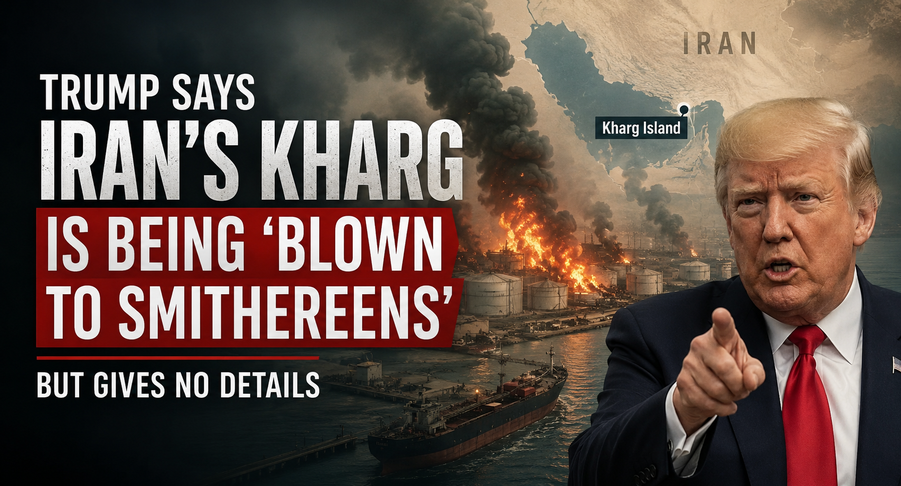
U.S. President Donald Trump has claimed that Iran’s strategically important Kharg Island is being “blown to smithereens,” adding fresh uncertainty to an already tense situation between Washington and Tehran. However, Trump provided no details or evidence to confirm that the Iranian oil hub was under attack, while U.S. and Iranian officials had not immediately verified the claim.
The statement came after renewed military exchanges between the United States and Iran, raising concerns about further escalation in the Middle East and its potential impact on energy markets, currencies and global financial markets.
Trump’s Kharg Island Claim Remains Unconfirmed
Trump posted the statement on social media alongside a video showing explosions at what was presented as Kharg Island. Reuters reported that the video appeared to be AI-generated and found no independent evidence that the Iranian energy hub was actually being attacked at the time of the post.
The lack of confirmation is particularly significant because Kharg Island is one of Iran’s most important energy assets. Before the war began, the island handled around 90% of Iran’s oil exports, making it a critical component of the country’s energy infrastructure. Any substantial damage to the facility could therefore have major consequences for Iran’s ability to export crude oil.
US-Iran Military Tensions Rise Around the Strait of Hormuz
The latest development follows U.S. strikes on two Iranian rocket launchers on Larak Island near the Strait of Hormuz. According to U.S. Central Command, the launchers were preparing to support the deployment of sea mines that could threaten international shipping.
Iran subsequently retaliated with missile attacks targeting U.S. military positions in Jordan. The renewed exchange represents a significant escalation after a period of comparatively reduced military activity.
The Strait of Hormuz remains at the centre of the geopolitical risk because it is one of the world’s most important energy shipping routes. Rising military tensions in the area have already affected commercial shipping activity, with some vessels reducing or disabling tracking signals amid security concerns.
Oil Prices and Global Markets Face Fresh Risks
The possibility of further disruption around Iran’s oil infrastructure and the Strait of Hormuz is closely watched by financial markets. Brent crude rose more than 2% on Monday as investors responded to the latest U.S.-Iran escalation and concerns over energy supplies.
A prolonged disruption could increase crude oil prices and reinforce inflationary pressures in major economies. Higher energy costs can influence central-bank interest-rate expectations, potentially affecting the U.S. dollar, Japanese yen, euro and other major currencies.
For forex traders, developments surrounding the conflict therefore remain an important source of volatility. Safe-haven demand could support currencies such as the U.S. dollar and Japanese yen, while higher oil prices could create different effects across oil-importing and oil-exporting economies.
US Sanctions Add to Economic Pressure on Iran
Military tensions are also being accompanied by increased economic pressure. U.S. Treasury Secretary Scott Bessent has indicated that Washington is expanding secondary sanctions against Iranian-linked financial institutions.
The administration is targeting banks and entities that assist Iran, potentially increasing pressure on companies and financial institutions that maintain links with the Iranian economy.
These measures could further restrict Iran’s access to international financial channels and increase uncertainty across regional trade and investment flows.
What Traders Should Watch Next
Markets will closely monitor whether the United States or Iran provides independent confirmation regarding Kharg Island. Any verified attack on the oil facility could represent a major escalation and potentially trigger another sharp reaction in crude oil, equities and currency markets.
Traders should also watch developments around the Strait of Hormuz, additional U.S. sanctions, Iranian retaliation and statements from U.S. military officials. Until more evidence emerges, Trump’s Kharg Island claim should be treated as an unconfirmed report rather than a verified military development.
The latest episode highlights how quickly geopolitical developments can influence energy prices, risk sentiment and foreign exchange markets, making the U.S.-Iran conflict an important theme for Forex News, financial markets and global investors.
