

US-Canada Trade War Escalates as Trump Threatens Tariff Hike on Vehicles
The trade relationship between the United States and Canada has entered another dangerous phase after U.S. President Donald Trump threatened to increase tariffs on Canadian vehicles, automotive parts and steel to 50% from January 1, 2027. The latest escalation comes just days after trade negotiations between Washington and Ottawa broke down, raising concerns that one […]
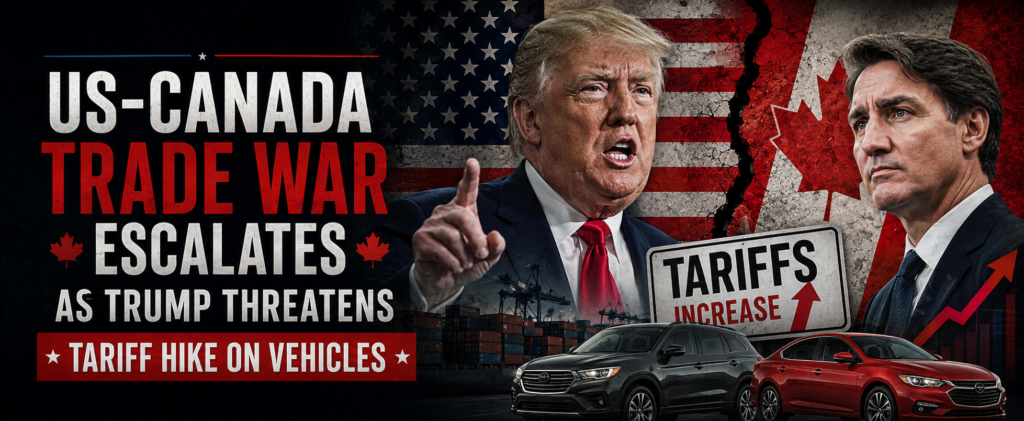
The trade relationship between the United States and Canada has entered another dangerous phase after U.S. President Donald Trump threatened to increase tariffs on Canadian vehicles, automotive parts and steel to 50% from January 1, 2027.
The latest escalation comes just days after trade negotiations between Washington and Ottawa broke down, raising concerns that one of the world’s most closely integrated economies could be heading toward a prolonged trade confrontation.
Trump’s proposed tariff increase has already put pressure on major North American automakers and raised concerns about supply chains, manufacturing costs, inflation and economic growth. Canada, meanwhile, has signalled that it will respond with retaliatory tariffs and other targeted measures designed to protect Canadian industries and workers.
For financial markets, the dispute is particularly important because Canada and the United States have deeply interconnected economies. Any disruption to cross-border trade could influence the Canadian dollar, U.S. dollar, equities, commodities and broader risk sentiment.
For Forex News traders, the USD/CAD currency pair is likely to remain one of the most closely watched markets as investors assess the economic consequences of a renewed U.S.-Canada trade war.
Trump Threatens 50% Tariffs on Canadian Vehicles
President Donald Trump said that tariffs on Canadian cars, trucks, automotive parts and steel could rise to 50% beginning January 1, 2027.
The proposed increase would represent a significant escalation from existing automotive tariffs. Reporting on the announcement indicates that U.S. tariffs on Canadian automobiles currently stand at 25% for applicable non-U.S. content, while steel tariffs are already at 50%.
Trump’s latest threat followed the collapse of U.S.-Canada trade negotiations. The U.S. administration has argued that Canadian trade policies disadvantage American businesses, particularly in the automotive sector.
The White House has previously accused Canada of applying discriminatory treatment to U.S. motor vehicles. A July 2026 presidential proclamation said Canada maintained a 25% tariff structure on certain U.S. vehicles and argued that Canadian measures had disadvantaged American commerce. The White House also said U.S. vehicle exports to Canada had fallen approximately 22% between the April 2025-March 2026 period and the comparable previous period.
Trump’s latest announcement therefore represents more than a simple tariff adjustment. It signals that Washington is prepared to use automotive trade as a major negotiating tool in its relationship with Ottawa.
Why the Auto Industry Is at the Centre of the Dispute
The automotive sector is particularly vulnerable because vehicle production in North America depends heavily on cross-border supply chains.
Cars and trucks assembled in Canada can contain components manufactured in the United States, Mexico and other countries. Similarly, American vehicle production relies on Canadian steel, aluminium, parts and other industrial inputs.
A substantial tariff imposed at the border can therefore increase costs at multiple stages of the production process.
For automakers, the problem is not simply the cost of importing a finished vehicle. Higher tariffs on components can raise production expenses before the final vehicle reaches consumers.
This creates several potential outcomes:
- Higher vehicle prices
- Lower profit margins for automakers
- Reduced investment in Canadian manufacturing
- Changes to production locations
- Supply-chain restructuring
- Reduced cross-border vehicle shipments
- Greater uncertainty for automotive workers
- Potential pressure on consumer inflation
Trump has encouraged companies to manufacture inside the United States, where vehicles could avoid the proposed tariff.
However, relocating production is not an immediate solution. Automotive factories require years of planning, significant capital investment and extensive supplier networks.
Ford is among the companies caught directly in the uncertainty. The company has a major manufacturing presence in Ontario, and its planned production strategy means that the proposed tariffs could affect its North American operations. Market reporting showed Ford shares falling after the latest tariff threat.
Canada Prepares Retaliatory Tariffs
Canada has responded strongly to Washington’s latest threats.
Prime Minister Mark Carney has rejected the idea that Canada should accept U.S. trade conditions that could weaken major Canadian industries. Ottawa has indicated that retaliatory tariffs are being prepared, with measures expected to target selected U.S. products.
Canada had already announced plans for dollar-for-dollar retaliation following the latest breakdown in negotiations, with tariffs expected to take effect on September 8. However, Canadian officials have suggested that the next response could become more targeted rather than simply matching every U.S. tariff.
Potential targets include sectors such as U.S. steel, agricultural products, machinery, electronics and other goods.
Ontario Premier Doug Ford has also called for a strong Canadian response, with discussion extending to strategically important exports such as electricity and critical minerals.
This increases the risk that the dispute could expand beyond automobiles and steel.
Trade War Risks Increase for Both Economies
The United States and Canada have one of the world’s most important bilateral trading relationships.
Their manufacturing systems are deeply integrated, particularly in industries such as automobiles, energy, agriculture, metals and machinery.
Consequently, tariffs imposed by one country can create costs for businesses and consumers in both economies.
For Canada, the risk is especially significant because its economy is heavily exposed to the U.S. market.
Canadian businesses that depend on American customers could face weaker demand if tariffs make their products more expensive.
For the United States, however, the economic impact may also be significant.
American manufacturers rely on Canadian inputs, while U.S. consumers purchase Canadian goods across multiple categories.
Higher tariffs can therefore act as a tax on imported products, potentially increasing prices and adding pressure to inflation.
The longer the dispute continues, the greater the probability that companies will begin making permanent changes to their supply chains.
What Does the Trade War Mean for the Canadian Dollar?
The Canadian dollar is likely to remain highly sensitive to developments in the U.S.-Canada trade dispute.
The CAD is particularly exposed because the United States is Canada’s largest trading partner and because Canada’s economy is closely connected to commodity exports.
When investors believe that tariffs will significantly damage Canadian economic growth, they may reduce exposure to the Canadian dollar.
This can create upward pressure on USD/CAD, meaning one U.S. dollar buys more Canadian dollars.
For Forex traders, the key issue is therefore whether the tariff dispute remains a political negotiating tactic or develops into a long-lasting trade barrier.
If negotiations resume quickly, some of the recent pressure on the Canadian dollar could ease.
However, if the United States moves ahead with 50% tariffs and Canada implements substantial retaliation, the economic outlook could deteriorate further.
That scenario could support USD/CAD as investors seek the relative safety and liquidity of the U.S. dollar.
USD/CAD Becomes a Key FX Market to Watch
The USD/CAD pair could become one of the most important currency indicators of the trade dispute.
A prolonged deterioration in Canada-U.S. trade relations could weaken the Canadian dollar through several channels.
1. Lower Canadian exports
If Canadian goods become significantly more expensive in the United States, demand could fall.
Lower exports would reduce economic activity and potentially weaken Canada’s growth outlook.
2. Lower business investment
Companies may delay investment decisions while waiting to see whether tariffs remain in place.
Lower capital expenditure could reduce economic growth and employment.
3. Inflation uncertainty
Retaliatory tariffs can increase the cost of imported goods.
That can create an uncomfortable situation for the Bank of Canada because policymakers could face weaker growth alongside higher prices.
4. Interest-rate expectations
Forex markets are heavily influenced by expectations for central-bank policy.
If investors expect the Bank of Canada to respond to weaker growth with easier monetary policy, the Canadian dollar could face additional pressure.
Conversely, persistent inflation caused by tariffs could complicate the Bank of Canada’s policy decisions.
5. Risk sentiment
The Canadian dollar is often viewed as a risk-sensitive currency.
A broad deterioration in global risk sentiment can therefore add another layer of pressure to CAD.
The U.S. Dollar Could Also Face Competing Forces
The trade dispute is not necessarily a one-way bullish story for the U.S. dollar.
Although investors may initially seek the dollar during periods of uncertainty, tariffs can also create economic costs for the United States.
If higher import prices increase inflation, the Federal Reserve could face a difficult policy environment.
At the same time, if tariffs reduce business investment, consumer spending and economic growth, expectations for monetary easing could increase.
The resulting effect on the dollar could therefore depend on which force dominates.
In the short term, safe-haven demand could support the U.S. dollar.
Over the longer term, however, markets could become increasingly focused on the impact of tariffs on U.S. inflation and economic growth.
This makes the trade dispute an important theme for both Forex News and broader global economic analysis.
Why Investors Are Watching the Automotive Sector Closely
The automotive industry provides an early indication of how seriously markets are taking the latest escalation.
Shares of major automakers including Ford, General Motors and Toyota were affected following Trump’s tariff announcement, reflecting investor concerns about supply-chain disruption and profitability.
The uncertainty extends beyond automakers.
Suppliers, transportation companies, steel producers, dealerships and consumers can all be affected by changes in vehicle tariffs.
A prolonged trade dispute could encourage companies to move production capacity or suppliers across the border.
But restructuring supply chains is expensive.
Companies could therefore initially absorb some tariff costs rather than immediately relocate production.
That could reduce corporate margins and potentially lead to higher prices for consumers.
USMCA Faces a New Test
The escalation also raises questions about the future of the United States-Mexico-Canada Agreement, or USMCA.
The agreement was designed to provide a stable framework for trade across North America.
However, repeated tariff disputes have increased uncertainty surrounding the long-term stability of the regional trading relationship.
The current confrontation could encourage businesses to reconsider whether North American supply chains provide enough certainty for long-term investment.
This is particularly important for industries that depend on components crossing borders multiple times before a final product is completed.
If trade uncertainty becomes structural rather than temporary, companies could begin prioritising supply-chain resilience over maximum production efficiency.
That could increase production costs across the region.
Could Canada Target U.S. Agriculture?
Agriculture is another major area of concern.
Canada has already discussed retaliatory action against American agricultural products.
Such measures could have political consequences because U.S. farmers depend heavily on access to Canadian and international markets.
If Canada targets U.S. agricultural exports, American producers could face weaker demand.
At the same time, Canadian consumers could experience higher prices for imported U.S. food products.
This creates the classic problem associated with trade wars: tariffs are intended to protect domestic industries, but they can also increase costs for domestic consumers and businesses.
Steel and Industrial Materials Could Become More Expensive
Steel is another critical component of the dispute.
Trump has threatened to increase tariffs affecting Canadian steel, while existing steel tariffs are already significant.
The consequences could extend far beyond steel producers.
Steel is used in:
- Automobiles
- Construction
- Machinery
- Infrastructure
- Appliances
- Energy equipment
- Industrial manufacturing
Higher steel prices can therefore increase costs throughout the economy.
For the United States, domestic steel producers may benefit from protection from Canadian competition.
But manufacturers that purchase steel as an input could face higher production costs.
Canada could face a similar problem if it retaliates against U.S. industrial products.
What Could Happen to Inflation?
Inflation is one of the most important economic consequences of a prolonged tariff war.
Tariffs increase the cost of imported goods.
Companies then have three basic choices:
- Absorb the additional cost.
- Reduce profit margins.
- Pass the cost to consumers.
In many cases, the actual outcome is a combination of all three.
If tariffs remain limited and companies absorb some of the costs, inflationary pressure may be manageable.
If tariffs expand across a large number of industries, however, the impact could become more significant.
This is why traders will closely monitor U.S. and Canadian inflation data in the coming months.
Central Banks Could Face Difficult Decisions
The Bank of Canada and Federal Reserve could both face complicated policy choices if the trade conflict intensifies.
For the Bank of Canada, a trade shock could reduce economic growth while simultaneously increasing prices.
Normally, weaker economic activity would argue for lower interest rates.
However, higher tariff-driven inflation could make policymakers more cautious.
The Federal Reserve could face a similar dilemma.
If U.S. tariffs raise consumer prices but also reduce economic activity, monetary policy becomes more difficult to calibrate.
Forex markets will therefore pay close attention to inflation reports, employment data, retail sales, GDP figures and central-bank communications.
What Forex Traders Should Watch
For traders following FX news, the U.S.-Canada trade dispute should be monitored alongside several key indicators.
USD/CAD
The most direct currency pair to watch is USD/CAD.
A deterioration in Canadian economic expectations could push the pair higher, while renewed negotiations or a reduction in tariff threats could support CAD.
CAD crosses
Traders should also monitor:
- EUR/CAD
- GBP/CAD
- CAD/JPY
- AUD/CAD
These pairs can provide additional information about whether CAD weakness is specific to the U.S.-Canada relationship or part of a broader risk-off move.
Oil prices
Canada is a major energy exporter.
Oil prices can therefore have an important influence on the Canadian dollar.
If oil prices rise strongly, they could partially offset negative trade-war pressure on CAD.
If oil prices fall while trade tensions increase, the Canadian dollar could face a more challenging environment.
Canadian economic data
Important releases include:
- Canadian GDP
- Employment data
- Consumer inflation
- Retail sales
- Manufacturing activity
- Trade balance
- Bank of Canada interest-rate decisions
U.S. economic data
Traders should also monitor:
- U.S. inflation
- Nonfarm payrolls
- GDP
- Retail sales
- Consumer confidence
- Federal Reserve decisions
- U.S. Treasury yields
These indicators can determine whether tariff uncertainty strengthens or weakens the U.S. dollar.
Could the Tariffs Trigger a Wider North American Slowdown?
A prolonged trade war could eventually affect the broader North American economy.
Manufacturers may delay investments.
Consumers may postpone major purchases.
Businesses could reduce hiring.
Supply chains may become more expensive.
Cross-border trade volumes could decline.
These effects could reinforce one another.
For example, higher vehicle prices could reduce vehicle demand. Lower demand could affect manufacturing employment. Reduced employment could weaken consumer spending. Lower spending could then slow economic growth.
This is why economists often warn that trade wars can have multiplier effects.
Trump Leaves Room for Negotiations
Despite the aggressive rhetoric, the proposed January 1, 2027 implementation date is significant.
It leaves several months for negotiations.
Market participants may therefore interpret the tariff threat as both an economic measure and a negotiating strategy.
The Washington Post reported that Trump’s announcement did not provide extensive additional details and that the January implementation date leaves time for the two countries to return to negotiations.
This creates a major source of uncertainty for financial markets.
If negotiations resume and both sides reach a compromise, CAD could recover and USD/CAD could reverse some of its recent gains.
If negotiations fail and the tariffs are implemented, the market could begin pricing a more significant economic shock.
Canada Faces a Difficult Balancing Act
Prime Minister Mark Carney’s government faces a difficult choice.
Canada needs to defend domestic industries and maintain negotiating leverage.
But aggressive retaliation could also increase costs for Canadian consumers and businesses.
A targeted response could therefore be more attractive than a broad tariff-for-tariff approach.
Canadian officials have indicated that they may focus retaliation on measures designed to protect Canadian workers and businesses rather than simply copying every U.S. tariff.
That strategy could reduce some economic damage while maintaining political pressure on Washington.
What This Means for Global Forex Markets
Although the dispute is primarily bilateral, its implications can extend into global FX markets.
Trade wars can influence:
- Global growth expectations
- Commodity prices
- Inflation expectations
- Interest-rate expectations
- Equity markets
- Safe-haven demand
- Capital flows
If investors become more concerned about global trade fragmentation, currencies associated with economic growth and commodities could experience increased volatility.
At the same time, the U.S. dollar could benefit from safe-haven demand.
However, if markets begin to believe that U.S. tariff policies are damaging American growth, dollar strength could become less predictable.
This makes the current environment particularly important for professional FX traders.
The Canadian Dollar’s Outlook Depends on the Next Round of Negotiations
The next phase of the dispute could determine the direction of CAD.
A negotiated settlement would likely reduce uncertainty.
A further escalation could produce additional pressure on the Canadian economy.
Three scenarios are particularly important.
Scenario 1: Negotiations Resume
If Washington and Ottawa return to negotiations and agree on lower tariffs, the Canadian dollar could recover.
USD/CAD could come under downward pressure as investors reduce expectations for a severe Canadian economic slowdown.
Scenario 2: Tariffs Are Implemented but Limited
If the 50% tariffs remain targeted and negotiations continue, the economic impact could be manageable.
Markets could experience significant volatility without a sustained trend.
Scenario 3: Full Trade War
If both countries continue expanding tariffs and retaliation spreads across multiple sectors, economic growth could weaken.
That scenario could increase demand for defensive assets and create substantial volatility in USD/CAD and other major currency pairs.
Key Takeaways for Forex Traders
The latest U.S.-Canada dispute has several important implications for the FX market.
First, the proposed 50% tariffs represent a major escalation in trade tensions.
Second, Canada is preparing retaliatory measures, increasing the risk of a broader trade confrontation.
Third, the automotive sector is particularly exposed because U.S. and Canadian manufacturing supply chains are deeply integrated.
Fourth, the Canadian dollar could remain vulnerable if investors expect weaker Canadian growth.
Fifth, USD/CAD volatility could increase as traders react to political statements, tariff announcements and economic data.
Finally, the January 1, 2027 implementation date leaves room for negotiations, meaning the market outlook could change rapidly.
Conclusion
The U.S.-Canada trade war has entered a critical new phase.
President Donald Trump’s threat to raise tariffs on Canadian vehicles, automotive parts and steel to 50% from January 1, 2027 has intensified pressure on one of the world’s most integrated trading relationships.
Canada’s planned retaliation adds another layer of uncertainty, while businesses across the automotive, steel, agriculture and manufacturing sectors prepare for potentially higher costs.
For the economy, the biggest risks are supply-chain disruption, higher consumer prices, weaker investment and slower growth.
For financial markets, the Canadian dollar and USD/CAD are likely to remain highly sensitive to developments.
The most important question now is whether the tariff threats ultimately lead to a negotiated agreement or become the foundation of a prolonged trade war.
For Forex News and FX news traders, this distinction could be crucial.
If negotiations succeed, some of the pressure on CAD could quickly fade.
If tariffs escalate, USD/CAD could remain highly volatile as markets reassess Canadian growth, U.S. inflation, central-bank policy and global risk sentiment.
With the January deadline still months away, traders should expect further headlines, policy announcements and market reactions before the final outcome becomes clear.
The U.S.-Canada trade relationship is therefore likely to remain a major theme for Forex markets throughout the remainder of 2026 and into 2027.
