

Fed Raises Rates to 3.75%–4.00% as Warsh Signals Further Tightening, Stocks Slide
The Federal Reserve raised interest rates by 25 basis points on Wednesday, taking the federal funds target range to 3.75%–4.00% in its first rate increase since 2023. The decision was unanimous, with all 12 voting members supporting the move as policymakers responded to inflation that remains above target while economic activity continues to expand. The […]
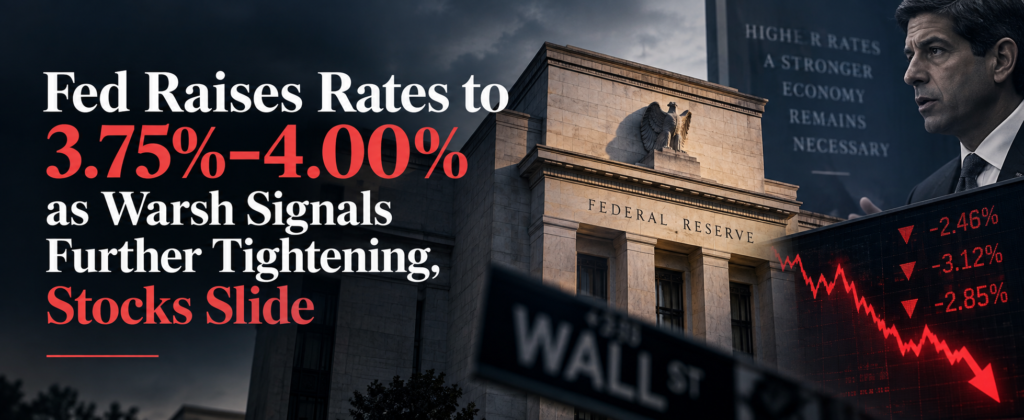
The Federal Reserve raised interest rates by 25 basis points on Wednesday, taking the federal funds target range to 3.75%–4.00% in its first rate increase since 2023. The decision was unanimous, with all 12 voting members supporting the move as policymakers responded to inflation that remains above target while economic activity continues to expand.
The rate decision was widely anticipated, but the accompanying economic projections and comments from new Fed Chair Kevin Warsh created a more restrictive policy signal for financial markets. Investors are now assessing the possibility of another increase before the end of the year.
Fed Dot Plot Signals Another Rate Increase
The updated September projections showed a significant shift in expectations for the remainder of 2026.
Sixteen of the 18 Federal Open Market Committee participants projected at least one additional 25-basis-point rate increase before the end of the year, according to the Fed’s updated Summary of Economic Projections. The median projection for the federal funds rate at the end of 2026 was 4.1%.
The projections do not guarantee another hike, but they indicate that a majority of policymakers currently see additional tightening as appropriate under their economic outlook.
Inflation Remains a Central Concern
The Fed said inflation remains elevated, while economic activity has continued to expand at a solid pace. That combination gives policymakers a reason to focus on preventing higher prices from becoming entrenched.
Warsh also emphasised the inflation challenge during his post-meeting communication. Reuters reported that the new chair’s comments reinforced expectations that the central bank may remain focused on bringing inflation back towards its 2% objective rather than quickly reversing the latest rate increase.
Higher Oil Prices Complicate the Inflation Outlook
The Fed’s decision comes as energy markets remain volatile.
Oil prices had recently moved above $100 a barrel amid Middle East supply disruptions, adding another potential source of inflationary pressure. Although crude prices fell on Wednesday as Saudi Arabia worked to maintain supplies through alternative export routes, energy costs remain a key variable for monetary policy.
Higher oil prices can increase transportation, manufacturing and consumer costs. The Federal Reserve cannot directly increase global oil supply, but tighter financial conditions can reduce demand and limit the risk that an energy shock spreads into broader inflation.
Treasury Yields and Dollar React to the Fed
The policy shift immediately affected US fixed-income markets.
The two-year Treasury yield rose sharply, while the 10-year yield climbed towards 5% following the Fed announcement. Shorter-dated yields are particularly sensitive to expectations for the federal funds rate and future policy decisions.
The US dollar also strengthened. Reuters reported that the dollar index gained around 0.63% on Wednesday as investors assessed the Fed’s more restrictive outlook.
For currency markets, the combination of higher US rates and stronger Treasury yields can support the dollar against major currencies. Traders will now watch upcoming inflation and employment data for evidence that could either reinforce or challenge expectations for another hike.
Wall Street Slides After Warsh’s Hawkish Signal
US equities initially showed resilience around the Fed decision but later moved lower as investors interpreted the policy outlook as more restrictive.
The Dow Jones Industrial Average fell 1.21%, while the S&P 500 declined 0.45%. The Nasdaq was almost unchanged after recovering from an earlier decline.
Higher interest rates can weigh particularly heavily on growth-oriented companies because future earnings become less attractive when discounted using higher borrowing costs.
Gold Also Faces Pressure From Higher Yields
Gold declined after the Fed announcement, with spot prices falling around 0.69% to $4,263.19 an ounce, according to Reuters market data.
Gold’s reaction reflects the competing forces currently affecting the metal. Geopolitical uncertainty and inflation can support safe-haven demand, but higher Treasury yields and a stronger dollar can make non-yielding bullion less attractive.
Markets Turn to the Next Fed Move
The September increase is now complete, leaving investors focused on whether another hike will follow later in 2026.
The key variables will be inflation, energy prices, economic activity and financial conditions. If inflation remains elevated, the projections suggest policymakers may continue to favour tighter policy. Conversely, a significant deterioration in economic activity could alter the path implied by the latest dot plot.
For global markets, the Fed’s latest decision has reinforced the importance of the US rate outlook. Traders will closely monitor US Treasury yields, DXY, EUR/USD, USD/JPY, gold, S&P 500 and Nasdaq futures, as well as Bitcoin, as expectations for future US monetary policy continue to evolve.
For now, the message from the September meeting is clear: the Fed has resumed tightening, and its latest projections indicate that the current rate increase may not be the final move of 2026.

Alexander
Alexander is a veteran of the currency markets with over 15 years of experience in institutional trading and risk management. He specializes in the intersection of macroeconomics and regulatory frameworks.
