

India Faces 100% U.S. Tariff Risk as House Passes Russia Sanctions Bill Over Russian Oil
India is facing a potential new trade and energy challenge after the US House of Representatives passed a sweeping Russia sanctions bill that could allow President Donald Trump to impose tariffs of up to 100% on countries purchasing Russian energy. The legislation passed the House on September 16 and was sent to the White House […]
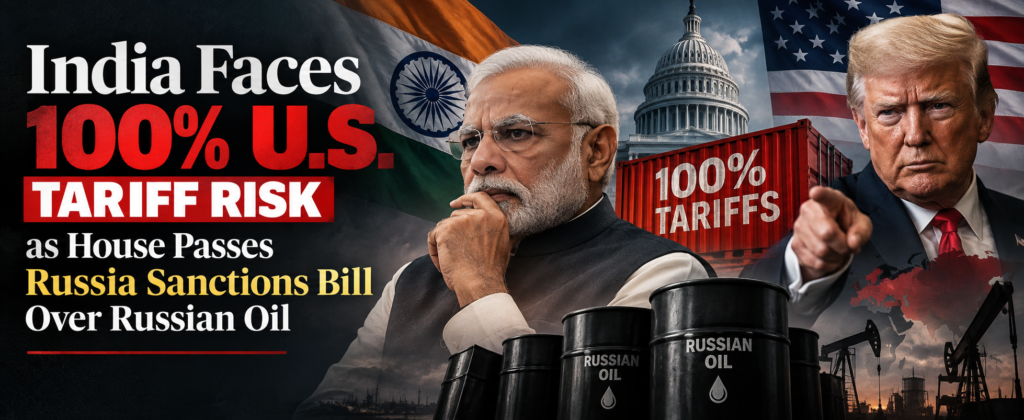
India is facing a potential new trade and energy challenge after the US House of Representatives passed a sweeping Russia sanctions bill that could allow President Donald Trump to impose tariffs of up to 100% on countries purchasing Russian energy.
The legislation passed the House on September 16 and was sent to the White House for consideration. The measure is designed to increase economic pressure on Russia over its war in Ukraine, but its secondary-tariff provisions could have significant consequences for major Russian oil buyers such as India and China.
The proposed tariffs have not yet been imposed on India. Their implementation would depend on the legislation becoming law and on any subsequent presidential action under the new authority.
India Warns Tariffs Could Affect Bilateral Ties
India has already responded to the latest US move, warning that additional tariffs on countries buying Russian oil could negatively affect relations between New Delhi and Washington.
India’s foreign ministry said the country remains focused on securing reliable and affordable energy for its population and intends to continue sourcing crude from diverse suppliers. Reuters reported that New Delhi also said it was prepared to take measures to protect its economic interests if necessary.
The issue comes at a sensitive point in India-US trade negotiations, where tariff policy and market access remain important issues.
Russian Oil Remains Important for Indian Refiners
India has become one of the world’s largest buyers of Russian crude since Western sanctions and the restructuring of global energy trade following Russia’s invasion of Ukraine.
Russian crude has supplied a significant portion of India’s import needs because refiners have been able to source the oil under commercially attractive conditions. According to reporting cited by Business Standard, Russia’s share of India’s crude imports has changed substantially since 2022 as refiners responded to discounts, sanctions and shifting global supply conditions.
A sharp tariff imposed on Indian exports to the United States could therefore affect the broader economics of continuing to purchase Russian oil.
How a 100% Tariff Could Affect India
The proposed measure targets countries buying Russian energy rather than directly placing a tax on Russian crude entering India.
That distinction is important. The potential economic effect on India would come mainly through US trade tariffs on Indian exports, creating pressure on industries that depend heavily on access to the American market.
If the US were to impose tariffs at the maximum level, Indian exporters could face substantially higher costs when selling goods into the United States. This could affect profit margins, competitiveness and investment decisions across trade-sensitive sectors.
At the same time, Indian refiners would need to assess whether the economics of Russian crude remain attractive after accounting for potential trade-related costs and geopolitical risks.
Energy Security Creates a Difficult Policy Trade-Off
India is the world’s third-largest oil importer, making crude prices and supply security particularly important for its economy. Reuters reported that the potential US tariff measures have raised concerns among Indian refiners because replacing large volumes of Russian oil could increase sourcing costs.
A shift toward alternative suppliers could also change freight costs, refinery margins and the geographic structure of India’s crude imports.
If replacement barrels are more expensive, higher import costs could eventually affect the trade deficit, the rupee and domestic fuel-price pressures.
Rupee and Inflation Risks Remain in Focus
The tariff dispute arrives as India’s currency is already under pressure from elevated oil prices and higher global borrowing costs.
Reuters reported that the Indian rupee ended around 95.90 per US dollar on September 17 after earlier falling beyond 96, with suspected Reserve Bank of India intervention helping the currency recover. Higher crude prices linked to the Iran conflict remain an important source of pressure on India’s external balances.
A weaker rupee raises the local-currency cost of imported crude, which can increase pressure on inflation and corporate costs.
For financial markets, the combination of expensive oil, a weaker currency and potential new US tariffs creates a complicated backdrop for Indian equities and bonds.
Global Oil Markets Could Also Feel the Impact
The dispute also matters beyond India.
If major buyers reduce Russian crude purchases because of US pressure, global trade flows could be redirected. Refiners may seek oil from the Middle East, West Africa, the United States or other producers, potentially increasing competition for alternative barrels.
At a time when Middle Eastern supply routes are already facing disruption, any major change in Russian oil flows could increase volatility in Brent and WTI markets.
Reuters reported that Brent crude was around $104.74 a barrel on September 17 after easing from recent highs as Saudi Arabia worked to maintain exports through alternative routes.
India-US Trade Relations Under Pressure
The latest House vote could also complicate negotiations over a broader India-US trade agreement.
New Delhi has signalled that energy security will remain an important consideration, while Washington’s legislation is designed to pressure countries that continue purchasing Russian energy. Reuters reported that India’s trade minister is expected to discuss the issue during an upcoming visit to the United States.
The outcome will depend on how the legislation is implemented and whether India receives any exemptions or adjustments.
What Traders Should Watch Next
Investors should monitor Trump’s decision on the legislation, US-India trade negotiations, India’s Russian crude purchases, Brent and WTI prices, USD/INR and refinery margins.
The most important point for markets is that the 100% tariff remains a potential measure rather than a tariff already applied to India.
For now, the House vote increases uncertainty around India’s energy sourcing and export relationship with the United States. If the measure becomes law and significant tariffs are ultimately applied, Indian exporters, refiners and the rupee could face additional pressure. If negotiations produce exemptions or other arrangements, some of that risk could ease.
For global oil markets, the bigger question is whether US pressure changes the flow of Russian crude into major consuming economies. Any large-scale reshuffling of global oil trade could affect prices, freight rates and inflation expectations well beyond India.

Alexander
Alexander is a veteran of the currency markets with over 15 years of experience in institutional trading and risk management. He specializes in the intersection of macroeconomics and regulatory frameworks.
