

Trump Threatens EU Tariffs Over Canada Associate-Member Plan as Trade Tensions Escalate
US President Donald Trump has threatened the European Union with potentially significant new tariffs if the bloc proceeds with a proposal to make Canada its first “associate member”, adding another layer of uncertainty to already strained transatlantic trade relations. Trump told reporters on September 16 that the United States could impose “very serious tariffs” or […]
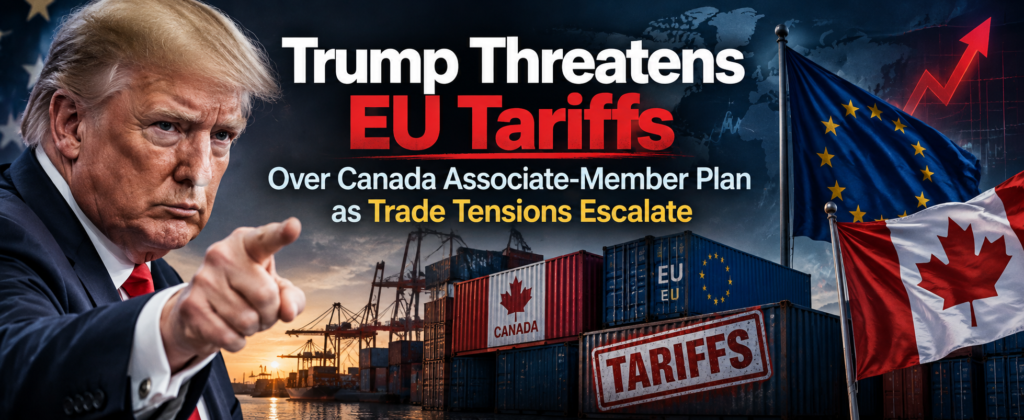
US President Donald Trump has threatened the European Union with potentially significant new tariffs if the bloc proceeds with a proposal to make Canada its first “associate member”, adding another layer of uncertainty to already strained transatlantic trade relations.
Trump told reporters on September 16 that the United States could impose “very serious tariffs” or restrict trade with Europe on some goods if Washington considered the proposed Canada-EU arrangement to be hostile. He also left open the possibility of no additional action if the initiative was judged to have positive intentions.
The comments came after European Commission President Ursula von der Leyen proposed giving Canada a new associate-member status during her State of the European Union address on September 16. The proposal would represent a new form of cooperation rather than full EU membership.
EU-Canada Economic Ties Enter a New Phase
The proposed arrangement would seek to expand cooperation between Canada and the European Union beyond the existing Comprehensive Economic and Trade Agreement (CETA).
Von der Leyen said the EU wants to build a broader economic and security relationship with Canada covering areas including intelligent manufacturing, technology, defence, energy, critical minerals, batteries, artificial intelligence, quantum computing and cybersecurity.
The European Commission has also highlighted the existing economic relationship between the two sides. According to von der Leyen, trade in goods between Canada and the EU has grown by 75% in less than a decade under CETA.
For financial markets, the expansion of these ties could eventually influence investment flows, supply chains and trade in strategically important commodities.
Canada Looks Beyond Its Traditional Trade Dependence
Canadian Prime Minister Mark Carney has been actively seeking stronger relationships with European partners as Ottawa works to diversify its international economic links.
The Canadian government said Carney’s September 15–17 European visit was intended to strengthen cooperation in trade, investment and security.
In meetings with European leaders on September 16, Carney supported deeper Canada-EU cooperation in critical minerals, defence industrial capacity, AI and computing, energy security, space, financial services and payments.
This strategy could become more important if uncertainty surrounding US-Canada trade continues.
Tariff Threat Adds Uncertainty for European Exports
Trump’s warning introduces a new potential trade risk for European exporters.
The US and EU already maintain major two-way trade relationships across automobiles, machinery, pharmaceuticals, technology, chemicals, agricultural products and other sectors. Any substantial increase in tariffs could raise import costs and potentially alter corporate supply-chain decisions.
However, the latest US tariff threat is conditional. Trump said action would depend on whether he considers the EU-Canada arrangement hostile. No new tariff rate on Europe has been announced as part of this statement.
That distinction is important for investors because the immediate financial impact is primarily an increase in uncertainty rather than a confirmed new trade duty.
EU Says the Canada Proposal Is Not Directed Against the US
The European Commission has said the proposed relationship with Canada is intended to strengthen cooperation between Europe and Canada rather than target another country. Von der Leyen described the partnership as being aimed at common economic and strategic strength.
France’s European affairs minister Benjamin Haddad also said the United States does not have the power to veto the EU’s geopolitical choices, according to Reuters reporting.
The differing positions leave investors watching whether the issue develops into another round of formal tariff negotiations.
Critical Minerals and Energy Could Become More Important
One of the most economically significant elements of the proposed Canada-EU relationship is cooperation around critical minerals and energy.
Canada has substantial natural-resource assets, while Europe is seeking to diversify supplies of strategically important materials used in batteries, advanced manufacturing, defence and technology.
Carney has previously described critical minerals, energy, AI, payments and defence capabilities as areas where deeper partnerships could increase Canada’s economic resilience and investment opportunities.
For global commodity markets, closer Canada-EU cooperation could therefore affect investment in mining, energy infrastructure and processing capacity over the longer term.
Potential Impact on CAD, EUR and Global Markets
The immediate market reaction is likely to remain linked to the possibility of further trade restrictions.
A deterioration in US-EU trade relations could weigh on European exporters and business confidence, while uncertainty around Canada’s future trading arrangements could influence the Canadian dollar (CAD).
For EUR/USD, additional US tariff threats could create pressure through expectations of weaker European exports and economic growth, although currency movements would also depend heavily on Federal Reserve and European Central Bank policy.
The Canadian dollar could similarly respond to changes in investor expectations for trade flows, commodity exports and foreign investment.
Supply Chains Remain a Key Market Variable
Companies may also reassess supply chains if North American and European trade barriers increase.
Canada is particularly important in areas such as energy and raw materials, while Europe has significant industrial and technology markets. Greater integration could eventually create alternative supply routes, but changes in trade policy could also increase transition costs for businesses.
What Traders Should Watch Next
Investors will be watching US-EU tariff negotiations, Canada’s proposed associate-member framework, Carney’s European meetings, CETA trade flows, CAD, EUR/USD and critical-mineral investment.
The proposed associate membership remains a new concept that would require further negotiations and institutional arrangements before becoming operational. The European Commission has presented it as a deeper partnership, while Canada’s government has welcomed the opportunity to strengthen strategic and economic ties with Europe.
For now, Trump’s comments have added a fresh trade-policy risk to global markets, but the economic consequences will depend on whether the threat leads to actual tariffs or further negotiations.
The key market question is therefore whether Canada-EU integration develops as a long-term diversification strategy while the United States and its major trading partners continue to negotiate the terms of future transatlantic trade.

Alexander
Alexander is a veteran of the currency markets with over 15 years of experience in institutional trading and risk management. He specializes in the intersection of macroeconomics and regulatory frameworks.
