

Saudi Arabia Intercepts Houthi Drone Near Mecca as Oil and Red Sea Risks Escalate
Saudi Arabia says its air defence systems intercepted and destroyed a Houthi drone south of Mecca before it entered the prohibited airspace over the holy city, adding another layer of tension to an increasingly unstable security environment around the Red Sea and the Arabian Peninsula. Saudi military spokesperson Maj. Gen. Turki al-Malki described the security […]
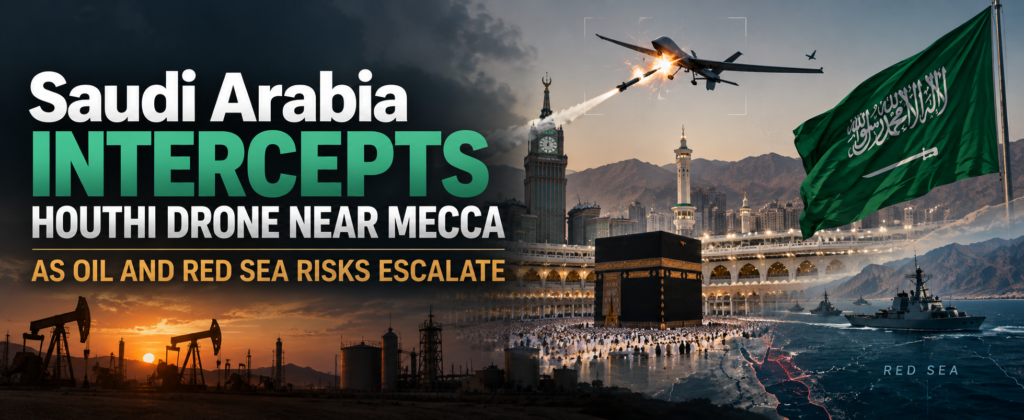
Saudi Arabia says its air defence systems intercepted and destroyed a Houthi drone south of Mecca before it entered the prohibited airspace over the holy city, adding another layer of tension to an increasingly unstable security environment around the Red Sea and the Arabian Peninsula. Saudi military spokesperson Maj. Gen. Turki al-Malki described the security of Mecca and Muslim pilgrims as a “red line.”
The Houthis, however, rejected the Saudi accusation that the drone was targeting Mecca. A Houthi spokesperson said the group’s stated targets were Saudi oil facilities and military positions. The differing accounts mean the specific intended target of the drone has not been independently established.
For financial markets, the incident matters less because of the location alone and more because it comes as Houthi forces expand their activity near critical shipping routes and Saudi energy infrastructure.
Houthi Activity Raises Broader Security Concerns
The incident follows a series of attacks and territorial advances by the Iran-aligned Houthis in Yemen.
The group has recently captured strategically important positions along Yemen’s Red Sea coastline, including the port of Mokha and islands near the Bab el-Mandeb Strait. That waterway connects the Red Sea with the Gulf of Aden and serves as an important route for global commercial and energy shipping.
The developments have increased concerns over Saudi Arabia’s ability to move oil through alternative export routes when normal Gulf shipping faces disruption.
Bab el-Mandeb Becomes More Important for Oil Markets
Bab el-Mandeb has gained additional importance because Saudi Arabia’s East-West oil pipeline provides a route for moving crude toward the Red Sea while avoiding the Strait of Hormuz.
But that alternative is also under pressure. A recent attack forced the shutdown of the 1,200-kilometre East-West pipeline, with the outage expected to last several weeks for repairs. The pipeline has the capacity to transport millions of barrels of oil per day toward Saudi export terminals on the Red Sea.
This creates a more complicated supply picture for global oil traders: disruption around Hormuz can limit Gulf shipping, while risks around Bab el-Mandeb can threaten an alternative route.
Saudi Oil Infrastructure Remains a Key Market Risk
Saudi Arabia has become increasingly focused on protecting its energy infrastructure as attacks intensify.
Recent disruptions involving the East-West pipeline have already contributed to elevated crude prices. Brent crude has remained above $100 a barrel, while WTI has also traded at elevated levels as traders assess the potential duration of supply interruptions.
The immediate effect of any individual drone interception may be limited if physical oil exports continue normally. The larger market concern is the possibility of repeated attacks that reduce Saudi export capacity or increase the cost of transporting crude.
Shipping Insurance and Freight Costs Could Rise
Higher security risks around the Red Sea can also affect the economics of commercial shipping.
When vessels face greater military or attack risks, insurers can increase premiums and shipping operators can demand higher freight rates. Longer or alternative routes may also require additional fuel and time.
Those costs can eventually affect the delivered price of crude, refined fuels and other commodities even when global production itself does not decline sharply.
Middle East Conflict Adds to Inflation Risks
The latest escalation comes while the global economy is already dealing with elevated energy prices.
Higher crude oil prices can raise costs for transportation, manufacturing, agriculture and logistics. A prolonged energy shock can therefore feed into consumer inflation and make monetary-policy decisions more difficult for central banks.
The relationship between geopolitical risk and monetary policy has become particularly important as investors monitor the Federal Reserve, European Central Bank and other major central banks.
If energy disruptions keep Brent and WTI prices elevated, markets could price a greater risk of persistent inflation, potentially affecting bond yields, currencies and equities.
Saudi Arabia Seeks Wider Security Support
The pressure on Riyadh extends beyond air defence.
Recent reporting indicates Saudi Arabia has been seeking additional assistance from regional and international partners as Houthi attacks increase. The kingdom has reportedly explored intelligence and defensive cooperation with Israel through US Central Command, while also seeking British and other regional support.
Saudi Crown Prince Mohammed bin Salman also met Egyptian President Abdel-Fattah el-Sissi as Riyadh sought political backing amid the worsening Red Sea security situation.
These developments suggest that protecting oil infrastructure and maritime routes is becoming an increasingly important component of the region’s security calculations.
Markets Watch Physical Oil Flows
For investors, the most important indicator will be whether geopolitical tensions begin to translate into measurable reductions in physical oil exports.
A continued flow of crude would limit the immediate supply impact, although risk premiums could remain elevated. A sustained loss of Saudi export capacity, combined with reduced shipping through Bab el-Mandeb or Hormuz, could create a much larger shock for global energy markets.
What Traders Should Watch Next
Markets will be monitoring Saudi oil exports, East-West pipeline repairs, Bab el-Mandeb vessel traffic, Strait of Hormuz crossings, tanker rates, Brent crude and WTI prices.
Further Houthi attacks on Saudi infrastructure could increase the geopolitical premium in oil markets. Conversely, improved maritime security or a restoration of damaged Saudi energy infrastructure could reduce some of the supply concerns.
For now, Saudi Arabia’s interception of the drone near Mecca represents another sign of the widening security pressure facing the kingdom. While the specific target remains disputed, the broader financial risk is clearer: continued instability around Saudi energy infrastructure and the Red Sea could keep global oil markets sensitive to every new military development.

Alexander
Alexander is a veteran of the currency markets with over 15 years of experience in institutional trading and risk management. He specializes in the intersection of macroeconomics and regulatory frameworks.
