

India-Pakistan Naval Collision Raises Fresh North Arabian Sea Security Concerns
A collision involving a Pakistani naval vessel and an Indian Navy warship in the North Arabian Sea has raised fresh questions over maritime security in a strategically important shipping corridor connecting the Arabian Sea with major Gulf energy routes. The incident took place on September 15, 2026, in international waters approximately 220 kilometres east of […]
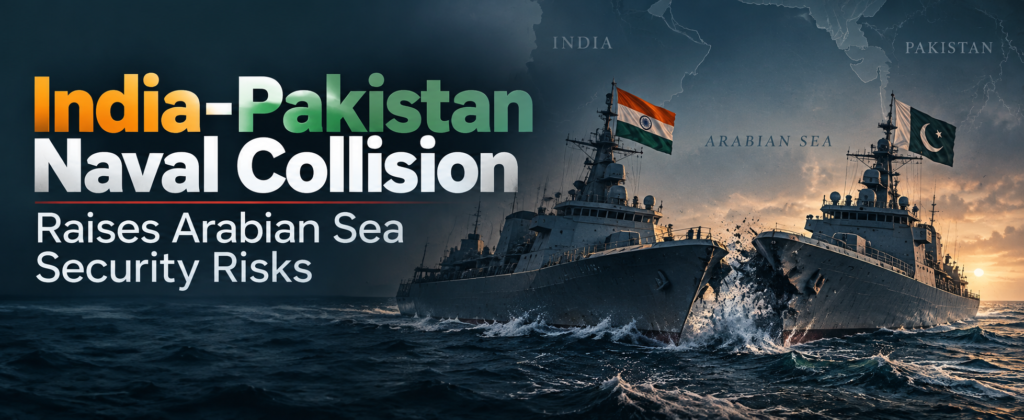
A collision involving a Pakistani naval vessel and an Indian Navy warship in the North Arabian Sea has raised fresh questions over maritime security in a strategically important shipping corridor connecting the Arabian Sea with major Gulf energy routes.
The incident took place on September 15, 2026, in international waters approximately 220 kilometres east of the Oman coast, according to Indian media reports. The Pakistani vessel, PNS Hunain, reportedly came close to an Indian Navy frontline warship that was conducting a routine surveillance mission. India subsequently summoned Pakistan’s Chargé d’Affaires and lodged a diplomatic protest over the incident.
The collision itself reportedly caused no major damage to the Indian vessel, while PNS Hunain sustained damage. Details surrounding the exact circumstances remain subject to further clarification.
Why the North Arabian Sea Matters for Global Trade
The location of the incident is economically important because the North Arabian Sea sits close to major commercial shipping routes linking the Gulf, South Asia, East Africa and international markets.
Large volumes of crude oil, petroleum products, containerised goods and other commodities move through waters connected to the Arabian Sea. Any sustained increase in maritime-security risks can affect shipping schedules, insurance costs and freight rates even when commercial vessels themselves are not directly targeted.
This makes developments involving naval forces relevant beyond the immediate India-Pakistan security relationship.
Maritime Security and Shipping Costs
Shipping companies typically assess route risks through a combination of naval activity, geopolitical tensions, insurance premiums and the possibility of delays.
The North Arabian Sea has also become more strategically important as disruptions around other Middle Eastern waterways have pushed governments and shipping companies to pay greater attention to alternative routes and security arrangements.
A single naval collision does not by itself indicate a disruption to commercial shipping. However, any repeated incidents or broader military escalation could increase the risk premium applied to vessels operating in the wider region.
PNS Hunain Is a Newer Pakistani Navy Vessel
PNS Hunain is a Yarmook-class offshore patrol vessel serving with the Pakistan Navy.
The ship was built by Damen Shipyards in Galați, Romania, and was commissioned by Pakistan in September 2024. Pakistan Navy records identify Hunain as the third vessel of the Yarmook class.
The vessel belongs to the larger offshore-patrol category, designed for long-endurance maritime-security missions, surveillance, patrol operations and other military tasks.
Damen says the newer Batch-II vessels derived from its OPV 2600 design are around 98 metres long, have a displacement of approximately 2,600 tonnes and are designed to operate in a range of maritime-security and military roles.
Vessel Has Broader Maritime-Security Duties
PNS Hunain has previously been involved in maritime safety operations.
In April 2026, the vessel participated in the rescue of 18 crew members from the merchant vessel MV Gold Autumn after a distress call in the North Arabian Sea. Pakistan’s maritime authorities said Hunain’s crew provided medical assistance, supported firefighting operations and helped evacuate the sailors.
The vessel’s presence in the region therefore extends beyond traditional military missions and includes maritime-security and emergency-response activities.
India-Pakistan Maritime Tensions Under Watch
The collision comes at a sensitive time for India-Pakistan relations.
According to India’s Ministry of External Affairs, the incident occurred in international waters and involved what New Delhi described as unacceptable and unprofessional conduct by the Pakistani naval unit. Indian authorities said the incident did not result in major damage.
Pakistan’s position and additional details about the incident will be important in determining whether the episode remains an isolated maritime accident or develops into a broader diplomatic issue.
For financial markets, the distinction matters because a one-off collision has a very different economic impact from sustained naval confrontation or restrictions on commercial navigation.
Potential Impact on Energy and Commodity Markets
The North Arabian Sea connects to some of the world’s most important energy corridors. Saudi Arabia, the UAE, Iraq, Qatar and other Gulf producers rely on maritime infrastructure and shipping routes to connect their exports with international buyers.
An increase in regional military risk could affect tanker insurance premiums, freight rates and shipping schedules. Those costs can eventually influence the delivered price of crude oil and other commodities.
At present, there is no evidence that this specific collision has disrupted commercial oil flows. Brent and WTI prices remain more directly influenced by the wider Middle East supply situation, including developments around the Strait of Hormuz, Saudi energy infrastructure and Red Sea shipping.
Oil Traders Will Watch for Wider Escalation
The key issue for energy markets will be whether the incident leads to additional naval deployments, diplomatic measures or restrictions affecting commercial vessels.
If commercial shipping continues normally, the immediate oil-market effect could remain limited. However, repeated maritime confrontations in the region could add to an already elevated geopolitical risk premium.
For economies dependent on imported energy, higher freight and insurance costs can add to fuel and transportation expenses even without a major change in crude production.
What Traders Should Watch Next
Investors will be watching India-Pakistan diplomatic developments, naval activity in the Arabian Sea, commercial shipping traffic, tanker insurance costs and Brent and WTI crude prices.
Further information from Indian or Pakistani authorities could clarify the circumstances surrounding the collision and whether any operational changes are planned.
For now, the incident remains primarily a maritime-security and diplomatic development rather than a confirmed disruption to global energy supplies. Its economic significance lies in the location: the North Arabian Sea forms part of a major commercial corridor, and any broader deterioration in maritime security could increase costs and uncertainty for regional shipping and energy markets.

Alexander
Alexander is a veteran of the currency markets with over 15 years of experience in institutional trading and risk management. He specializes in the intersection of macroeconomics and regulatory frameworks.
