

Trump Administration Prepares $2.8 Billion Israel Arms Package as U.S. Defence Spending Rises
The Trump administration is preparing a proposed $2.8 billion arms package for Israel that would include 40,000 2,000-pound bombs, according to US officials cited by The Washington Post and Reuters. The package has been shared informally with relevant congressional committees but is not yet final, making the reported plan subject to further review. The proposed […]
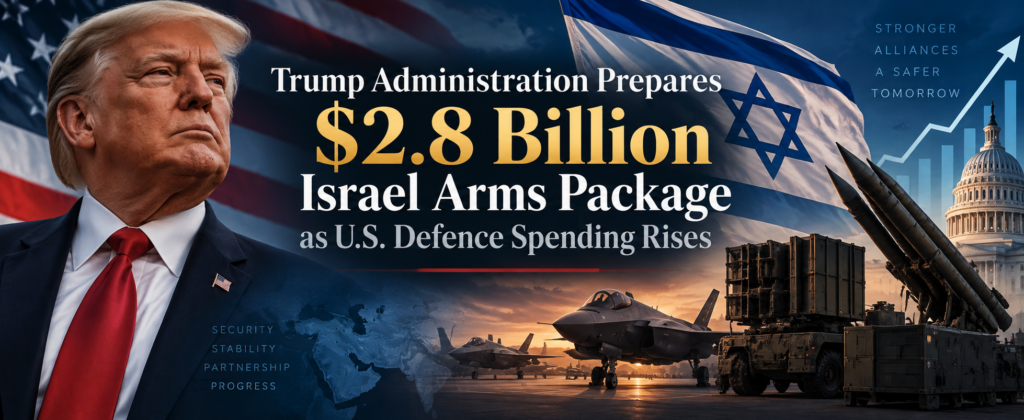
The Trump administration is preparing a proposed $2.8 billion arms package for Israel that would include 40,000 2,000-pound bombs, according to US officials cited by The Washington Post and Reuters. The package has been shared informally with relevant congressional committees but is not yet final, making the reported plan subject to further review.
The proposed transfer adds another major defence commitment to Washington’s support for Israel and comes as the United States faces rising military expenditures linked to conflicts and security operations across the Middle East.
For financial markets, the development is relevant not only because of the size of the proposed package, but also because it highlights the growing connection between geopolitical tensions, government spending and the US defence industry.
$2.8 Billion Package Includes Thousands of Heavy Bombs
According to the reports, the proposed package includes 20,000 MK-84 bombs and 20,000 BLU-117 bombs, each weighing 2,000 pounds. It would also include 20,000 I-2000 Penetrator warheads. The package would reportedly be purchased using US taxpayer-funded Foreign Military Financing.
The scale of the proposed transfer makes it one of the larger recent US munitions packages for Israel. Reuters reported that the plan has been discussed with congressional committees, although there had been no public comment from the State Department or the Israeli embassy at the time of its report.
Because the proposal remains subject to the US arms-sale process, the final value, composition and timing could still change.
Previous Restrictions on 2,000-Pound Bombs
The proposed transfer is also notable because similar 2,000-pound bombs had previously faced restrictions under the Biden administration over concerns about their potential use and civilian casualties in Gaza. The Trump administration’s reported plan would represent a significant change in the handling of those weapons.
The Washington Post reported that the pending transfer could become a significant political issue in the United States as lawmakers debate military assistance to Israel.
Impact on U.S. Defence Spending
The proposed $2.8 billion package comes at a time when US military costs are already under scrutiny.
A recent Pentagon Inspector General report on the Iran conflict identified weapons inventory shortages and bottlenecks in the US defence industrial base. The report also documented substantial damage to US military equipment and facilities during the conflict. This creates an additional backdrop for any large new munitions order, particularly if US stockpiles need to be replenished at the same time.
For defence manufacturers, sustained demand from the US government and foreign military customers can increase production requirements and support revenues across parts of the aerospace and defence supply chain.
However, higher procurement commitments also represent additional government expenditure and can influence budget priorities.
Defence Companies and Supply Chains in Focus
Large weapons programmes affect more than the initial purchase price. Manufacturing, transportation, maintenance, replacement components and future replenishment can all contribute to the longer-term economic footprint of defence contracts.
The latest proposal therefore comes as investors are paying closer attention to US defence budgets and the capacity of manufacturers to expand production.
The issue is particularly relevant because the US defence sector is already managing demand linked to multiple theatres and the need to replenish inventories after heavy weapons use. The Pentagon watchdog’s findings about strategic inventory shortfalls provide context for the industrial challenge facing the sector.
Taxpayer Funding Adds a Fiscal Dimension
Using Foreign Military Financing means the proposed purchase would involve US government resources rather than being financed solely by Israel through commercial borrowing.
That makes the package relevant to broader discussions about US federal spending. The immediate $2.8 billion figure is relatively small compared with the total federal budget, but repeated military commitments can become more significant when combined with other overseas security and defence expenditures.
Investors will therefore continue monitoring US defence appropriations, military procurement and government borrowing alongside developments in the Middle East.
Geopolitical Risks Could Keep Markets Volatile
The arms proposal also arrives against a backdrop of continuing Middle East tensions. Recent attacks and disruptions have already affected regional energy infrastructure and contributed to elevated oil prices, keeping inflation and global-market risks in focus.
Further escalation could affect crude prices, shipping costs, Treasury yields and the US dollar. At the same time, stronger defence demand could support parts of the US aerospace and defence sector.
The market impact will ultimately depend on whether the proposed sale moves forward and whether wider regional tensions intensify.
What Investors Should Watch Next
Investors will be watching the final US approval process, congressional developments, defence-sector orders, Pentagon inventory levels and Middle East geopolitical conditions.
For now, the reported $2.8 billion package remains a proposal rather than a completed transaction. If approved, however, it would represent another sizeable commitment of US resources to Israel and add to the broader financial and industrial consequences of America’s expanding defence requirements.

Alexander
Alexander is a veteran of the currency markets with over 15 years of experience in institutional trading and risk management. He specializes in the intersection of macroeconomics and regulatory frameworks.
