
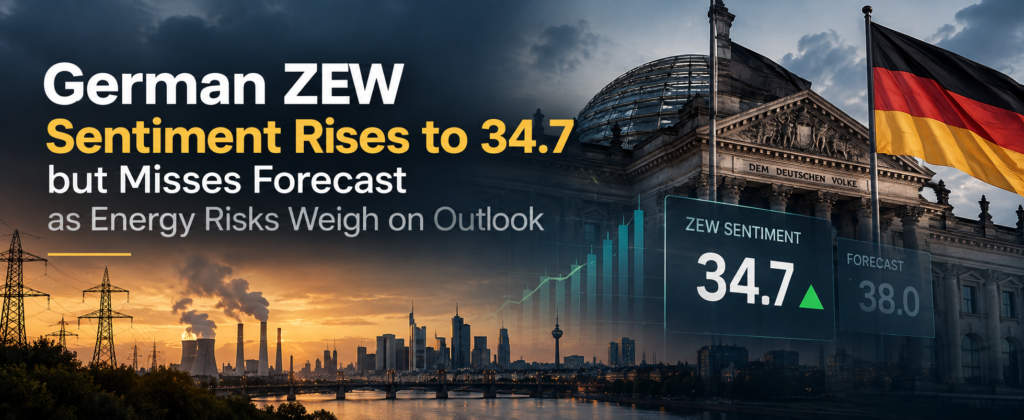
German ZEW Sentiment Rises to 34.7 but Misses Forecast as Energy Risks Weigh on Outlook
Germany’s economic outlook improved slightly in September, but the latest ZEW survey showed that investor optimism remains cautious as elevated energy prices and geopolitical uncertainty continue to cloud Europe’s largest economy. The ZEW Indicator of Economic Sentiment rose to 34.7 points in September from 34.2 in August, according to data released on Tuesday. Although the […]
Germany’s economic outlook improved slightly in September, but the latest ZEW survey showed that investor optimism remains cautious as elevated energy prices and geopolitical uncertainty continue to cloud Europe’s largest economy.
The ZEW Indicator of Economic Sentiment rose to 34.7 points in September from 34.2 in August, according to data released on Tuesday. Although the index remained firmly in positive territory, it fell short of the roughly 40-point expectation among analysts, signalling that confidence is improving more slowly than markets had anticipated.
The data provide a mixed picture for investors. Expectations for Germany’s future economic performance remain positive, while the assessment of current conditions improved significantly. However, rising energy costs linked to the Middle East conflict are creating a fresh risk for growth and inflation.
German Investor Confidence Improves, but Below Expectations
The 0.5-point rise in the ZEW sentiment indicator marked another improvement in investor expectations, but the modest increase suggests that optimism has yet to translate into stronger confidence.
The more encouraging component was the assessment of Germany’s current economic situation. The index improved sharply to -47.1 from -61.1 in August. While the reading remains negative, the move indicates that financial-market experts see fewer immediate risks to economic activity than they did one month earlier.
ZEW President Achim Wambach said German growth is currently being supported by fiscal measures and strong export performance. Government investment and improving external demand are helping offset some of the weakness in domestic activity.
Energy Prices Remain a Major Threat
Despite the improvement, the outlook remains vulnerable to the latest energy shock.
Brent crude has remained above $100 a barrel, recently moving above $108 as geopolitical tensions disrupted Middle Eastern energy infrastructure and shipping routes. Higher oil prices can increase costs for German manufacturers, transport companies and households while also putting upward pressure on inflation.
ZEW specifically highlighted persistently high energy prices resulting from the Iran conflict as a significant downside risk. Increased uncertainty surrounding hybrid attacks and the wider geopolitical environment is also making businesses and investors more cautious.
What the ZEW Data Means for the Euro
The ZEW survey is an important leading indicator for Germany and can influence expectations surrounding the euro-area economy and the European Central Bank.
A stronger-than-expected reading would normally support the euro because it suggests improving economic momentum. However, the September result’s miss against expectations limits the positive signal.
For EUR/USD, this creates a mixed environment. Germany’s improved current conditions provide some support, but weaker-than-expected expectations and elevated energy costs may restrict the euro’s upside.
The currency is also facing pressure from broader monetary-policy differences. The US dollar has strengthened as markets increase expectations for a Federal Reserve rate hike, with Treasury yields climbing alongside higher oil prices. Reuters reported that the euro was trading near a one-month low around $1.153 on Tuesday.
ECB Faces a Difficult Energy and Growth Balance
The latest German data arrive at a sensitive time for the ECB.
Higher energy prices are creating an unusual policy challenge. On one hand, stronger fuel and gas prices increase inflation risks and could encourage the ECB to maintain a restrictive stance. On the other, expensive energy can weaken household consumption and industrial activity, creating pressure on economic growth.
The ECB’s September projections already warned that inflation could rise significantly because of the energy shock. The central bank expects euro-area inflation to peak at 3.6% in the fourth quarter of 2026 under its baseline scenario before gradually easing.
This makes future energy prices a critical variable for both the ECB and financial markets.
Germany’s Recovery Is Not Yet Broad-Based
The improvement in the ZEW current-conditions index is encouraging, but Germany still faces structural challenges.
Recent government data showed that economic momentum weakened at the beginning of the third quarter as domestic consumption lost strength and the boost to energy-intensive industries began to fade.
That means the stronger ZEW reading should not be interpreted as confirmation of a broad and powerful recovery. Instead, it suggests that investors see a path toward improvement while remaining concerned about the risks surrounding energy, trade and geopolitics.
What Traders Should Watch Next
For markets, the next major signals will come from euro-area inflation data, energy prices, ECB policy communication and the direction of EUR/USD.
If oil and gas prices remain elevated, Germany’s economic recovery could face renewed pressure while the ECB confronts higher inflation expectations. Conversely, a decline in energy prices could improve industrial confidence and strengthen the euro-area growth outlook.
For now, the September ZEW survey shows that Germany’s economic sentiment is moving in the right direction, but only cautiously. The small improvement to 34.7, combined with a large rise in current conditions, points to a more stable outlook. Yet the miss against expectations and rising energy risks indicate that Germany’s recovery remains vulnerable to developments beyond its control.

Alexander
Alexander is a veteran of the currency markets with over 15 years of experience in institutional trading and risk management. He specializes in the intersection of macroeconomics and regulatory frameworks.
