

U.S. Sanctions Russia’s VTB Bank Over Iran Ties as Financial Pressure on Tehran Intensifies
The United States has imposed fresh sanctions on Russia’s VTB Bank, accusing the major Russian lender of helping Iran evade American restrictions and creating financial channels that allowed Tehran to access parts of the international banking system. The U.S. Treasury Department announced the measures on September 14, 2026, under its broader Operation Economic Outcast, which […]
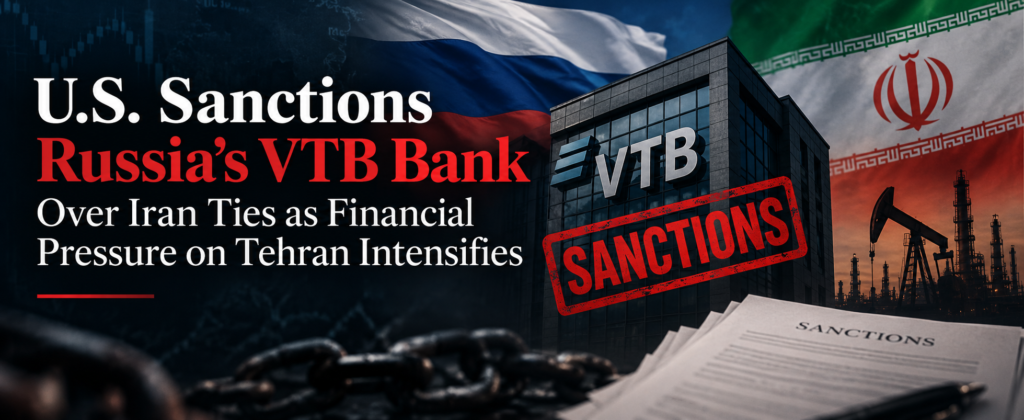
The United States has imposed fresh sanctions on Russia’s VTB Bank, accusing the major Russian lender of helping Iran evade American restrictions and creating financial channels that allowed Tehran to access parts of the international banking system.
The U.S. Treasury Department announced the measures on September 14, 2026, under its broader Operation Economic Outcast, which is designed to disrupt financial networks supporting Iran. The move puts additional pressure on one of Russia’s largest banks and increases the risks for foreign financial institutions that continue to maintain relationships with VTB.
VTB Targeted Over Iran Banking Relationships
According to the Treasury Department, VTB established correspondent banking relationships with Iranian financial institutions that were already under U.S. sanctions. The Russian bank also opened offices in Iran and took steps to strengthen banking cooperation between Moscow and Tehran.
Washington said VTB had taken steps to move billions of dollars in frozen Iranian assets and developed settlement arrangements using Iranian rial and Russian ruble correspondent accounts. Treasury said these mechanisms were intended to support bilateral trade while reducing reliance on conventional international financial channels.
The designation adds an Iran-related layer to VTB’s already extensive sanctions exposure. The bank had previously been targeted by the United States in 2022 following Russia’s escalation of the war in Ukraine and was again designated in January 2025 under additional Russia-related sanctions authorities.
Secondary-Sanctions Risk Expands
The latest action could have wider consequences beyond VTB itself.
The Treasury Department warned that foreign financial institutions continuing to conduct business with VTB after its Iran-related designation face greater secondary-sanctions exposure. That creates additional pressure on banks and companies in countries that maintain trade or settlement relationships with Russia and Iran.
For international banks, the risk is significant because access to the U.S. financial system remains an important part of global cross-border transactions. Companies may therefore need to reassess payment routes, correspondent relationships and counterparties connected to VTB.
Washington Tightens Iran’s Financial Isolation
The VTB designation is part of an expanding US campaign to restrict Iran’s access to international finance.
Treasury said Operation Economic Outcast is targeting the networks Iran uses to move money, evade sanctions, smuggle oil and finance activities abroad. Washington has also recently taken action against financial institutions in Turkey and the UAE as it seeks to identify intermediaries helping Tehran maintain access to international markets.
The US Treasury is also working directly with global financial institutions to provide information about revenue and procurement networks linked to Iran, the Islamic Revolutionary Guard Corps and associated entities.
This suggests sanctions enforcement could become broader rather than focusing only on Iranian banks and companies.
Impact on Russia-Iran Trade
The latest sanctions could complicate efforts by Moscow and Tehran to deepen economic relations outside the traditional Western financial system.
Both countries have faced extensive US sanctions and have increasingly explored alternative payment mechanisms, including local-currency settlements and non-Western banking channels. VTB’s activity in Iran was intended in part to facilitate bilateral trade and financial coordination.
Removing or restricting a major Russian financial institution from these channels could increase transaction costs and make cross-border settlements more complicated.
For companies trading with either country, the developments may also encourage greater use of compliance checks and alternative financial intermediaries. This could slow some transactions and increase the cost of servicing trade flows.
Potential Implications for Global Markets
Although the sanctions target a financial institution rather than a commodity directly, the move has broader implications for markets.
Stricter restrictions on Iran’s financial channels could affect the country’s ability to receive payments linked to oil exports and other international trade. If sanctions enforcement begins to disrupt physical commodity transactions or shipping payments, energy markets could become more sensitive to geopolitical developments.
At the same time, growing use of alternative payment systems by heavily sanctioned countries could accelerate the fragmentation of global financial networks.
The immediate market impact is therefore likely to depend on whether other banks and trading companies reduce their exposure to VTB and whether Washington expands secondary sanctions to additional institutions.
What Traders and Banks Will Watch Next
Financial markets will be watching for further Treasury designations, especially against banks or payment intermediaries connected to Iran, Russia or their trading partners.
Investors will also monitor oil prices, sanctions enforcement, Russia-Iran trade, the US dollar and cross-border payment flows for signs that the latest measures are having a wider economic effect.
For now, the VTB action represents another step in Washington’s effort to restrict Tehran’s access to global finance. By targeting the banking channels that connect Iran with international counterparties, the United States is increasing pressure not only on Iranian institutions but also on foreign banks that facilitate those transactions.
The broader question for markets is whether the campaign remains focused on individual institutions or develops into a wider disruption of Iran’s trade and financial infrastructure.

Alexander
Alexander is a veteran of the currency markets with over 15 years of experience in institutional trading and risk management. He specializes in the intersection of macroeconomics and regulatory frameworks.
