

U.S. Iran War Costs Reach $38 Billion as House Votes to Limit Trump’s Military Authority
The U.S. House of Representatives voted for a third time to restrict President Donald Trump’s ability to continue military action against Iran without congressional approval, while a new Congressional Budget Office estimate put the direct cost of the conflict at roughly $38 billion through August 1. The House approved the war powers resolution 220-204 late […]
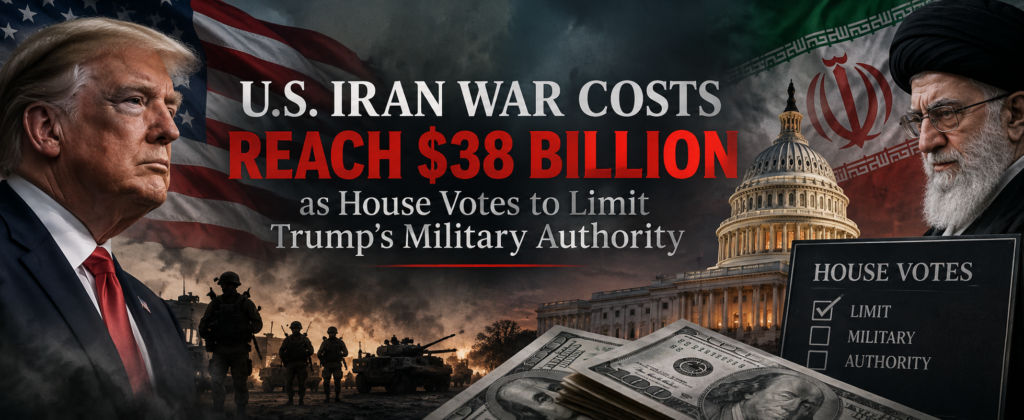
The U.S. House of Representatives voted for a third time to restrict President Donald Trump’s ability to continue military action against Iran without congressional approval, while a new Congressional Budget Office estimate put the direct cost of the conflict at roughly $38 billion through August 1.
The House approved the war powers resolution 220-204 late Tuesday, with all voting Democrats and seven Republicans supporting the measure. The resolution would direct the administration to remove US forces from hostilities against Iran, while allowing personnel to remain in the region for defensive purposes.
The vote comes as the financial burden of the conflict becomes a larger issue for Washington, with the CBO warning that continued fighting could require another $2 billion to $3 billion per month, depending on the intensity of military operations.
CBO Puts Iran War Cost Above $38 Billion
The Congressional Budget Office released its assessment on September 15, estimating that combat operations against Iran had cost approximately $38 billion by August 1. The figure covers direct military costs associated with the conflict.
CBO’s assessment comes after months of weapons use, aircraft operations, fuel consumption and other military expenditures. The Pentagon had previously estimated a cost of about $37.5 billion through the end of September, but that earlier estimate did not include substantial damage to US military bases across the region.
The watchdog and budget assessments therefore show that the total financial impact of the conflict extends beyond the headline cost of combat operations.
Additional Monthly Costs Could Keep Rising
The CBO estimates that each additional month of fighting could add between $2 billion and $3 billion to federal costs. The range depends on the scale and intensity of ongoing military operations.
At the lower end, a three-month continuation would represent roughly another $6 billion. At the higher end, the same period could add around $9 billion.
These figures illustrate how quickly prolonged military operations can affect government spending even without a major expansion in the scope of the conflict.
Oil Prices Add a Broader Economic Cost
The financial impact of the war is not limited to federal military spending.
The conflict has disrupted oil flows through the Strait of Hormuz, contributing to elevated gasoline and energy prices. AP reported that higher pump prices are becoming an important economic issue as the conflict continues to affect the movement of oil resources through the region.
Higher crude prices can increase transportation, manufacturing and energy costs across the economy. They can also raise inflation expectations and influence the outlook for monetary policy.
For markets, this creates a second channel of economic pressure: the US government is spending heavily on the conflict while businesses and households are also exposed to higher energy costs.
Inflation Could Remain Elevated
The CBO also estimated that the Iran conflict could leave US inflation 0.5 percentage points higher than previously expected heading into 2027.
That matters because energy-driven inflation can complicate the Federal Reserve’s policy decisions. Higher fuel and transportation costs can feed into broader prices, potentially making it more difficult for policymakers to bring inflation down.
The combination of higher oil prices and increased government spending therefore creates a wider macroeconomic challenge extending beyond the battlefield.
Pressure on the Federal Budget
The United States is already running a large federal deficit. CBO’s August budget review estimated that the federal budget deficit had reached $2.0 trillion during the first 11 months of fiscal year 2026.
Against that backdrop, additional wartime costs could add to spending pressures. While the Iran conflict represents only one component of federal expenditure, continued monthly costs could become more significant if military operations continue for an extended period.
Investors will therefore be watching the relationship between defence spending, Treasury borrowing requirements, bond yields and the wider fiscal outlook.
House Vote Highlights Congressional Dispute
The House resolution marks the third attempt this year to limit the administration’s military action in Iran. Previous measures also sought to use congressional war powers to change the course of the conflict.
The latest vote passed with support from seven Republicans alongside Democrats. The administration has previously maintained that similar measures do not legally bind the president, and the White House is expected to oppose the latest resolution if it advances further.
The vote itself does not immediately end US military operations, meaning the financial implications of the conflict remain dependent on developments in the coming weeks.
What Markets Will Watch Next
For investors, the key indicators will include Brent crude, US Treasury yields, the US dollar, inflation expectations and federal defence spending.
A prolonged conflict could keep pressure on energy prices while increasing government expenditures and potentially adding to inflation. Conversely, a reduction in hostilities could ease some of the pressure on crude markets and government operating costs.
For now, the new CBO estimate provides a clearer picture of the economic burden of the Iran conflict: around $38 billion already spent, plus another $2 billion to $3 billion potentially required each month while fighting continues.
That combination of military spending, energy disruption and inflation risk makes the conflict an increasingly important factor for US fiscal policy and global financial markets.

Alexander
Alexander is a veteran of the currency markets with over 15 years of experience in institutional trading and risk management. He specializes in the intersection of macroeconomics and regulatory frameworks.
