

U.S., Israel and Arab Military Chiefs Meet as Hormuz Security and Oil Risks Intensify
Senior military commanders from the United States, Israel and several Arab countries met in Germany last week as the Iran conflict and growing threats to Middle East shipping increased pressure on regional security arrangements. The meeting was organised by US Central Command (CENTCOM) Commander Admiral Brad Cooper and brought together military chiefs from Israel, Saudi […]
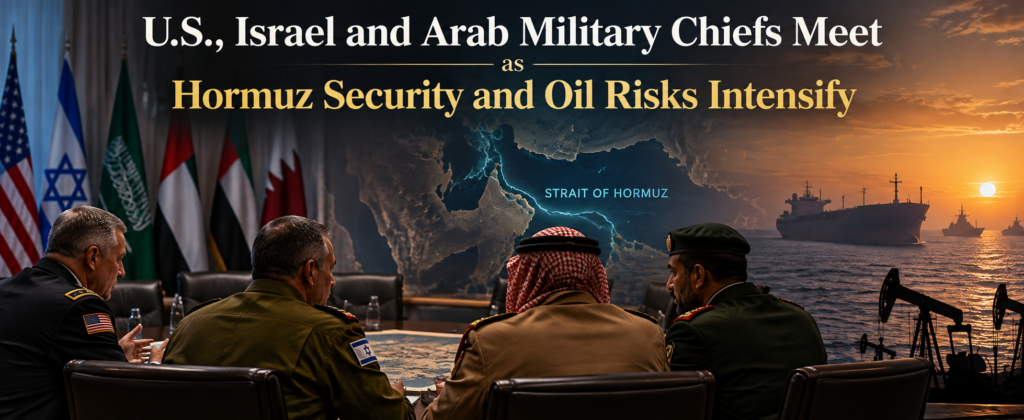
Senior military commanders from the United States, Israel and several Arab countries met in Germany last week as the Iran conflict and growing threats to Middle East shipping increased pressure on regional security arrangements.
The meeting was organised by US Central Command (CENTCOM) Commander Admiral Brad Cooper and brought together military chiefs from Israel, Saudi Arabia, the United Arab Emirates, Bahrain, Kuwait, Qatar, Jordan and Egypt. A US official later confirmed that CENTCOM had hosted senior military leaders from eight nations at a scheduled Germany conference focused on strengthening security cooperation in the Middle East.
The gathering comes as oil markets remain highly sensitive to disruptions around the Strait of Hormuz and other major energy routes.
Regional Military Cooperation Takes Centre Stage
The Germany meeting highlights the growing coordination between Washington and regional partners as the Iran war continues to affect security across the Middle East.
According to Axios, Cooper told participating commanders that the United States does not plan to withdraw its forces from the region. The meeting also included discussions about increasing ship traffic through the Strait of Hormuz, one of the world’s most important energy corridors.
Israel’s military chief, Lt. Gen. Eyal Zamir, reportedly briefed participants on Israeli military operations across multiple fronts. The presence of senior commanders from Saudi Arabia, the UAE, Bahrain, Kuwait, Qatar, Jordan and Egypt indicates the discussion extended beyond the immediate Iran conflict to wider regional security challenges.
CENTCOM’s public description was narrower, saying the leaders discussed opportunities to strengthen security cooperation in the Middle East. It did not publicly provide the full agenda or confirm the specific operational details reported separately by Axios.
Why the Meeting Matters for Hormuz
The Strait of Hormuz is central to the global energy market because a major share of international oil and liquefied natural gas shipments normally passes through the waterway.
Recent fighting has sharply reduced maritime traffic. Reuters reported that only four vessels crossed the strait on Tuesday, compared with a 10-day average of 18, and none of the detected vessels were very large crude carriers or LNG tankers.
The decline has increased concern among traders about the ability of Middle Eastern producers to move crude and gas to international buyers.
Oil Markets Remain Highly Sensitive to Security Risks
The latest military discussions come after a sharp rise in crude prices caused by attacks on Saudi energy infrastructure and growing threats to shipping.
Brent crude recently climbed above $108 per barrel, while US West Texas Intermediate also moved above $104. Reuters reported that both benchmarks had risen by more than $3 on Tuesday as supply concerns intensified.
Although oil prices eased on Wednesday after a large increase in US crude inventories, geopolitical risks continue to provide support to the market. Saudi Arabia has faced disruptions to oil exports following attacks on its East-West pipeline, while the country’s Yanbu terminal has also experienced interruptions.
Shipping Costs Add Another Layer of Pressure
Reduced traffic through Hormuz and continued risks around the Bab el-Mandeb Strait are also affecting shipping economics.
Reuters reported that tanker rates had reached record levels and bunker fuel supplies had become tighter as vessels faced greater security risks. These higher transportation costs can increase the delivered price of crude and refined products even when the underlying oil price is not rising sharply.
For import-dependent economies, that combination can translate into higher fuel, freight and industrial costs.
From Military Security to Inflation Risk
The regional security situation is increasingly important for financial markets because energy disruptions can quickly feed into inflation.
Higher crude prices raise fuel and transport costs, while elevated tanker rates increase the expense of moving commodities around the world. If such conditions persist, central banks may face pressure to keep monetary policy tighter for longer.
The Federal Reserve is particularly sensitive to that risk. Rising energy prices can complicate the inflation outlook just as policymakers assess interest-rate conditions. Reuters has reported that markets have been closely watching the relationship between oil prices, Treasury yields and expectations for US monetary policy.
Impact on Global Markets
The combination of geopolitical uncertainty, higher energy costs and tighter financial conditions can affect several major asset classes.
The US dollar may benefit from safe-haven demand and higher US yields, while equity markets can face pressure from concerns about corporate costs and slower economic growth. Gold can receive support from geopolitical uncertainty but may face offsetting pressure if rising yields make non-yielding assets less attractive.
Oil-sensitive currencies and emerging markets are also vulnerable if crude remains elevated for an extended period.
What Traders Should Watch Next
Markets will be watching Strait of Hormuz traffic, Saudi export volumes, tanker rates, Brent and WTI prices, US Treasury yields and further military developments.
Any increase in shipping through Hormuz could ease some concerns about physical supply availability. Conversely, continued disruption or a further reduction in tanker movements could increase the risk premium in crude markets.
The Germany meeting also suggests that regional military coordination remains an active priority for Washington and its partners. While the exact operational details remain partly undisclosed, the broader message is clear: security around Middle Eastern shipping routes has become increasingly important to both governments and global energy markets.
For investors, the key issue is no longer only the military situation itself, but how long the conflict continues to constrain energy transportation. A prolonged disruption could keep oil prices elevated, add to inflation pressures and increase volatility across currencies, bonds and equities.

Alexander
Alexander is a veteran of the currency markets with over 15 years of experience in institutional trading and risk management. He specializes in the intersection of macroeconomics and regulatory frameworks.
