

Japanese Yen Surges to Highest Since May as BOJ Rate-Hike Bets and Intervention Risks Rise
The Japanese yen has climbed to its strongest level since May, extending a sharp recovery against the US dollar as traders reassess the outlook for Bank of Japan policy and the possibility of further currency intervention. The move has pushed the yen into the spotlight again, with investors watching USD/JPY closely for signs that the […]
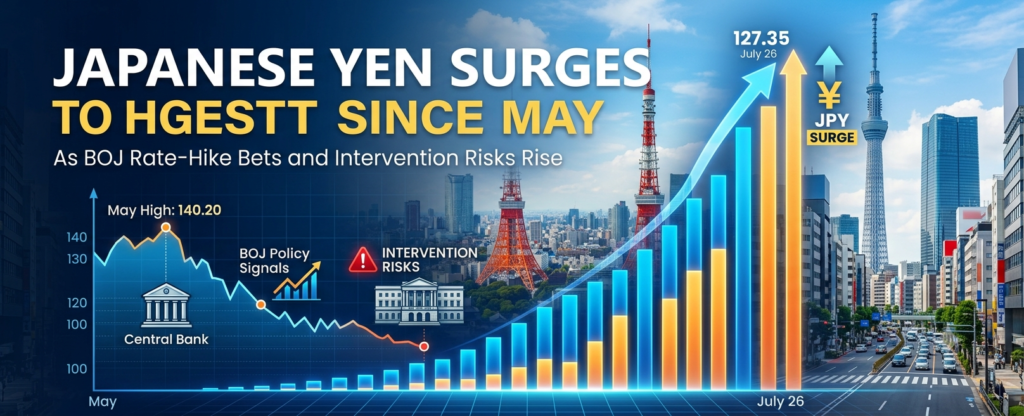
The Japanese yen has climbed to its strongest level since May, extending a sharp recovery against the US dollar as traders reassess the outlook for Bank of Japan policy and the possibility of further currency intervention. The move has pushed the yen into the spotlight again, with investors watching USD/JPY closely for signs that the long-running bearish trend against the Japanese currency is reversing.
The yen’s latest advance comes after a period of heavy selling pressure that had previously pushed the currency to multi-decade lows. Market sentiment has changed significantly in recent weeks as expectations for higher Japanese interest rates have strengthened and traders have begun unwinding large short-yen positions.
BOJ Rate-Hike Bets Support the Yen
One of the most important drivers behind the yen’s recovery is the growing expectation that the Bank of Japan could raise interest rates further.
Markets have increasingly priced in a more hawkish BOJ outlook after Japanese policymakers signalled greater flexibility toward future rate increases. BOJ board member Hajime Takata recently argued for an agile approach to rate hikes, helping reinforce expectations that Japanese monetary policy could become less accommodative. Reuters reported that markets were pricing a substantial probability of a 25-basis-point BOJ hike at the September meeting.
Higher Japanese interest rates could narrow the gap between Japanese and US borrowing costs, reducing the appeal of the yen-funded carry trade. For years, traders have borrowed cheaply in yen and invested in higher-yielding assets elsewhere, contributing to persistent pressure on the currency.
As expectations for tighter BOJ policy increase, some of those positions are being unwound, creating additional demand for the yen.
Intervention Remains a Major Market Risk
Japan’s authorities have also demonstrated that they are prepared to use foreign-exchange intervention when yen weakness becomes excessive.
New government data released Monday showed that Japan’s foreign-exchange reserves fell by a record $79.6 billion in August, with the decline attributed largely to record yen-buying intervention. Reuters reported that Japan spent around 15.4 trillion yen ($98.66 billion) between July 30 and August 26 in an effort to support the currency.
The scale of the intervention means traders cannot ignore the possibility of additional official action if USD/JPY begins moving sharply higher again.
The threat of intervention can itself influence trading behaviour because investors may become less willing to maintain large short-yen positions when authorities have demonstrated their willingness to act.
USD/JPY Faces New Pressure
The changing policy outlook has important implications for USD/JPY.
The pair had previously benefited from the wide interest-rate differential between Japan and the United States. However, expectations of additional BOJ tightening, combined with uncertainty surrounding US monetary policy, are changing that equation.
Reuters previously reported that the yen had gained around 2% in a week as capital repatriation, carry-trade unwinding and policy pressure gave yen bears reasons to reconsider their positions. Some analysts have suggested that a large-scale unwinding of short yen positions could push USD/JPY substantially lower.
For Forex traders, this makes the 155–156 area particularly important as the market assesses whether the yen’s latest strength represents a temporary correction or the beginning of a broader trend.
Fed Expectations Also Matter
The yen’s strength is not being driven solely by Japan. Expectations surrounding US interest rates are also influencing the dollar side of the USD/JPY equation.
Earlier in September, the dollar weakened after Federal Reserve Governor Christopher Waller indicated that he could support keeping rates steady if inflation continued to cool. This reduced some expectations for aggressive US monetary tightening and helped strengthen currencies including the yen.
However, upcoming US inflation data and Federal Reserve policy signals remain important risks for the pair. A stronger-than-expected US inflation reading could lift Treasury yields and support the dollar, potentially limiting further yen gains.
What Forex Traders Should Watch
The Japanese yen is now being supported by three major forces: higher BOJ rate-hike expectations, the unwinding of yen short positions and the threat of further Japanese intervention.
For USD/JPY traders, the next major catalysts will include Japanese monetary-policy signals, US inflation data, Treasury yields and comments from Japanese currency officials.
If the BOJ becomes more hawkish while US rate expectations soften, USD/JPY could face further downside pressure. Conversely, stronger US economic data or renewed global risk aversion around energy and geopolitical developments could strengthen the dollar and slow the yen’s advance.
For The Finance Chronicles, the yen’s move is a high-priority Forex development because it combines central-bank policy, currency intervention and major shifts in global positioning. The coming sessions will determine whether the yen’s rise to its highest level since May becomes a sustained trend or another temporary recovery in a highly volatile currency market.
