

JD Vance Urges Fed to Cut Interest Rates as September Policy Decision Nears
U.S. Vice President JD Vance has called on the Federal Reserve to lower interest rates, adding fresh pressure on the central bank ahead of its September policy meeting. Vance argued that lower borrowing costs would help make housing more affordable for Americans, while the Trump administration continues to push for easier monetary policy. Speaking at […]
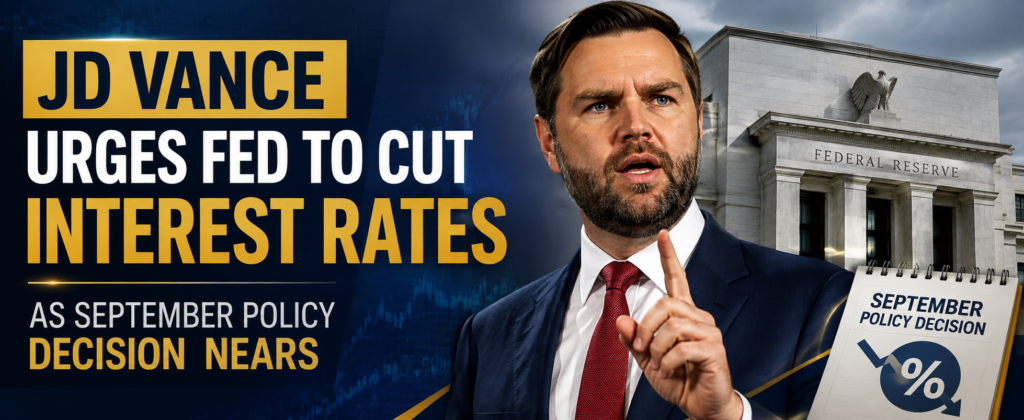
U.S. Vice President JD Vance has called on the Federal Reserve to lower interest rates, adding fresh pressure on the central bank ahead of its September policy meeting. Vance argued that lower borrowing costs would help make housing more affordable for Americans, while the Trump administration continues to push for easier monetary policy.
Speaking at a White House briefing on Thursday, Vance said the administration was taking steps to keep interest rates down but suggested that it would welcome greater support from the Federal Reserve. His comments add another political dimension to an already uncertain debate over the direction of U.S. monetary policy.
The remarks come less than two weeks before the Federal Open Market Committee is scheduled to meet on September 15–16. Investors are currently assessing whether the Fed could raise rates, hold them steady or eventually move toward cuts, making upcoming economic data particularly important.
Vance Focuses on Housing Affordability
Vance linked his call for lower interest rates primarily to the U.S. housing market. Higher borrowing costs have made mortgages more expensive, creating additional pressure for households trying to purchase homes.
The Trump administration has repeatedly argued that lower interest rates could reduce financing costs and improve affordability. Vance described a rate cut as an appropriate response to current economic conditions and pointed to recent inflation data as part of the argument for easier monetary policy.
However, the Federal Reserve must balance housing and economic growth concerns against its mandate to maintain price stability and support employment.
Fed Officials Send Mixed Signals
Vance’s comments come at a time when Federal Reserve policymakers appear divided over the next move.
Fed Governor Christopher Waller recently indicated that his position on a potential September rate hike depends heavily on upcoming inflation data. If inflation continues to cool, Waller has indicated that he could support keeping rates unchanged. A stronger inflation reading, however, could increase the case for tighter policy.
At the same time, Fed Chair Kevin Warsh has maintained a more cautious stance toward inflation. Recent comments have kept open the possibility that interest rates could move higher if price pressures remain persistent.
This creates a significant policy gap between the White House’s preference for lower borrowing costs and some policymakers’ concerns about inflation.
September Fed Decision in Focus
The September FOMC meeting is becoming one of the most important events for financial markets. Investors are closely watching employment and inflation data for clues about the Fed’s next move.
The upcoming U.S. Nonfarm Payrolls report could have a major impact on expectations. A weak labour-market reading could strengthen the argument for holding or eventually cutting rates, while stronger employment data could support the case for maintaining a restrictive policy.
Inflation will remain equally important. If price pressures prove persistent, Fed officials may be reluctant to cut rates despite political pressure.
Potential Impact on the US Dollar
For Forex traders, the debate surrounding the Federal Reserve is particularly significant because interest-rate expectations are a major driver of the U.S. Dollar.
If markets increasingly price in a Fed rate cut, Treasury yields could come under pressure and the Dollar could weaken against major currencies. This could provide support to pairs such as EUR/USD while potentially adding downward pressure to USD/JPY, depending on Japanese monetary-policy expectations.
Conversely, stronger inflation or employment data could revive expectations for tighter U.S. monetary policy. Higher Treasury yields could then support the Dollar and increase volatility across currency markets.
Gold could also benefit from falling yields and a weaker Dollar, while risk-sensitive assets could react to changes in expectations for U.S. borrowing costs.
Fed Independence Remains a Key Issue
Vance’s comments also bring renewed attention to the independence of the Federal Reserve. Political pressure on the central bank has increased as the administration has repeatedly called for lower rates.
For markets, the key question is whether monetary policy will ultimately be driven by economic data or political demands. The Fed’s credibility and independence remain important factors for investor confidence, Treasury markets and the Dollar.
With the September meeting approaching, traders will therefore focus less on political statements alone and more on the combination of employment, inflation, Treasury yields and Fed communication.
For Forex and global-market participants, the message is clear: the next major move in the U.S. Dollar may depend on whether incoming economic data supports Vance’s call for lower rates or reinforces the Fed’s concerns about inflation.
